

369
Electrospinning and Electrospraying
These are electro-hydrodynamic atomisation methods used for the production of
nanoformulations of polymeric fibers or particles by the application of electrical
forces (Jayaraman et al. 2015). When electric field is applied to the capillary nozzle, two major electrostatic forces act on the liquid jet at the needle tip namely the
electrostatic repulsion of like charges and the coulombic force of the external
electric field due to which the hemispherical droplet is distorted into a conical
shape known as the Taylor cone. When electrostatic forces overcome the surface
tension, a charged polymer jet is ejected from the tip of the Taylor cone (Reneker
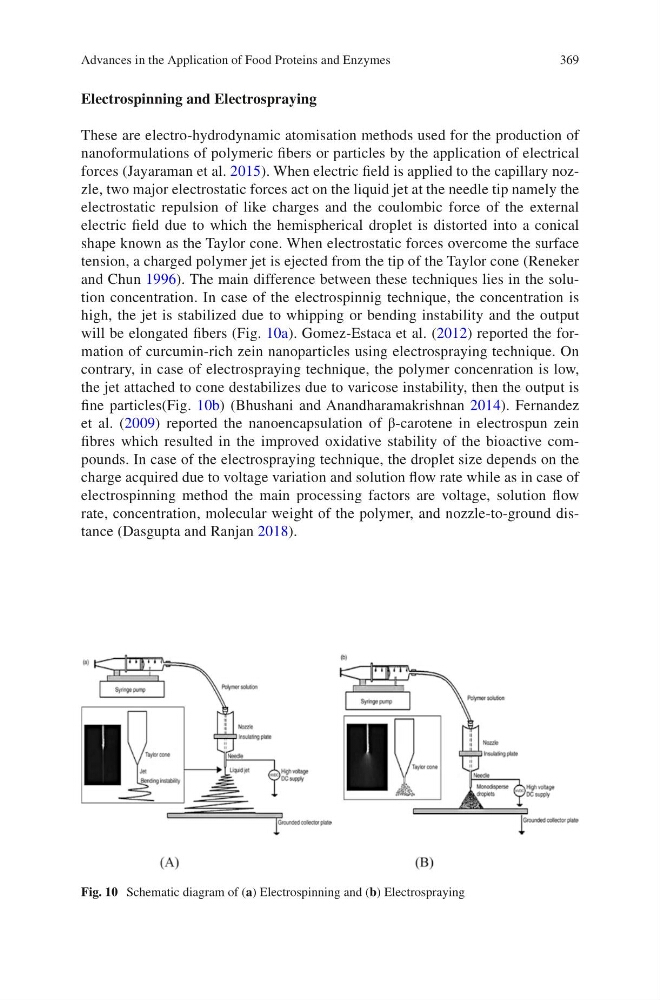
and Chun 1996). The main difference between these techniques lies in the solution concentration. In case of the electrospinnig technique, the concentration is
high, the jet is stabilized due to whipping or bending instability and the output
will be elongated fibers (Fig. 10a). Gomez-Estaca et al. (2012) reported the formation of curcumin- rich zein nanoparticles using electrospraying technique. On
contrary, in case of electrospraying technique, the polymer concenration is low,
the jet attached to cone destabilizes due to varicose instability, then the output is
fine particles(Fig. 10b) (Bhushani and Anandharamakrishnan 2014). Fernandez
et al. (2009) reported the nanoencapsulation of β-carotene in electrospun zein
fibres which resulted in the improved oxidative stability of the bioactive compounds. In case of the electrospraying technique, the droplet size depends on the
charge acquired due to voltage variation and solution flow rate while as in case of
electrospinning method the main processing factors are voltage, solution flow
rate, concentration, molecular weight of the polymer, and nozzle-to-ground distance (Dasgupta and Ranjan 2018).
Fig. 10 Schematic diagram of (a) Electrospinning and (b) Electrospraying
Advances in the Application of Food Proteins and Enzymes
Electrospinning and Electrospraying
These are electro-hydrodynamic atomisation methods used for the production of
nanoformulations of polymeric fibers or particles by the application of electrical
forces (Jayaraman et al. 2015). When electric field is applied to the capillary nozzle, two major electrostatic forces act on the liquid jet at the needle tip namely the
electrostatic repulsion of like charges and the coulombic force of the external
electric field due to which the hemispherical droplet is distorted into a conical
shape known as the Taylor cone. When electrostatic forces overcome the surface
tension, a charged polymer jet is ejected from the tip of the Taylor cone (Reneker
and Chun 1996). The main difference between these techniques lies in the solution concentration. In case of the electrospinnig technique, the concentration is
high, the jet is stabilized due to whipping or bending instability and the output
will be elongated fibers (Fig. 10a). Gomez-Estaca et al. (2012) reported the formation of curcumin- rich zein nanoparticles using electrospraying technique. On
contrary, in case of electrospraying technique, the polymer concenration is low,
the jet attached to cone destabilizes due to varicose instability, then the output is
fine particles(Fig. 10b) (Bhushani and Anandharamakrishnan 2014). Fernandez
et al. (2009) reported the nanoencapsulation of β-carotene in electrospun zein
fibres which resulted in the improved oxidative stability of the bioactive compounds. In case of the electrospraying technique, the droplet size depends on the
charge acquired due to voltage variation and solution flow rate while as in case of
electrospinning method the main processing factors are voltage, solution flow
rate, concentration, molecular weight of the polymer, and nozzle-to-ground distance (Dasgupta and Ranjan 2018).
Fig. 10 Schematic diagram of (a) Electrospinning and (b) Electrospraying
Advances in the Application of Food Proteins and Enzymes