

368
ultrasonic waves (Lin and Chen 2008; Leong et al. 2009). It consists of a sonicator
probe as shown in Fig. 8 made of piezoelectric quartz crystals that expand and contract in response to an alternating electrical voltage; this provides energy input for
the disruption of emulsion. Acute mechanical vibrations are produced within the
emulsion by placing the tip of sonicator probe directly into the emulsion. This
results in the generation of cavitation effects developing intense disruptive forces in
that leads to droplet disruption. Greater the ultrasonic wave intensity smaller will be
the emulsion droplet size (Maa and Hsu 1999). Whey protein concentrate-based
nanoemulsion was prepared using this method for the encapsulation of d-limonene
oil with droplet size below 250 nm (Jafari et al. 2006).
Nano-Spray Drying
This is most common technique used to dry liquids into fine powder efficiently.
Spray drying is widely and commercially applied for the production of protein
nanoparticles because of its ability to convert them into particles without undergoing chemical degradation due to its relatively short drying time. The process of
spray drying can be divided into four steps: (1) atomization of the nanoparticles
suspension into a spray, (2) spray-air contact, (3) drying of the spray and (4) separation of the dried end product from the drying gas (Haggag and Faheem 2015).
Nowadays, the progress in nanotechnology of spray drying led to the development
of a novel technology at the spray head, heating system and particle collector of the
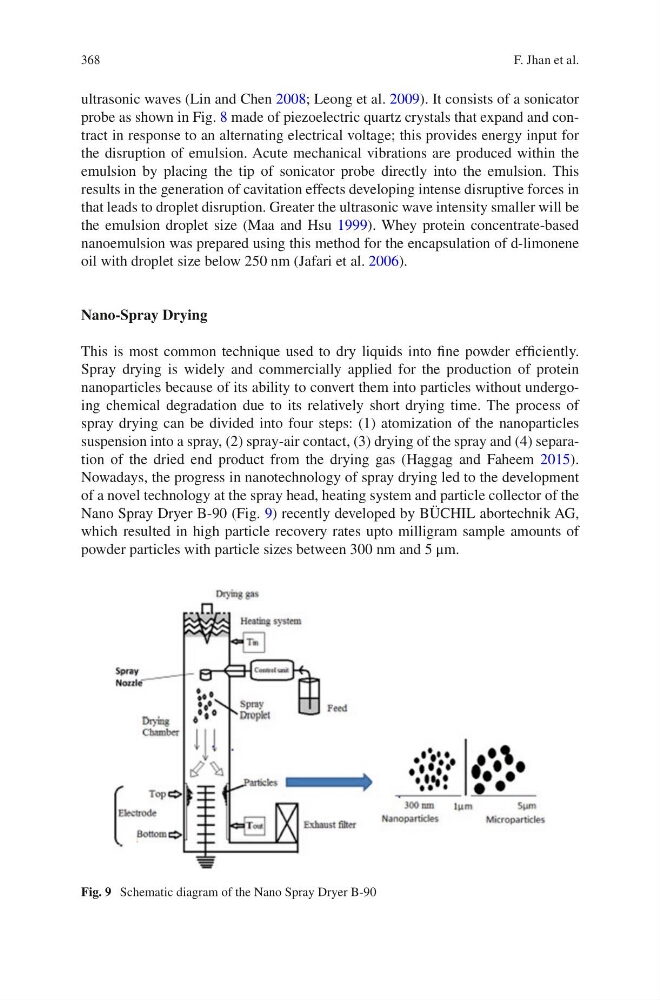
Nano Spray Dryer B-90 (Fig. 9) recently developed by BÜCHIL abortechnik AG,
which resulted in high particle recovery rates upto milligram sample amounts of
powder particles with particle sizes between 300 nm and 5 μm.
Fig. 9 Schematic diagram of the Nano Spray Dryer B-90
F. Jhan et al.
ultrasonic waves (Lin and Chen 2008; Leong et al. 2009). It consists of a sonicator
probe as shown in Fig. 8 made of piezoelectric quartz crystals that expand and contract in response to an alternating electrical voltage; this provides energy input for
the disruption of emulsion. Acute mechanical vibrations are produced within the
emulsion by placing the tip of sonicator probe directly into the emulsion. This
results in the generation of cavitation effects developing intense disruptive forces in
that leads to droplet disruption. Greater the ultrasonic wave intensity smaller will be
the emulsion droplet size (Maa and Hsu 1999). Whey protein concentrate-based
nanoemulsion was prepared using this method for the encapsulation of d-limonene
oil with droplet size below 250 nm (Jafari et al. 2006).
Nano-Spray Drying
This is most common technique used to dry liquids into fine powder efficiently.
Spray drying is widely and commercially applied for the production of protein
nanoparticles because of its ability to convert them into particles without undergoing chemical degradation due to its relatively short drying time. The process of
spray drying can be divided into four steps: (1) atomization of the nanoparticles
suspension into a spray, (2) spray-air contact, (3) drying of the spray and (4) separation of the dried end product from the drying gas (Haggag and Faheem 2015).
Nowadays, the progress in nanotechnology of spray drying led to the development
of a novel technology at the spray head, heating system and particle collector of the
Nano Spray Dryer B-90 (Fig. 9) recently developed by BÜCHIL abortechnik AG,
which resulted in high particle recovery rates upto milligram sample amounts of
powder particles with particle sizes between 300 nm and 5 μm.
Fig. 9 Schematic diagram of the Nano Spray Dryer B-90
F. Jhan et al.