

311
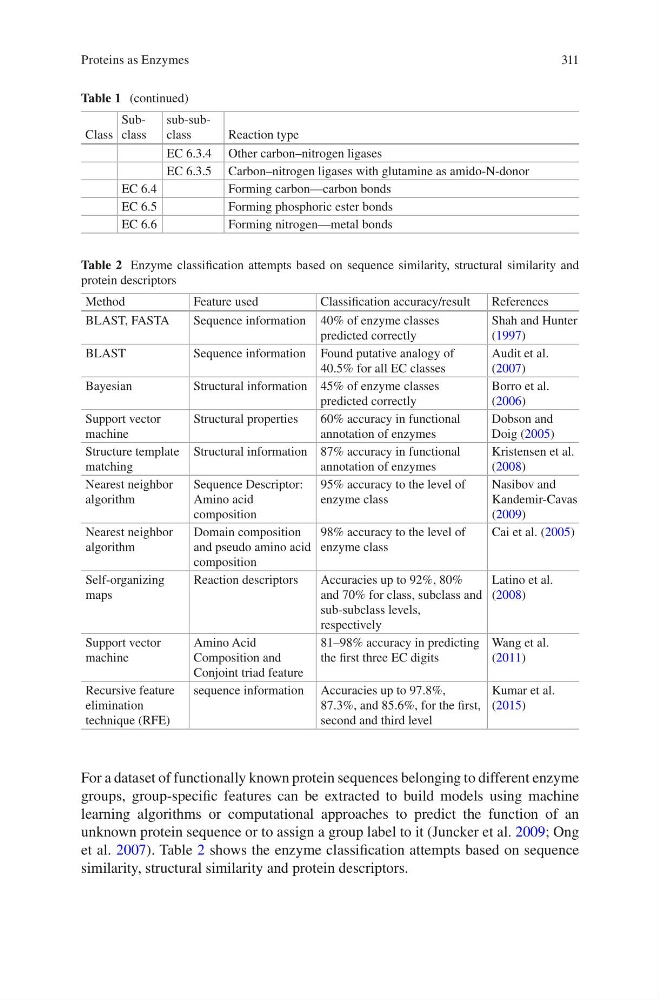
For a dataset of functionally known protein sequences belonging to different enzyme
groups, group-specific features can be extracted to build models using machine
learning algorithms or computational approaches to predict the function of an
unknown protein sequence or to assign a group label to it (Juncker et al. 2009; Ong
et al. 2007). Table 2 shows the enzyme classification attempts based on sequence
similarity, structural similarity and protein descriptors.
Table 1 (continued)
Class
Subclass
sub-subclass
Reaction type
EC 6.3.4 Other carbon–nitrogen ligases
EC 6.3.5 Carbon–nitrogen ligases with glutamine as amido-N-donor
EC 6.4
Forming carbon—carbon bonds
EC 6.5
Forming phosphoric ester bonds
EC 6.6
Forming nitrogen—metal bonds
Table 2 Enzyme classification attempts based on sequence similarity, structural similarity and
protein descriptors
Method
Feature used
Classification accuracy/result
References
BLAST, FASTA
Sequence information 40% of enzyme classes
predicted correctly
Shah and Hunter
(1997)
BLAST
Sequence information Found putative analogy of
40.5% for all EC classes
Audit et al.
(2007)
Bayesian
Structural information 45% of enzyme classes
predicted correctly
Borro et al.
(2006)
Support vector
machine
Structural properties
60% accuracy in functional
annotation of enzymes
Dobson and
Doig (2005)
Structure template
matching
Structural information 87% accuracy in functional
annotation of enzymes
Kristensen et al.
(2008)
Nearest neighbor
algorithm
Sequence Descriptor:
Amino acid
composition
95% accuracy to the level of
enzyme class
Nasibov and
Kandemir-Cavas
(2009)
Nearest neighbor
algorithm
Domain composition
and pseudo amino acid
composition
98% accuracy to the level of
enzyme class
Cai et al. (2005)
Self-organizing
maps
Reaction descriptors
Accuracies up to 92%, 80%
and 70% for class, subclass and
sub-subclass levels,
respectively
Latino et al.
(2008)
Support vector
machine
Amino Acid
Composition and
Conjoint triad feature
81–98% accuracy in predicting
the first three EC digits
Wang et al.
(2011)
Recursive feature
elimination
technique (RFE)
sequence information Accuracies up to 97.8%,
87.3%, and 85.6%, for the first,
second and third level
Kumar et al.
(2015)
Proteins as Enzymes
For a dataset of functionally known protein sequences belonging to different enzyme
groups, group-specific features can be extracted to build models using machine
learning algorithms or computational approaches to predict the function of an
unknown protein sequence or to assign a group label to it (Juncker et al. 2009; Ong
et al. 2007). Table 2 shows the enzyme classification attempts based on sequence
similarity, structural similarity and protein descriptors.
Table 1 (continued)
Class
Subclass
sub-subclass
Reaction type
EC 6.3.4 Other carbon–nitrogen ligases
EC 6.3.5 Carbon–nitrogen ligases with glutamine as amido-N-donor
EC 6.4
Forming carbon—carbon bonds
EC 6.5
Forming phosphoric ester bonds
EC 6.6
Forming nitrogen—metal bonds
Table 2 Enzyme classification attempts based on sequence similarity, structural similarity and
protein descriptors
Method
Feature used
Classification accuracy/result
References
BLAST, FASTA
Sequence information 40% of enzyme classes
predicted correctly
Shah and Hunter
(1997)
BLAST
Sequence information Found putative analogy of
40.5% for all EC classes
Audit et al.
(2007)
Bayesian
Structural information 45% of enzyme classes
predicted correctly
Borro et al.
(2006)
Support vector
machine
Structural properties
60% accuracy in functional
annotation of enzymes
Dobson and
Doig (2005)
Structure template
matching
Structural information 87% accuracy in functional
annotation of enzymes
Kristensen et al.
(2008)
Nearest neighbor
algorithm
Sequence Descriptor:
Amino acid
composition
95% accuracy to the level of
enzyme class
Nasibov and
Kandemir-Cavas
(2009)
Nearest neighbor
algorithm
Domain composition
and pseudo amino acid
composition
98% accuracy to the level of
enzyme class
Cai et al. (2005)
Self-organizing
maps
Reaction descriptors
Accuracies up to 92%, 80%
and 70% for class, subclass and
sub-subclass levels,
respectively
Latino et al.
(2008)
Support vector
machine
Amino Acid
Composition and
Conjoint triad feature
81–98% accuracy in predicting
the first three EC digits
Wang et al.
(2011)
Recursive feature
elimination
technique (RFE)
sequence information Accuracies up to 97.8%,
87.3%, and 85.6%, for the first,
second and third level
Kumar et al.
(2015)
Proteins as Enzymes