

310
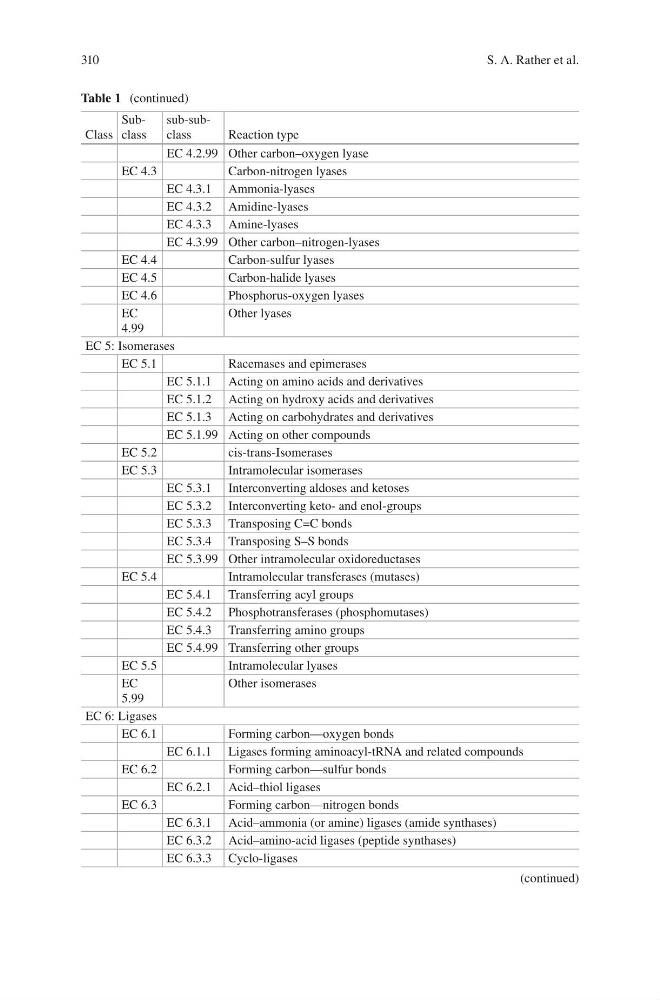
Table 1 (continued)
Class
Subclass
sub-subclass
Reaction type
EC 4.2.99 Other carbon–oxygen lyase
EC 4.3
Carbon-nitrogen lyases
EC 4.3.1 Ammonia-lyases
EC 4.3.2 Amidine-lyases
EC 4.3.3 Amine-lyases
EC 4.3.99 Other carbon–nitrogen-lyases
EC 4.4
Carbon-sulfur lyases
EC 4.5
Carbon-halide lyases
EC 4.6
Phosphorus-oxygen lyases
EC
4.99
Other lyases
EC 5: Isomerases
EC 5.1
Racemases and epimerases
EC 5.1.1 Acting on amino acids and derivatives
EC 5.1.2 Acting on hydroxy acids and derivatives
EC 5.1.3 Acting on carbohydrates and derivatives
EC 5.1.99 Acting on other compounds
EC 5.2
cis-trans-Isomerases
EC 5.3
Intramolecular isomerases
EC 5.3.1 Interconverting aldoses and ketoses
EC 5.3.2 Interconverting keto- and enol-groups
EC 5.3.3 Transposing C=C bonds
EC 5.3.4 Transposing S–S bonds
EC 5.3.99 Other intramolecular oxidoreductases
EC 5.4
Intramolecular transferases (mutases)
EC 5.4.1 Transferring acyl groups
EC 5.4.2 Phosphotransferases (phosphomutases)
EC 5.4.3 Transferring amino groups
EC 5.4.99 Transferring other groups
EC 5.5
Intramolecular lyases
EC
5.99
Other isomerases
EC 6: Ligases
EC 6.1
Forming carbon—oxygen bonds
EC 6.1.1 Ligases forming aminoacyl-tRNA and related compounds
EC 6.2
Forming carbon—sulfur bonds
EC 6.2.1 Acid–thiol ligases
EC 6.3
Forming carbon—nitrogen bonds
EC 6.3.1 Acid–ammonia (or amine) ligases (amide synthases)
EC 6.3.2 Acid–amino-acid ligases (peptide synthases)
EC 6.3.3 Cyclo-ligases
(continued)
S. A. Rather et al.
Table 1 (continued)
Class
Subclass
sub-subclass
Reaction type
EC 4.2.99 Other carbon–oxygen lyase
EC 4.3
Carbon-nitrogen lyases
EC 4.3.1 Ammonia-lyases
EC 4.3.2 Amidine-lyases
EC 4.3.3 Amine-lyases
EC 4.3.99 Other carbon–nitrogen-lyases
EC 4.4
Carbon-sulfur lyases
EC 4.5
Carbon-halide lyases
EC 4.6
Phosphorus-oxygen lyases
EC
4.99
Other lyases
EC 5: Isomerases
EC 5.1
Racemases and epimerases
EC 5.1.1 Acting on amino acids and derivatives
EC 5.1.2 Acting on hydroxy acids and derivatives
EC 5.1.3 Acting on carbohydrates and derivatives
EC 5.1.99 Acting on other compounds
EC 5.2
cis-trans-Isomerases
EC 5.3
Intramolecular isomerases
EC 5.3.1 Interconverting aldoses and ketoses
EC 5.3.2 Interconverting keto- and enol-groups
EC 5.3.3 Transposing C=C bonds
EC 5.3.4 Transposing S–S bonds
EC 5.3.99 Other intramolecular oxidoreductases
EC 5.4
Intramolecular transferases (mutases)
EC 5.4.1 Transferring acyl groups
EC 5.4.2 Phosphotransferases (phosphomutases)
EC 5.4.3 Transferring amino groups
EC 5.4.99 Transferring other groups
EC 5.5
Intramolecular lyases
EC
5.99
Other isomerases
EC 6: Ligases
EC 6.1
Forming carbon—oxygen bonds
EC 6.1.1 Ligases forming aminoacyl-tRNA and related compounds
EC 6.2
Forming carbon—sulfur bonds
EC 6.2.1 Acid–thiol ligases
EC 6.3
Forming carbon—nitrogen bonds
EC 6.3.1 Acid–ammonia (or amine) ligases (amide synthases)
EC 6.3.2 Acid–amino-acid ligases (peptide synthases)
EC 6.3.3 Cyclo-ligases
(continued)
S. A. Rather et al.