

272
UV Visible Absorption Spectroscopy
This method is based on accurate measurement of fraction of an incident light beam
absorbed by sample protein in solution. Absorbance measured at 280 nm (A 280 ) and
at 205 nm (A 205 ) can be used to quantitate total protein in crude lysates and purified
or partially purified protein. Both of these methods are simple and can be completed
quickly (Simonian 2004). Although the A 280 method is most commonly used, the
A 205 method can detect lower concentrations of protein and can quantitate dilute
protein samples, but is more susceptible to interference from solvents and biological
buffer components than the A 280 method.
Protein Estimation by Near UV Absorbance; A 280 Method (Range 20–3000 μg)
This method is based on the measuring absorbance of UV light at 280 nm by the
aromatic amino acids, tryptophan, tyrosine, and by cystine, disulfide-bonded cysteine residues, in protein solutions to calculated protein concentration (Simonian
2004). The assay is suitable for protein concentration ranging between 20 μg/mL
and 3000 μg/mL assuming that protein is pure containing no nonprotein component
such as nucleotide cofactors, haem, or iron-sulfur centres (Nobel and Bailey 2009).
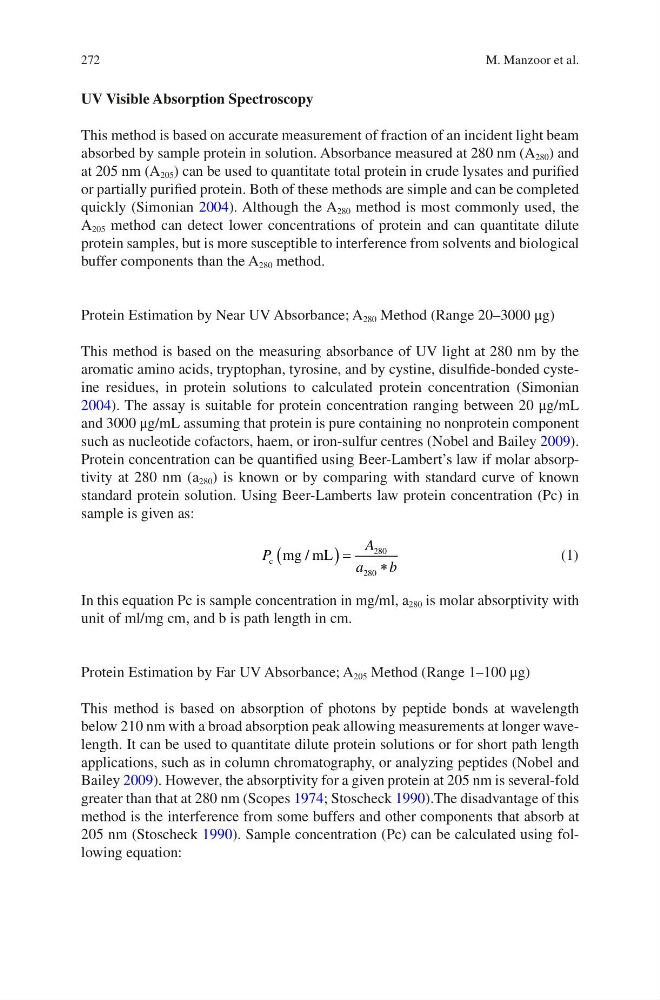
Protein concentration can be quantified using Beer-Lambert’s law if molar absorptivity at 280 nm (a 280 ) is known or by comparing with standard curve of known
standard protein solution. Using Beer-Lamberts law protein concentration (Pc) in
sample is given as:
P
A
a
b
c mg mL
/
280
280
(1)
In this equation Pc is sample concentration in mg/ml, a 280 is molar absorptivity with
unit of ml/mg cm, and b is path length in cm.
Protein Estimation by Far UV Absorbance; A 205 Method (Range 1–100 μg)
This method is based on absorption of photons by peptide bonds at wavelength
below 210 nm with a broad absorption peak allowing measurements at longer wavelength. It can be used to quantitate dilute protein solutions or for short path length
applications, such as in column chromatography, or analyzing peptides (Nobel and
Bailey 2009). However, the absorptivity for a given protein at 205 nm is several-fold
greater than that at 280 nm (Scopes 1974; Stoscheck 1990).The disadvantage of this
method is the interference from some buffers and other components that absorb at
205 nm (Stoscheck 1990). Sample concentration (Pc) can be calculated using following equation:
M. Manzoor et al.
UV Visible Absorption Spectroscopy
This method is based on accurate measurement of fraction of an incident light beam
absorbed by sample protein in solution. Absorbance measured at 280 nm (A 280 ) and
at 205 nm (A 205 ) can be used to quantitate total protein in crude lysates and purified
or partially purified protein. Both of these methods are simple and can be completed
quickly (Simonian 2004). Although the A 280 method is most commonly used, the
A 205 method can detect lower concentrations of protein and can quantitate dilute
protein samples, but is more susceptible to interference from solvents and biological
buffer components than the A 280 method.
Protein Estimation by Near UV Absorbance; A 280 Method (Range 20–3000 μg)
This method is based on the measuring absorbance of UV light at 280 nm by the
aromatic amino acids, tryptophan, tyrosine, and by cystine, disulfide-bonded cysteine residues, in protein solutions to calculated protein concentration (Simonian
2004). The assay is suitable for protein concentration ranging between 20 μg/mL
and 3000 μg/mL assuming that protein is pure containing no nonprotein component
such as nucleotide cofactors, haem, or iron-sulfur centres (Nobel and Bailey 2009).
Protein concentration can be quantified using Beer-Lambert’s law if molar absorptivity at 280 nm (a 280 ) is known or by comparing with standard curve of known
standard protein solution. Using Beer-Lamberts law protein concentration (Pc) in
sample is given as:
P
A
a
b
c mg mL
/
280
280
(1)
In this equation Pc is sample concentration in mg/ml, a 280 is molar absorptivity with
unit of ml/mg cm, and b is path length in cm.
Protein Estimation by Far UV Absorbance; A 205 Method (Range 1–100 μg)
This method is based on absorption of photons by peptide bonds at wavelength
below 210 nm with a broad absorption peak allowing measurements at longer wavelength. It can be used to quantitate dilute protein solutions or for short path length
applications, such as in column chromatography, or analyzing peptides (Nobel and
Bailey 2009). However, the absorptivity for a given protein at 205 nm is several-fold
greater than that at 280 nm (Scopes 1974; Stoscheck 1990).The disadvantage of this
method is the interference from some buffers and other components that absorb at
205 nm (Stoscheck 1990). Sample concentration (Pc) can be calculated using following equation:
M. Manzoor et al.