

200
Recent Advances in Beta Glucan Application
Introduction
β-Glucans are polysaccharides of D-glucose monomers linked through β-glycosidic
bonds. It is a kind of dietary fiber and is found in a variety of natural sources such
as yeasts, mushrooms, bacteria, algae, barley and oat (Zhu et al. 2015). β-Glucan
shows a broad spectrum of biological activities which include anti-tumor, immunomodulating, anti-aging and anti-inflammatory properties. β-Glucans have attracted
attention over the years because of their physical and chemical properties. β-Glucan
from different sources and with different molecular weights have different biological activities (Du and Xu 2014). β-Glucan from baker’s yeast consists of β-(1 → 3)
and (1 → 6) linkages, other β-glucans, derived from cereals, are polysaccharides of
glucose residues with β-(1 → 3) and β-(1 → 4) linkages whereas cellulose is a
(1 → 4) β-glucan; curdlan is a (1 → 3) β-glucan; andβ-glucan from lichen may
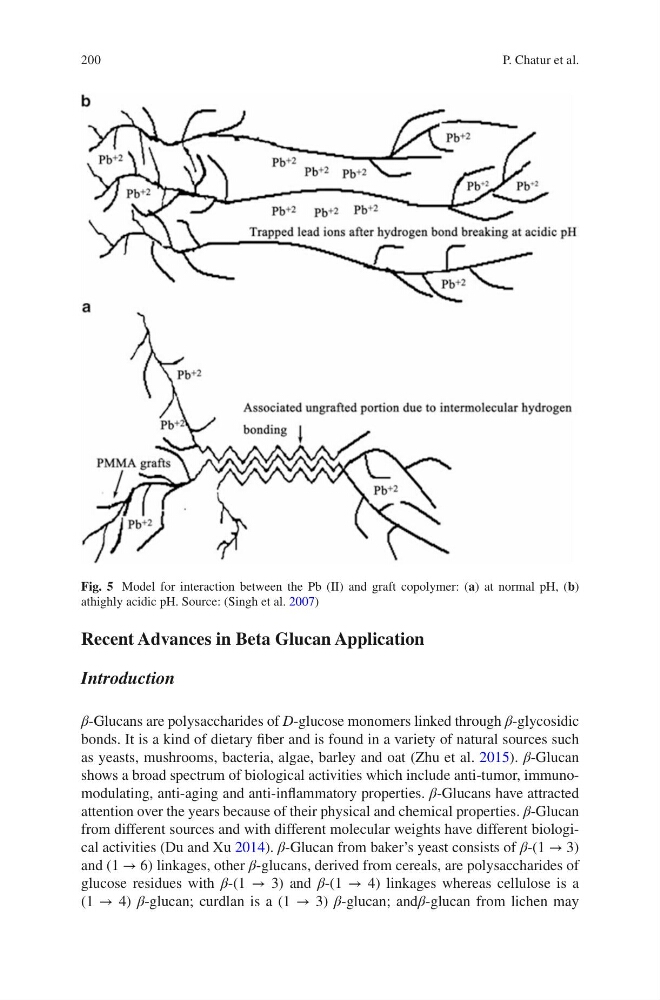
Fig. 5 Model for interaction between the Pb (II) and graft copolymer: (a) at normal pH, (b)
athighly acidic pH. Source: (Singh et al. 2007)
P. Chatur et al.
Recent Advances in Beta Glucan Application
Introduction
β-Glucans are polysaccharides of D-glucose monomers linked through β-glycosidic
bonds. It is a kind of dietary fiber and is found in a variety of natural sources such
as yeasts, mushrooms, bacteria, algae, barley and oat (Zhu et al. 2015). β-Glucan
shows a broad spectrum of biological activities which include anti-tumor, immunomodulating, anti-aging and anti-inflammatory properties. β-Glucans have attracted
attention over the years because of their physical and chemical properties. β-Glucan
from different sources and with different molecular weights have different biological activities (Du and Xu 2014). β-Glucan from baker’s yeast consists of β-(1 → 3)
and (1 → 6) linkages, other β-glucans, derived from cereals, are polysaccharides of
glucose residues with β-(1 → 3) and β-(1 → 4) linkages whereas cellulose is a
(1 → 4) β-glucan; curdlan is a (1 → 3) β-glucan; andβ-glucan from lichen may
Fig. 5 Model for interaction between the Pb (II) and graft copolymer: (a) at normal pH, (b)
athighly acidic pH. Source: (Singh et al. 2007)
P. Chatur et al.