

199
with Poly (N-vinyl-2-pyrrolidone) polymer prepared by Sharma and Lalita for the
sorption of Fe
2+
and Cr
6+
and was found that the adsorption amount increased with
increasing percent of grafting (Sharma and Lalita 2011). (Singh et al. 2007) also
proved the Cassia grandis seed gum-graft-poly (methyl methacrylate) has stronger
combination action with the Pb (II) ions than the gum. The basic model of adsorbtion of Pb (II) ions by grafted gum polymers is shown in Fig. 5.
The increasing global resource and environmental crisis continuously propels
the development of eco-friendly materials. The naturally occurring raw materials
have recently raised a research upsurge owing to their unique “green” characteristics that results in the exploration of new natural polymers. These polymers were
modified by various methods to utilize and derive new eco-friendly materials with
desirable applicability. Gums are one of the most rapidly developed natural polymers by virtue of its abundance, biodegradability, processability, and structural
diversity, and thus play an irreplaceable role in the modern world. The derivatization
or modification of gums may tailor the properties of gums by introducing additional
functional groups, and deepening the application domains. Furthermore, gums are
well tolerated by the human body because they are easily degraded to monosaccharides by colonic bacteria. However, the highly swellable nature of their putative
form often restricts their use for delivering drugs to distal parts of the gastrointestinal tract. The derivatization or modification of these gums improves their use for the
preparation of various dosage forms with modified drug release profiles.
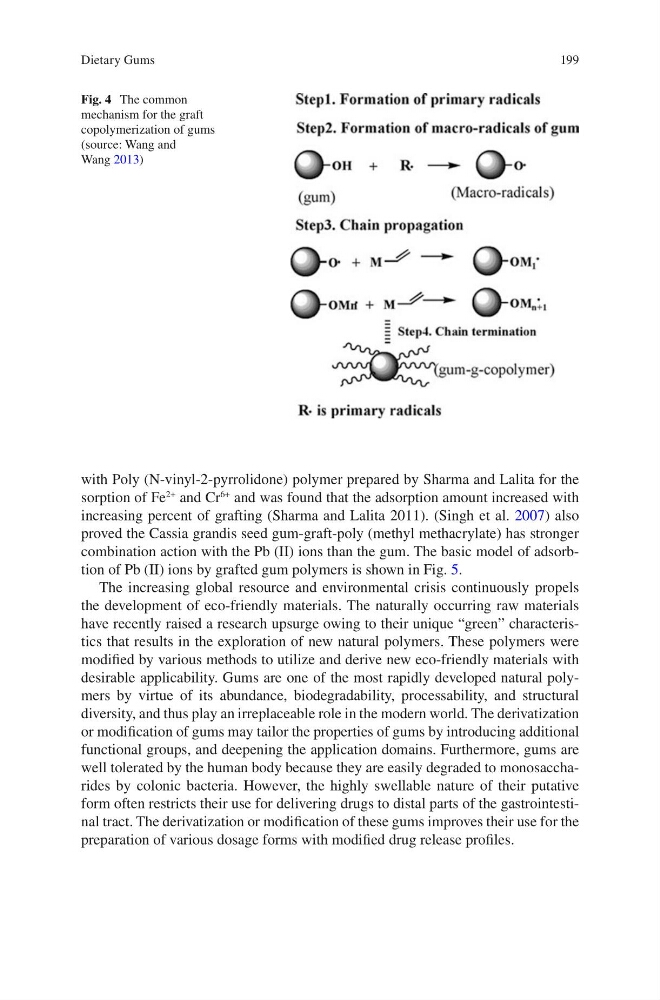
Fig. 4 The common
mechanism for the graft
copolymerization of gums
(source: Wang and
Wang 2013)
Dietary Gums
with Poly (N-vinyl-2-pyrrolidone) polymer prepared by Sharma and Lalita for the
sorption of Fe
2+
and Cr
6+
and was found that the adsorption amount increased with
increasing percent of grafting (Sharma and Lalita 2011). (Singh et al. 2007) also
proved the Cassia grandis seed gum-graft-poly (methyl methacrylate) has stronger
combination action with the Pb (II) ions than the gum. The basic model of adsorbtion of Pb (II) ions by grafted gum polymers is shown in Fig. 5.
The increasing global resource and environmental crisis continuously propels
the development of eco-friendly materials. The naturally occurring raw materials
have recently raised a research upsurge owing to their unique “green” characteristics that results in the exploration of new natural polymers. These polymers were
modified by various methods to utilize and derive new eco-friendly materials with
desirable applicability. Gums are one of the most rapidly developed natural polymers by virtue of its abundance, biodegradability, processability, and structural
diversity, and thus play an irreplaceable role in the modern world. The derivatization
or modification of gums may tailor the properties of gums by introducing additional
functional groups, and deepening the application domains. Furthermore, gums are
well tolerated by the human body because they are easily degraded to monosaccharides by colonic bacteria. However, the highly swellable nature of their putative
form often restricts their use for delivering drugs to distal parts of the gastrointestinal tract. The derivatization or modification of these gums improves their use for the
preparation of various dosage forms with modified drug release profiles.
Fig. 4 The common
mechanism for the graft
copolymerization of gums
(source: Wang and
Wang 2013)
Dietary Gums