

12
Applications of Modified Starches
Starches have found enormous uses in food and other industries. Modification of
starch is an ever evolving industry with numerous possibilities to generate novel
starches which includes new functional and value added properties as demanded by
the industry. Modified starches have wide applications as compared to native
starches. Starch modification is primarily carried to overcome the shortcomings of
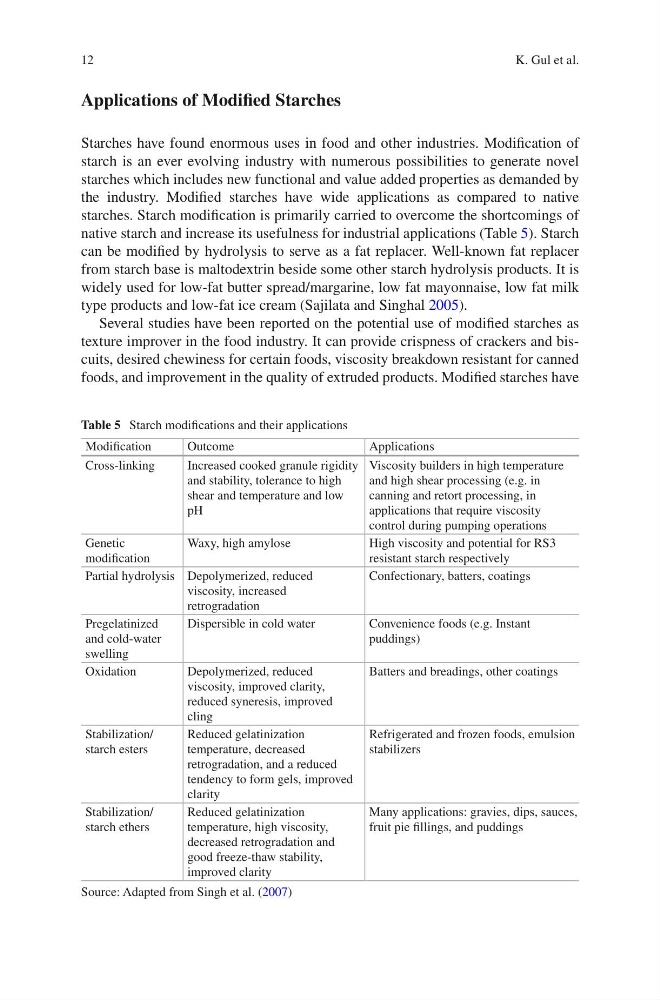
native starch and increase its usefulness for industrial applications (Table 5). Starch
can be modified by hydrolysis to serve as a fat replacer. Well-known fat replacer
from starch base is maltodextrin beside some other starch hydrolysis products. It is
widely used for low-fat butter spread/margarine, low fat mayonnaise, low fat milk
type products and low-fat ice cream (Sajilata and Singhal 2005).
Several studies have been reported on the potential use of modified starches as
texture improver in the food industry. It can provide crispness of crackers and biscuits, desired chewiness for certain foods, viscosity breakdown resistant for canned
foods, and improvement in the quality of extruded products. Modified starches have
Table 5 Starch modifications and their applications
Modification
Outcome
Applications
Cross-linking
Increased cooked granule rigidity
and stability, tolerance to high
shear and temperature and low
pH
Viscosity builders in high temperature
and high shear processing (e.g. in
canning and retort processing, in
applications that require viscosity
control during pumping operations
Genetic
modification
Waxy, high amylose
High viscosity and potential for RS3
resistant starch respectively
Partial hydrolysis Depolymerized, reduced
viscosity, increased
retrogradation
Confectionary, batters, coatings
Pregelatinized
and cold-water
swelling
Dispersible in cold water
Convenience foods (e.g. Instant
puddings)
Oxidation
Depolymerized, reduced
viscosity, improved clarity,
reduced syneresis, improved
cling
Batters and breadings, other coatings
Stabilization/
starch esters
Reduced gelatinization
temperature, decreased
retrogradation, and a reduced
tendency to form gels, improved
clarity
Refrigerated and frozen foods, emulsion
stabilizers
Stabilization/
starch ethers
Reduced gelatinization
temperature, high viscosity,
decreased retrogradation and
good freeze-thaw stability,
improved clarity
Many applications: gravies, dips, sauces,
fruit pie fillings, and puddings
Source: Adapted from Singh et al. (2007)
K. Gul et al.
Applications of Modified Starches
Starches have found enormous uses in food and other industries. Modification of
starch is an ever evolving industry with numerous possibilities to generate novel
starches which includes new functional and value added properties as demanded by
the industry. Modified starches have wide applications as compared to native
starches. Starch modification is primarily carried to overcome the shortcomings of
native starch and increase its usefulness for industrial applications (Table 5). Starch
can be modified by hydrolysis to serve as a fat replacer. Well-known fat replacer
from starch base is maltodextrin beside some other starch hydrolysis products. It is
widely used for low-fat butter spread/margarine, low fat mayonnaise, low fat milk
type products and low-fat ice cream (Sajilata and Singhal 2005).
Several studies have been reported on the potential use of modified starches as
texture improver in the food industry. It can provide crispness of crackers and biscuits, desired chewiness for certain foods, viscosity breakdown resistant for canned
foods, and improvement in the quality of extruded products. Modified starches have
Table 5 Starch modifications and their applications
Modification
Outcome
Applications
Cross-linking
Increased cooked granule rigidity
and stability, tolerance to high
shear and temperature and low
pH
Viscosity builders in high temperature
and high shear processing (e.g. in
canning and retort processing, in
applications that require viscosity
control during pumping operations
Genetic
modification
Waxy, high amylose
High viscosity and potential for RS3
resistant starch respectively
Partial hydrolysis Depolymerized, reduced
viscosity, increased
retrogradation
Confectionary, batters, coatings
Pregelatinized
and cold-water
swelling
Dispersible in cold water
Convenience foods (e.g. Instant
puddings)
Oxidation
Depolymerized, reduced
viscosity, improved clarity,
reduced syneresis, improved
cling
Batters and breadings, other coatings
Stabilization/
starch esters
Reduced gelatinization
temperature, decreased
retrogradation, and a reduced
tendency to form gels, improved
clarity
Refrigerated and frozen foods, emulsion
stabilizers
Stabilization/
starch ethers
Reduced gelatinization
temperature, high viscosity,
decreased retrogradation and
good freeze-thaw stability,
improved clarity
Many applications: gravies, dips, sauces,
fruit pie fillings, and puddings
Source: Adapted from Singh et al. (2007)
K. Gul et al.