

144
units promotes the hydrogen bonding between the pectin molecules Although the
hydrogen bonds are weak, still these offer a good thermodynamic stability to the gel
and is the only force that is maintains the gel structure. This interaction is however
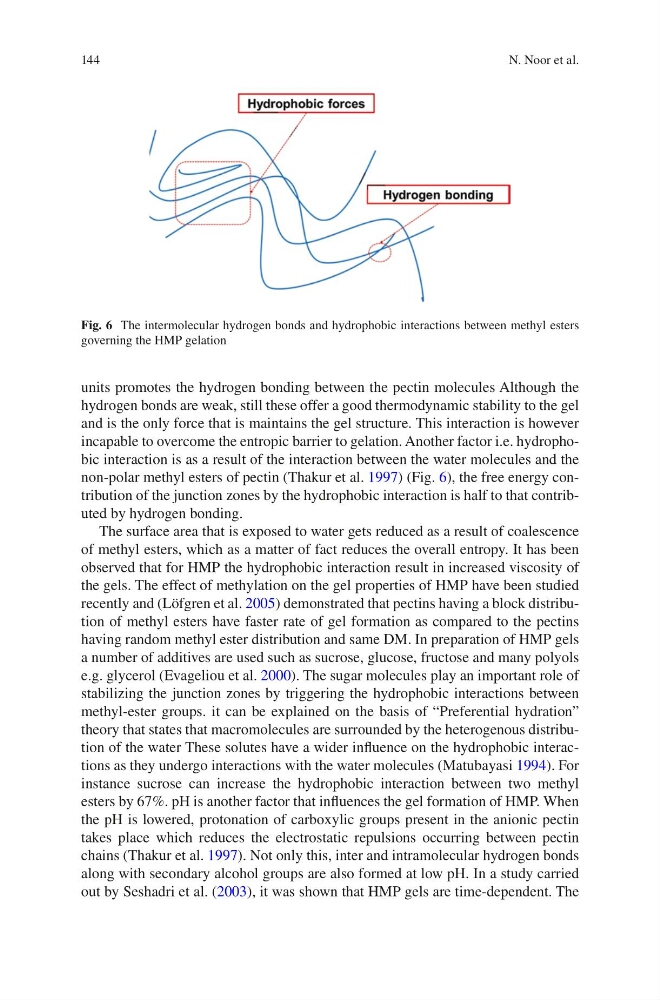
incapable to overcome the entropic barrier to gelation. Another factor i.e. hydrophobic interaction is as a result of the interaction between the water molecules and the
non-polar methyl esters of pectin (Thakur et al. 1997) (Fig. 6), the free energy contribution of the junction zones by the hydrophobic interaction is half to that contributed by hydrogen bonding.
The surface area that is exposed to water gets reduced as a result of coalescence
of methyl esters, which as a matter of fact reduces the overall entropy. It has been
observed that for HMP the hydrophobic interaction result in increased viscosity of
the gels. The effect of methylation on the gel properties of HMP have been studied
recently and (Löfgren et al. 2005) demonstrated that pectins having a block distribution of methyl esters have faster rate of gel formation as compared to the pectins
having random methyl ester distribution and same DM. In preparation of HMP gels
a number of additives are used such as sucrose, glucose, fructose and many polyols
e.g. glycerol (Evageliou et al. 2000). The sugar molecules play an important role of
stabilizing the junction zones by triggering the hydrophobic interactions between
methyl-ester groups. it can be explained on the basis of “Preferential hydration”
theory that states that macromolecules are surrounded by the heterogenous distribution of the water These solutes have a wider influence on the hydrophobic interactions as they undergo interactions with the water molecules (Matubayasi 1994). For
instance sucrose can increase the hydrophobic interaction between two methyl
esters by 67%. pH is another factor that influences the gel formation of HMP. When
the pH is lowered, protonation of carboxylic groups present in the anionic pectin
takes place which reduces the electrostatic repulsions occurring between pectin
chains (Thakur et al. 1997). Not only this, inter and intramolecular hydrogen bonds
along with secondary alcohol groups are also formed at low pH. In a study carried
out by Seshadri et al. (2003), it was shown that HMP gels are time-dependent. The
Fig. 6 The intermolecular hydrogen bonds and hydrophobic interactions between methyl esters
governing the HMP gelation
N. Noor et al.
units promotes the hydrogen bonding between the pectin molecules Although the
hydrogen bonds are weak, still these offer a good thermodynamic stability to the gel
and is the only force that is maintains the gel structure. This interaction is however
incapable to overcome the entropic barrier to gelation. Another factor i.e. hydrophobic interaction is as a result of the interaction between the water molecules and the
non-polar methyl esters of pectin (Thakur et al. 1997) (Fig. 6), the free energy contribution of the junction zones by the hydrophobic interaction is half to that contributed by hydrogen bonding.
The surface area that is exposed to water gets reduced as a result of coalescence
of methyl esters, which as a matter of fact reduces the overall entropy. It has been
observed that for HMP the hydrophobic interaction result in increased viscosity of
the gels. The effect of methylation on the gel properties of HMP have been studied
recently and (Löfgren et al. 2005) demonstrated that pectins having a block distribution of methyl esters have faster rate of gel formation as compared to the pectins
having random methyl ester distribution and same DM. In preparation of HMP gels
a number of additives are used such as sucrose, glucose, fructose and many polyols
e.g. glycerol (Evageliou et al. 2000). The sugar molecules play an important role of
stabilizing the junction zones by triggering the hydrophobic interactions between
methyl-ester groups. it can be explained on the basis of “Preferential hydration”
theory that states that macromolecules are surrounded by the heterogenous distribution of the water These solutes have a wider influence on the hydrophobic interactions as they undergo interactions with the water molecules (Matubayasi 1994). For
instance sucrose can increase the hydrophobic interaction between two methyl
esters by 67%. pH is another factor that influences the gel formation of HMP. When
the pH is lowered, protonation of carboxylic groups present in the anionic pectin
takes place which reduces the electrostatic repulsions occurring between pectin
chains (Thakur et al. 1997). Not only this, inter and intramolecular hydrogen bonds
along with secondary alcohol groups are also formed at low pH. In a study carried
out by Seshadri et al. (2003), it was shown that HMP gels are time-dependent. The
Fig. 6 The intermolecular hydrogen bonds and hydrophobic interactions between methyl esters
governing the HMP gelation
N. Noor et al.