

133
Enzymatic Methods
Enzymes can be used to catalyse the release of the pectin and this extraction has
been found to be comparable to that of acidic extraction. The physicochemical properties of pectin like, viscosity, yield and gel strength are speculated to be similar to
conventional extraction. Also as the environmental concerns are growing, large volumes of acidic affluent may further aggravate this. Further the long chain pectins
may break down as a result of harsh treatment of acids which may cause loss of
functional properties. So enzymatic extraction can offer the advantages of specificity, less energy consumption and affluent management. Many enzymes have been
used for this purpose, like cellulases, hemi cellulases and fungal or plant-derived
pectin methyl esterases in a study carried out by Dominiak et al. (2014) six commercial cellulases were used for obtaining the pectin from lime peel and it was
reported that when lime peel was treated with enzyme preparation Laminex C2K
derived from Penicillium funiculosum during 4 h treatment (pH 3.5, 50 °C), it
released pectin with molecular weight, functional properties like gelling, viscosity
similar to that obtained from conventional acid extraction during 8 h treatment (at
70 °C, pH < 2). It was further reported that pectin extraction carried out using
enzymes had higher amounts of methylated pectin whereas pectins that were
extracted using acids, had lower amounts pf methylated pectins.
Non-Conventional Methods
The success of the pectin extraction process is dependent upon the two factors (1)
The rate at which the hydrolysis of the protopectin (i.e. pectin bound to the other
polysaccharides in the cell matrix) takes place and (2) How fast the resultant pectin
gets solubilised i.e. the diffusion of dissolved pectin into the extracting solvent (Cho
and Hwang 2000; Minkov et al. 1996). Various mathematical models have been
developed that take into account the above mentioned factors i.e. hydrolysis and
solubilisation/degradation and have been found to follow a first-order chemical
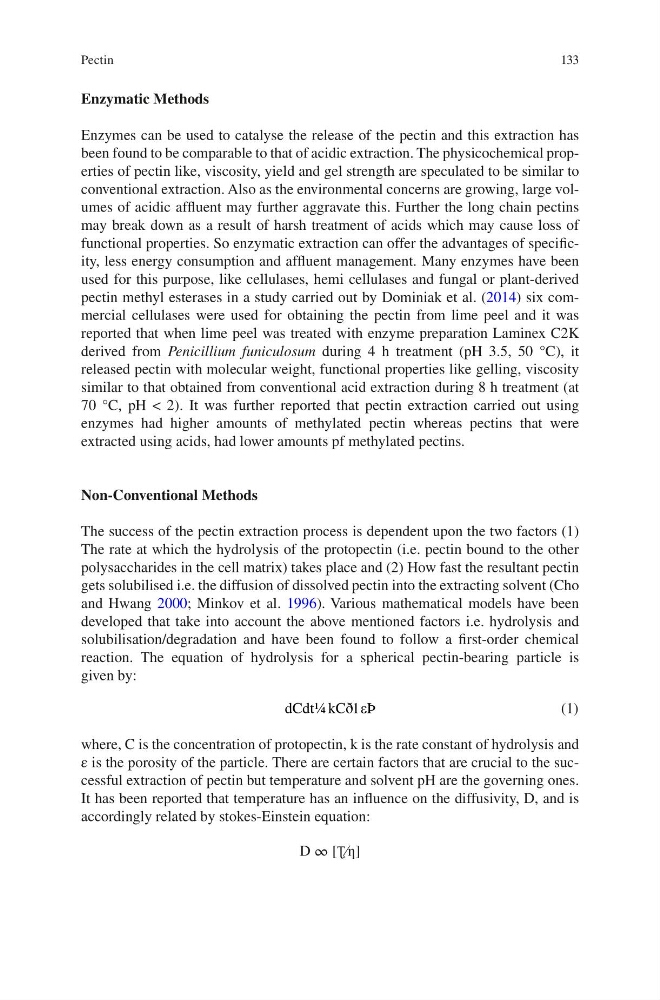
reaction. The equation of hydrolysis for a spherical pectin-bearing particle is
given by:
dCdt kC 1
¼ ð εÞ
(1)
where, C is the concentration of protopectin, k is the rate constant of hydrolysis and
ε is the porosity of the particle. There are certain factors that are crucial to the successful extraction of pectin but temperature and solvent pH are the governing ones.
It has been reported that temperature has an influence on the diffusivity, D, and is
accordingly related by stokes-Einstein equation:
D ∞ [Ʈ∕ƞ]
Pectin
Enzymatic Methods
Enzymes can be used to catalyse the release of the pectin and this extraction has
been found to be comparable to that of acidic extraction. The physicochemical properties of pectin like, viscosity, yield and gel strength are speculated to be similar to
conventional extraction. Also as the environmental concerns are growing, large volumes of acidic affluent may further aggravate this. Further the long chain pectins
may break down as a result of harsh treatment of acids which may cause loss of
functional properties. So enzymatic extraction can offer the advantages of specificity, less energy consumption and affluent management. Many enzymes have been
used for this purpose, like cellulases, hemi cellulases and fungal or plant-derived
pectin methyl esterases in a study carried out by Dominiak et al. (2014) six commercial cellulases were used for obtaining the pectin from lime peel and it was
reported that when lime peel was treated with enzyme preparation Laminex C2K
derived from Penicillium funiculosum during 4 h treatment (pH 3.5, 50 °C), it
released pectin with molecular weight, functional properties like gelling, viscosity
similar to that obtained from conventional acid extraction during 8 h treatment (at
70 °C, pH < 2). It was further reported that pectin extraction carried out using
enzymes had higher amounts of methylated pectin whereas pectins that were
extracted using acids, had lower amounts pf methylated pectins.
Non-Conventional Methods
The success of the pectin extraction process is dependent upon the two factors (1)
The rate at which the hydrolysis of the protopectin (i.e. pectin bound to the other
polysaccharides in the cell matrix) takes place and (2) How fast the resultant pectin
gets solubilised i.e. the diffusion of dissolved pectin into the extracting solvent (Cho
and Hwang 2000; Minkov et al. 1996). Various mathematical models have been
developed that take into account the above mentioned factors i.e. hydrolysis and
solubilisation/degradation and have been found to follow a first-order chemical
reaction. The equation of hydrolysis for a spherical pectin-bearing particle is
given by:
dCdt kC 1
¼ ð εÞ
(1)
where, C is the concentration of protopectin, k is the rate constant of hydrolysis and
ε is the porosity of the particle. There are certain factors that are crucial to the successful extraction of pectin but temperature and solvent pH are the governing ones.
It has been reported that temperature has an influence on the diffusivity, D, and is
accordingly related by stokes-Einstein equation:
D ∞ [Ʈ∕ƞ]
Pectin