

132
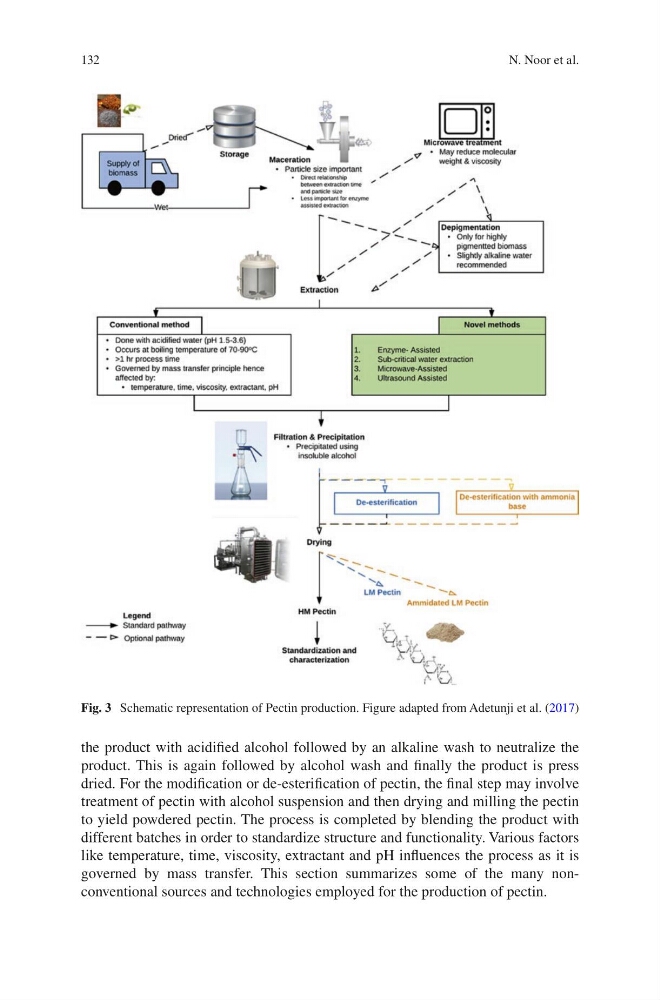
the product with acidified alcohol followed by an alkaline wash to neutralize the
product. This is again followed by alcohol wash and finally the product is press
dried. For the modification or de-esterification of pectin, the final step may involve
treatment of pectin with alcohol suspension and then drying and milling the pectin
to yield powdered pectin. The process is completed by blending the product with
different batches in order to standardize structure and functionality. Various factors
like temperature, time, viscosity, extractant and pH influences the process as it is
governed by mass transfer. This section summarizes some of the many nonconventional sources and technologies employed for the production of pectin.
Fig. 3 Schematic representation of Pectin production. Figure adapted from Adetunji et al. (2017)
N. Noor et al.
the product with acidified alcohol followed by an alkaline wash to neutralize the
product. This is again followed by alcohol wash and finally the product is press
dried. For the modification or de-esterification of pectin, the final step may involve
treatment of pectin with alcohol suspension and then drying and milling the pectin
to yield powdered pectin. The process is completed by blending the product with
different batches in order to standardize structure and functionality. Various factors
like temperature, time, viscosity, extractant and pH influences the process as it is
governed by mass transfer. This section summarizes some of the many nonconventional sources and technologies employed for the production of pectin.
Fig. 3 Schematic representation of Pectin production. Figure adapted from Adetunji et al. (2017)
N. Noor et al.