

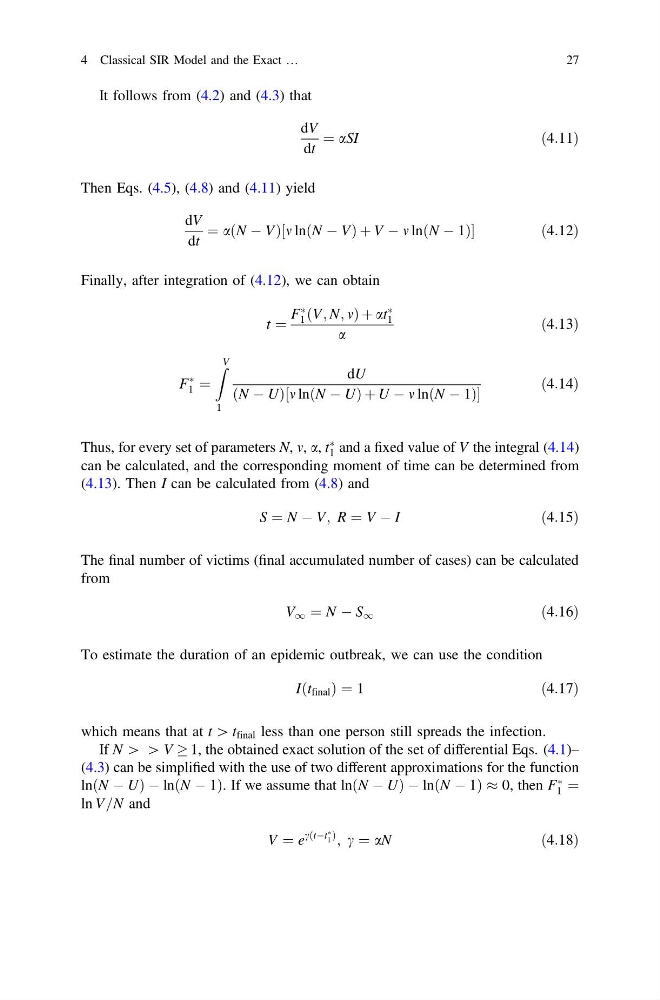
It follows from (4.2) and (4.3) that
dV
dt
¼ aSI
ð4:11Þ
Then Eqs. (4.5), (4.8) and (4.11) yield
dV
dt
¼ a N À V
ð
Þm lnðN À VÞ þ V À m lnðN À 1Þ
½
ð 4:12Þ
Finally, after integration of (4.12), we can obtain
t ¼
F
Ã
1 ðV; N; mÞ þ at
Ã
1
a
ð4:13Þ
F
Ã
1 ¼
Z V
1
dU
N À U
ð
Þm ln N À U
ð
ÞþU À m ln N À 1
ð
Þ
½
ð4:14Þ
Thus, for every set of parameters N, m, a, t
Ã
1 and a fixed value of V the integral (4.14)
can be calculated, and the corresponding moment of time can be determined from
(4.13). Then I can be calculated from (4.8) and
S ¼ N À V; R ¼ V À I
ð4:15Þ
The final number of victims (final accumulated number of cases) can be calculated
from
V 1 ¼ N À S 1
ð4:16Þ
To estimate the duration of an epidemic outbreak, we can use the condition
I t final
ð
Þ ¼ 1
ð4:17Þ
which means that at t [ t final less than one person still spreads the infection.
If N [ [ V ! 1, the obtained exact solution of the set of differential Eqs. (4.1)–
(4.3) can be simplified with the use of two different approximations for the function
ln N À U
ð
ÞÀln N À 1
ð
Þ. If we assume that ln N À U
ð
ÞÀln N À 1
ð
Þ%0, then F
Ã
1 ¼
ln V=N and
V ¼ e
cðtÀt
Ã
1 Þ
; c ¼ aN
ð4:18Þ
4 Classical SIR Model and the Exact …
27
dV
dt
¼ aSI
ð4:11Þ
Then Eqs. (4.5), (4.8) and (4.11) yield
dV
dt
¼ a N À V
ð
Þm lnðN À VÞ þ V À m lnðN À 1Þ
½
ð 4:12Þ
Finally, after integration of (4.12), we can obtain
t ¼
F
Ã
1 ðV; N; mÞ þ at
Ã
1
a
ð4:13Þ
F
Ã
1 ¼
Z V
1
dU
N À U
ð
Þm ln N À U
ð
ÞþU À m ln N À 1
ð
Þ
½
ð4:14Þ
Thus, for every set of parameters N, m, a, t
Ã
1 and a fixed value of V the integral (4.14)
can be calculated, and the corresponding moment of time can be determined from
(4.13). Then I can be calculated from (4.8) and
S ¼ N À V; R ¼ V À I
ð4:15Þ
The final number of victims (final accumulated number of cases) can be calculated
from
V 1 ¼ N À S 1
ð4:16Þ
To estimate the duration of an epidemic outbreak, we can use the condition
I t final
ð
Þ ¼ 1
ð4:17Þ
which means that at t [ t final less than one person still spreads the infection.
If N [ [ V ! 1, the obtained exact solution of the set of differential Eqs. (4.1)–
(4.3) can be simplified with the use of two different approximations for the function
ln N À U
ð
ÞÀln N À 1
ð
Þ. If we assume that ln N À U
ð
ÞÀln N À 1
ð
Þ%0, then F
Ã
1 ¼
ln V=N and
V ¼ e
cðtÀt
Ã
1 Þ
; c ¼ aN
ð4:18Þ
4 Classical SIR Model and the Exact …
27