

84
5 Flux Pinning Phenomena
W =
P p dt = −
μ 0
8H p
−H m
H m
(H m − H 0 )
2 dH 0 × 2 =
2μ 0 H
3
m
3H p
.
(5.39)
This result shows that the pinning loss energy in a unit cycle is constant. This is a
characteristic property of hysteresis loss. The same result can be obtained from the
area of a closed magnetization loop.
For H m > H p , a similar calculation is derived:
W = 2μ 0 H p H m
1 −
2H p
3H m
.
(5.40)
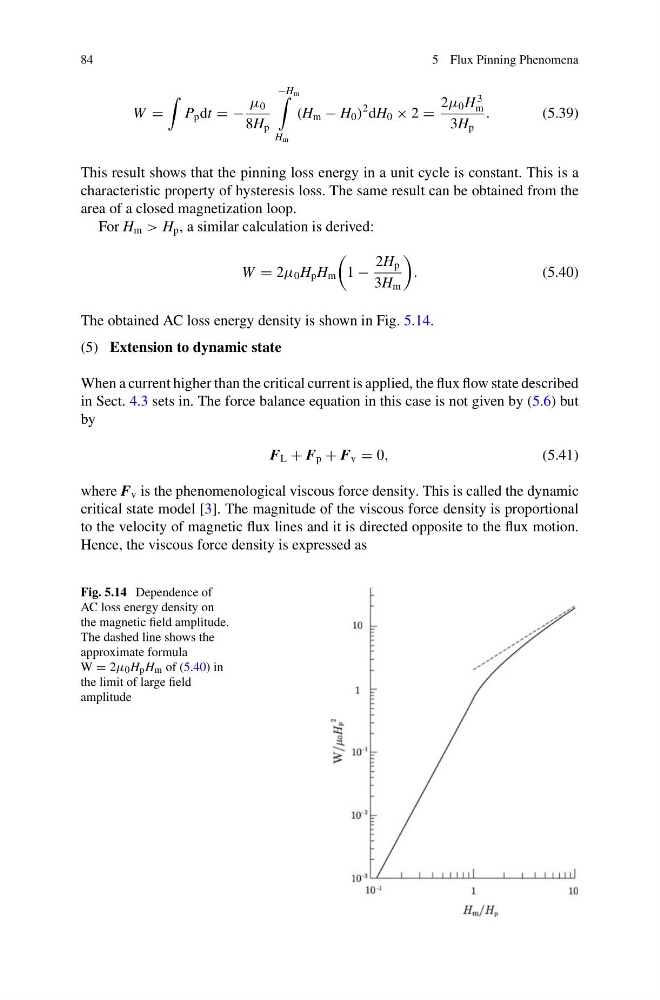
The obtained AC loss energy density is shown in Fig. 5.14.
(5) Extension to dynamic state
When a current higher than the critical current is applied, the flux flow state described
in Sect. 4.3 sets in. The force balance equation in this case is not given by (5.6) but
by
F L + F p + F v = 0,
(5.41)
where F v is the phenomenological viscous force density. This is called the dynamic
critical state model [3]. The magnitude of the viscous force density is proportional
to the velocity of magnetic flux lines and it is directed opposite to the flux motion.
Hence, the viscous force density is expressed as
Fig. 5.14 Dependence of
AC loss energy density on
the magnetic field amplitude.
The dashed line shows the
approximate formula
W = 2μ 0 H p H m of (5.40) in
the limit of large field
amplitude
5 Flux Pinning Phenomena
W =
P p dt = −
μ 0
8H p
−H m
H m
(H m − H 0 )
2 dH 0 × 2 =
2μ 0 H
3
m
3H p
.
(5.39)
This result shows that the pinning loss energy in a unit cycle is constant. This is a
characteristic property of hysteresis loss. The same result can be obtained from the
area of a closed magnetization loop.
For H m > H p , a similar calculation is derived:
W = 2μ 0 H p H m
1 −
2H p
3H m
.
(5.40)
The obtained AC loss energy density is shown in Fig. 5.14.
(5) Extension to dynamic state
When a current higher than the critical current is applied, the flux flow state described
in Sect. 4.3 sets in. The force balance equation in this case is not given by (5.6) but
by
F L + F p + F v = 0,
(5.41)
where F v is the phenomenological viscous force density. This is called the dynamic
critical state model [3]. The magnitude of the viscous force density is proportional
to the velocity of magnetic flux lines and it is directed opposite to the flux motion.
Hence, the viscous force density is expressed as
Fig. 5.14 Dependence of
AC loss energy density on
the magnetic field amplitude.
The dashed line shows the
approximate formula
W = 2μ 0 H p H m of (5.40) in
the limit of large field
amplitude