

80
5 Flux Pinning Phenomena
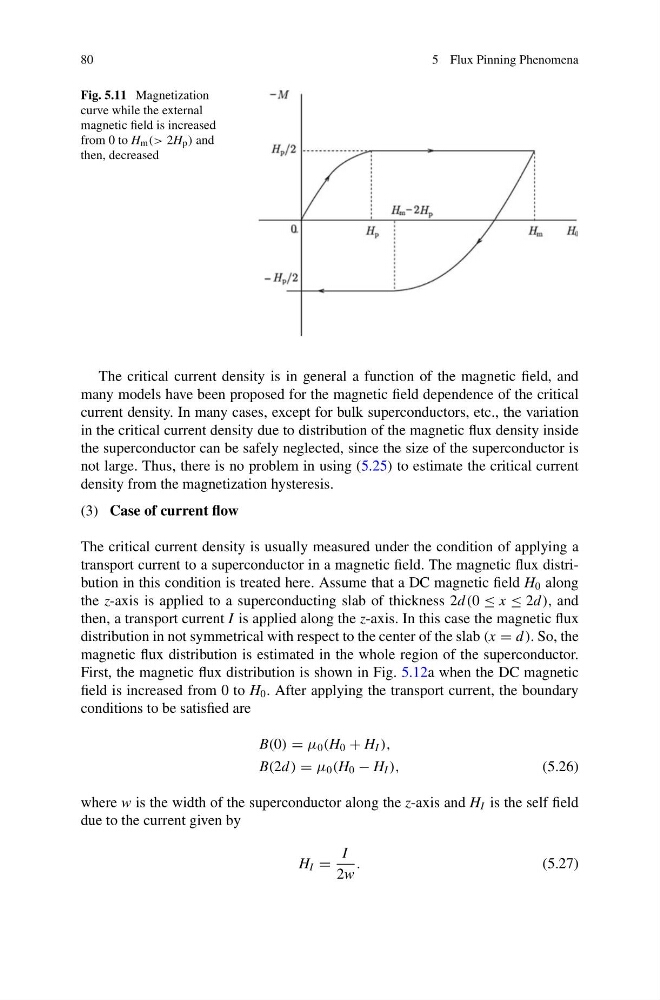
Fig. 5.11 Magnetization
curve while the external
magnetic field is increased
from 0 to H m (> 2H p ) and
then, decreased
The critical current density is in general a function of the magnetic field, and
many models have been proposed for the magnetic field dependence of the critical
current density. In many cases, except for bulk superconductors, etc., the variation
in the critical current density due to distribution of the magnetic flux density inside
the superconductor can be safely neglected, since the size of the superconductor is
not large. Thus, there is no problem in using (5.25) to estimate the critical current
density from the magnetization hysteresis.
(3) Case of current flow
The critical current density is usually measured under the condition of applying a
transport current to a superconductor in a magnetic field. The magnetic flux distribution in this condition is treated here. Assume that a DC magnetic field H 0 along
the z-axis is applied to a superconducting slab of thickness 2d (0 ≤ x ≤ 2d ), and
then, a transport current I is applied along the z-axis. In this case the magnetic flux
distribution in not symmetrical with respect to the center of the slab (x = d ). So, the
magnetic flux distribution is estimated in the whole region of the superconductor.
First, the magnetic flux distribution is shown in Fig. 5.12a when the DC magnetic
field is increased from 0 to H 0 . After applying the transport current, the boundary
conditions to be satisfied are
B(0) = μ 0 (H 0 + H I ),
B(2d ) = μ 0 (H 0 − H I ),
(5.26)
where w is the width of the superconductor along the z-axis and H I is the self field
due to the current given by
H I =
I
2w
.
(5.27)
5 Flux Pinning Phenomena
Fig. 5.11 Magnetization
curve while the external
magnetic field is increased
from 0 to H m (> 2H p ) and
then, decreased
The critical current density is in general a function of the magnetic field, and
many models have been proposed for the magnetic field dependence of the critical
current density. In many cases, except for bulk superconductors, etc., the variation
in the critical current density due to distribution of the magnetic flux density inside
the superconductor can be safely neglected, since the size of the superconductor is
not large. Thus, there is no problem in using (5.25) to estimate the critical current
density from the magnetization hysteresis.
(3) Case of current flow
The critical current density is usually measured under the condition of applying a
transport current to a superconductor in a magnetic field. The magnetic flux distribution in this condition is treated here. Assume that a DC magnetic field H 0 along
the z-axis is applied to a superconducting slab of thickness 2d (0 ≤ x ≤ 2d ), and
then, a transport current I is applied along the z-axis. In this case the magnetic flux
distribution in not symmetrical with respect to the center of the slab (x = d ). So, the
magnetic flux distribution is estimated in the whole region of the superconductor.
First, the magnetic flux distribution is shown in Fig. 5.12a when the DC magnetic
field is increased from 0 to H 0 . After applying the transport current, the boundary
conditions to be satisfied are
B(0) = μ 0 (H 0 + H I ),
B(2d ) = μ 0 (H 0 − H I ),
(5.26)
where w is the width of the superconductor along the z-axis and H I is the self field
due to the current given by
H I =
I
2w
.
(5.27)