

5.2 Critical State Model
75
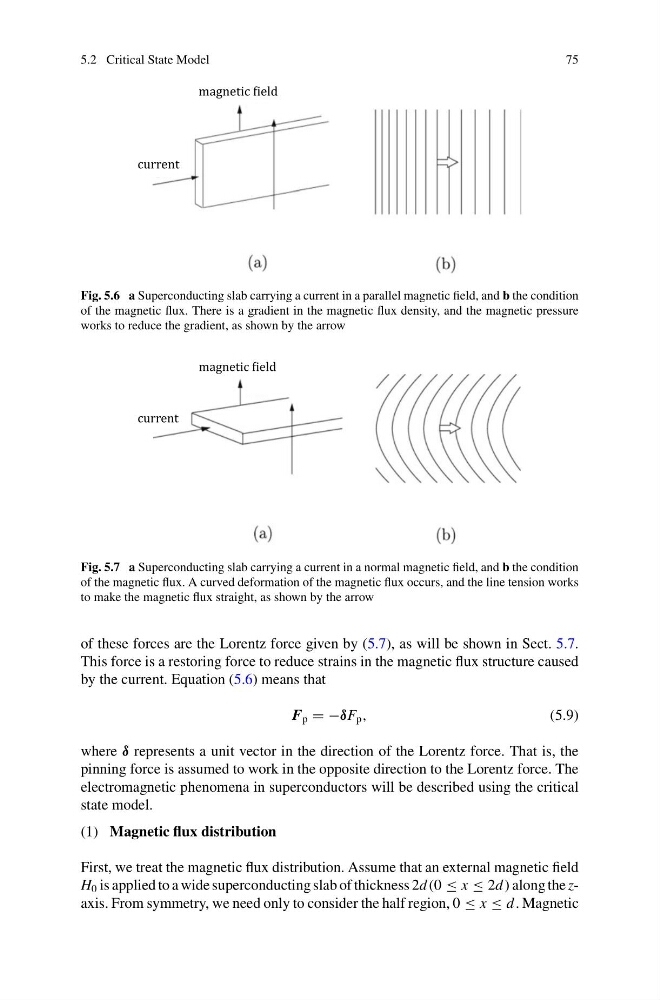
Fig. 5.6 a Superconducting slab carrying a current in a parallel magnetic field, and b the condition
of the magnetic flux. There is a gradient in the magnetic flux density, and the magnetic pressure
works to reduce the gradient, as shown by the arrow
Fig. 5.7 a Superconducting slab carrying a current in a normal magnetic field, and b the condition
of the magnetic flux. A curved deformation of the magnetic flux occurs, and the line tension works
to make the magnetic flux straight, as shown by the arrow
of these forces are the Lorentz force given by (5.7), as will be shown in Sect. 5.7.
This force is a restoring force to reduce strains in the magnetic flux structure caused
by the current. Equation (5.6) means that
F p = −δF p ,
(5.9)
where δ represents a unit vector in the direction of the Lorentz force. That is, the
pinning force is assumed to work in the opposite direction to the Lorentz force. The
electromagnetic phenomena in superconductors will be described using the critical
state model.
(1) Magnetic flux distribution
First, we treat the magnetic flux distribution. Assume that an external magnetic field
H 0 is applied to a wide superconducting slab of thickness 2d (0 ≤ x ≤ 2d ) along the zaxis. From symmetry, we need only to consider the half region, 0 ≤ x ≤ d . Magnetic
75
Fig. 5.6 a Superconducting slab carrying a current in a parallel magnetic field, and b the condition
of the magnetic flux. There is a gradient in the magnetic flux density, and the magnetic pressure
works to reduce the gradient, as shown by the arrow
Fig. 5.7 a Superconducting slab carrying a current in a normal magnetic field, and b the condition
of the magnetic flux. A curved deformation of the magnetic flux occurs, and the line tension works
to make the magnetic flux straight, as shown by the arrow
of these forces are the Lorentz force given by (5.7), as will be shown in Sect. 5.7.
This force is a restoring force to reduce strains in the magnetic flux structure caused
by the current. Equation (5.6) means that
F p = −δF p ,
(5.9)
where δ represents a unit vector in the direction of the Lorentz force. That is, the
pinning force is assumed to work in the opposite direction to the Lorentz force. The
electromagnetic phenomena in superconductors will be described using the critical
state model.
(1) Magnetic flux distribution
First, we treat the magnetic flux distribution. Assume that an external magnetic field
H 0 is applied to a wide superconducting slab of thickness 2d (0 ≤ x ≤ 2d ) along the zaxis. From symmetry, we need only to consider the half region, 0 ≤ x ≤ d . Magnetic