

74
5 Flux Pinning Phenomena
F p ∝ N p f
2
p .
(5.5)
This is called the statistical summation, since the functional form is the same as the
prediction of the statistical theory.
5.2 Critical State Model
Before going to the summation theory, the critical state model is introduced, which
correctly describes irreversible electromagnetic phenomena in superconductors,
since it is necessary to understand the irreversibility.
It is assumed in the static critical state model that the magnetic flux distribution
is determined by the balance between the Lorentz force and the pinning force [2]:
F L + F p = 0.
(5.6)
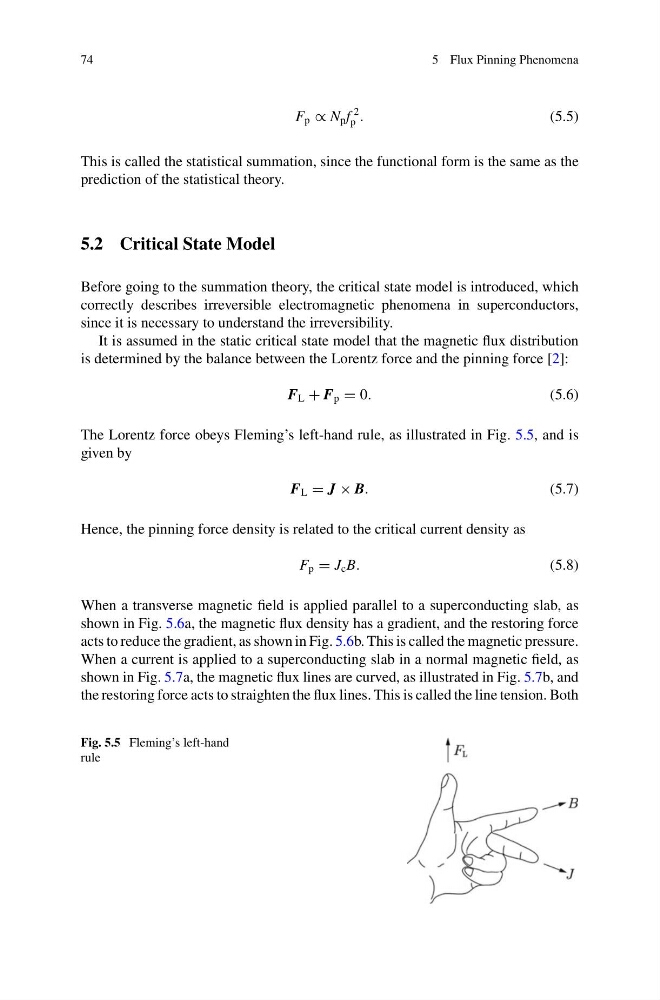
The Lorentz force obeys Fleming’s left-hand rule, as illustrated in Fig. 5.5, and is
given by
F L = J × B.
(5.7)
Hence, the pinning force density is related to the critical current density as
F p = J c B.
(5.8)
When a transverse magnetic field is applied parallel to a superconducting slab, as
shown in Fig. 5.6a, the magnetic flux density has a gradient, and the restoring force
acts to reduce the gradient, as shown in Fig. 5.6b. This is called the magnetic pressure.
When a current is applied to a superconducting slab in a normal magnetic field, as
shown in Fig. 5.7a, the magnetic flux lines are curved, as illustrated in Fig. 5.7b, and
the restoring force acts to straighten the flux lines. This is called the line tension. Both
Fig. 5.5 Fleming’s left-hand
rule
5 Flux Pinning Phenomena
F p ∝ N p f
2
p .
(5.5)
This is called the statistical summation, since the functional form is the same as the
prediction of the statistical theory.
5.2 Critical State Model
Before going to the summation theory, the critical state model is introduced, which
correctly describes irreversible electromagnetic phenomena in superconductors,
since it is necessary to understand the irreversibility.
It is assumed in the static critical state model that the magnetic flux distribution
is determined by the balance between the Lorentz force and the pinning force [2]:
F L + F p = 0.
(5.6)
The Lorentz force obeys Fleming’s left-hand rule, as illustrated in Fig. 5.5, and is
given by
F L = J × B.
(5.7)
Hence, the pinning force density is related to the critical current density as
F p = J c B.
(5.8)
When a transverse magnetic field is applied parallel to a superconducting slab, as
shown in Fig. 5.6a, the magnetic flux density has a gradient, and the restoring force
acts to reduce the gradient, as shown in Fig. 5.6b. This is called the magnetic pressure.
When a current is applied to a superconducting slab in a normal magnetic field, as
shown in Fig. 5.7a, the magnetic flux lines are curved, as illustrated in Fig. 5.7b, and
the restoring force acts to straighten the flux lines. This is called the line tension. Both
Fig. 5.5 Fleming’s left-hand
rule