

66
4 Fundamental Electromagnetic Properties of Superconductors
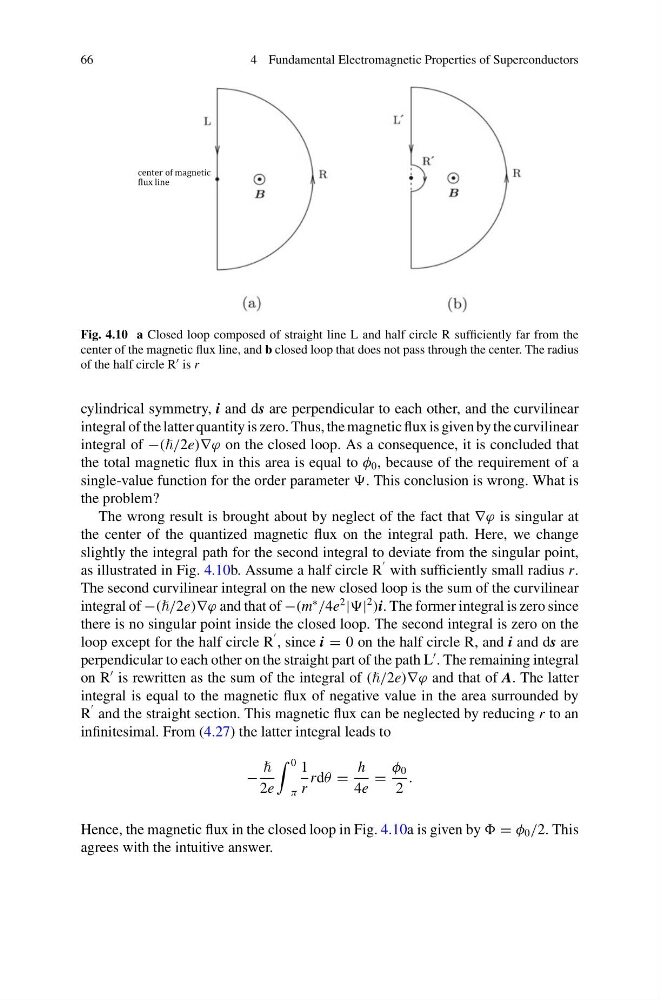
Fig. 4.10 a Closed loop composed of straight line L and half circle R sufficiently far from the
center of the magnetic flux line, and b closed loop that does not pass through the center. The radius
of the half circle R is r
cylindrical symmetry, i and ds are perpendicular to each other, and the curvilinear
integral of the latter quantity is zero. Thus, the magnetic flux is given by the curvilinear
integral of −( on the closed loop. As a consequence, it is concluded that
the total magnetic flux in this area is equal to φ 0 , because of the requirement of a
single-value function for the order parameter . This conclusion is wrong. What is
the problem?
The wrong result is brought about by neglect of the fact that ∇ϕ is singular at
the center of the quantized magnetic flux on the integral path. Here, we change
slightly the integral path for the second integral to deviate from the singular point,
as illustrated in Fig. 4.10b. Assume a half circle R
with sufficiently small radius r.
The second curvilinear integral on the new closed loop is the sum of the curvilinear
integral of −( and that of −(m
∗
/4e
2
|
2
)i. The former integral is zero since
there is no singular point inside the closed loop. The second integral is zero on the
loop except for the half circle R
, since i = 0 on the half circle R, and i and ds are
perpendicular to each other on the straight part of the path L
. The remaining integral
on R
is rewritten as the sum of the integral of ( and that of A. The latter
integral is equal to the magnetic flux of negative value in the area surrounded by
R
and the straight section. This magnetic flux can be neglected by reducing r to an
infinitesimal. From (4.27) the latter integral leads to
−
2e
0
π
1
r
rdθ =
h
4e
=
φ 0
2
.
Hence, the magnetic flux in the closed loop in Fig. 4.10a is given by = φ 0 /2. This
agrees with the intuitive answer.
4 Fundamental Electromagnetic Properties of Superconductors
Fig. 4.10 a Closed loop composed of straight line L and half circle R sufficiently far from the
center of the magnetic flux line, and b closed loop that does not pass through the center. The radius
of the half circle R is r
cylindrical symmetry, i and ds are perpendicular to each other, and the curvilinear
integral of the latter quantity is zero. Thus, the magnetic flux is given by the curvilinear
integral of −( on the closed loop. As a consequence, it is concluded that
the total magnetic flux in this area is equal to φ 0 , because of the requirement of a
single-value function for the order parameter . This conclusion is wrong. What is
the problem?
The wrong result is brought about by neglect of the fact that ∇ϕ is singular at
the center of the quantized magnetic flux on the integral path. Here, we change
slightly the integral path for the second integral to deviate from the singular point,
as illustrated in Fig. 4.10b. Assume a half circle R
with sufficiently small radius r.
The second curvilinear integral on the new closed loop is the sum of the curvilinear
integral of −( and that of −(m
∗
/4e
2
|
2
)i. The former integral is zero since
there is no singular point inside the closed loop. The second integral is zero on the
loop except for the half circle R
, since i = 0 on the half circle R, and i and ds are
perpendicular to each other on the straight part of the path L
. The remaining integral
on R
is rewritten as the sum of the integral of ( and that of A. The latter
integral is equal to the magnetic flux of negative value in the area surrounded by
R
and the straight section. This magnetic flux can be neglected by reducing r to an
infinitesimal. From (4.27) the latter integral leads to
−
2e
0
π
1
r
rdθ =
h
4e
=
φ 0
2
.
Hence, the magnetic flux in the closed loop in Fig. 4.10a is given by = φ 0 /2. This
agrees with the intuitive answer.