

4.3 Flux Flow State
65
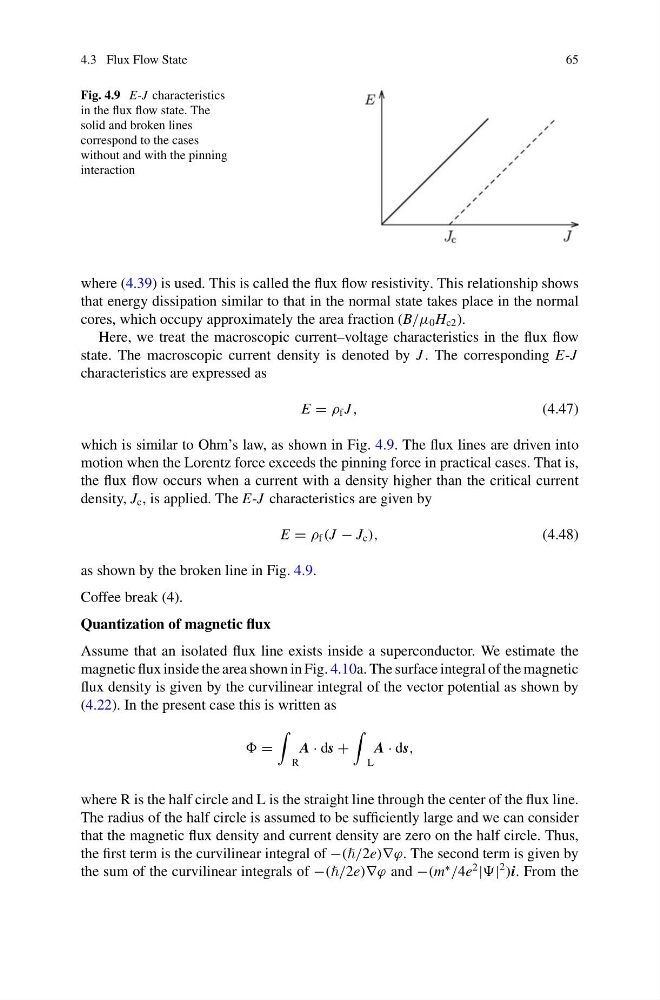
Fig. 4.9 E-J characteristics
in the flux flow state. The
solid and broken lines
correspond to the cases
without and with the pinning
interaction
where (4.39) is used. This is called the flux flow resistivity. This relationship shows
that energy dissipation similar to that in the normal state takes place in the normal
cores, which occupy approximately the area fraction (B/μ 0 H c2 ).
Here, we treat the macroscopic current–voltage characteristics in the flux flow
state. The macroscopic current density is denoted by J . The corresponding E-J
characteristics are expressed as
E = ρ f J ,
(4.47)
which is similar to Ohm’s law, as shown in Fig. 4.9. The flux lines are driven into
motion when the Lorentz force exceeds the pinning force in practical cases. That is,
the flux flow occurs when a current with a density higher than the critical current
density, J c , is applied. The E-J characteristics are given by
E = ρ f (J − J c ),
(4.48)
as shown by the broken line in Fig. 4.9.
Coffee break (4).
Quantization of magnetic flux
Assume that an isolated flux line exists inside a superconductor. We estimate the
magnetic flux inside the area shown in Fig. 4.10a. The surface integral of the magnetic
flux density is given by the curvilinear integral of the vector potential as shown by
(4.22). In the present case this is written as
=
R
A · ds +
L
A · ds,
where R is the half circle and L is the straight line through the center of the flux line.
The radius of the half circle is assumed to be sufficiently large and we can consider
that the magnetic flux density and current density are zero on the half circle. Thus,
the first term is the curvilinear integral of −(/2e)∇ϕ. The second term is given by
the sum of the curvilinear integrals of −(/2e)∇ϕ and −(m
∗
/4e
2
||
2
)i. From the
65
Fig. 4.9 E-J characteristics
in the flux flow state. The
solid and broken lines
correspond to the cases
without and with the pinning
interaction
where (4.39) is used. This is called the flux flow resistivity. This relationship shows
that energy dissipation similar to that in the normal state takes place in the normal
cores, which occupy approximately the area fraction (B/μ 0 H c2 ).
Here, we treat the macroscopic current–voltage characteristics in the flux flow
state. The macroscopic current density is denoted by J . The corresponding E-J
characteristics are expressed as
E = ρ f J ,
(4.47)
which is similar to Ohm’s law, as shown in Fig. 4.9. The flux lines are driven into
motion when the Lorentz force exceeds the pinning force in practical cases. That is,
the flux flow occurs when a current with a density higher than the critical current
density, J c , is applied. The E-J characteristics are given by
E = ρ f (J − J c ),
(4.48)
as shown by the broken line in Fig. 4.9.
Coffee break (4).
Quantization of magnetic flux
Assume that an isolated flux line exists inside a superconductor. We estimate the
magnetic flux inside the area shown in Fig. 4.10a. The surface integral of the magnetic
flux density is given by the curvilinear integral of the vector potential as shown by
(4.22). In the present case this is written as
=
R
A · ds +
L
A · ds,
where R is the half circle and L is the straight line through the center of the flux line.
The radius of the half circle is assumed to be sufficiently large and we can consider
that the magnetic flux density and current density are zero on the half circle. Thus,
the first term is the curvilinear integral of −(/2e)∇ϕ. The second term is given by
the sum of the curvilinear integrals of −(/2e)∇ϕ and −(m
∗
/4e
2
||
2
)i. From the