

4.2 Ginzburg–Landau Theory
59
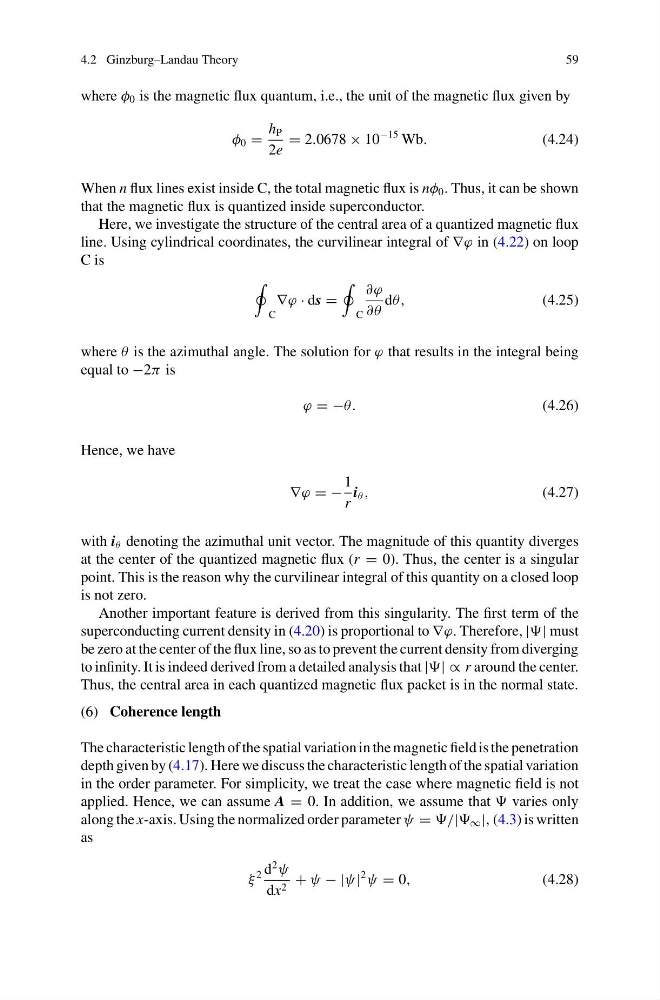
where φ 0 is the magnetic flux quantum, i.e., the unit of the magnetic flux given by
φ 0 =
h P
2e
= 2.0678 × 10
−15 Wb.
(4.24)
When n flux lines exist inside C, the total magnetic flux is nφ 0 . Thus, it can be shown
that the magnetic flux is quantized inside superconductor.
Here, we investigate the structure of the central area of a quantized magnetic flux
line. Using cylindrical coordinates, the curvilinear integral of ∇ϕ in (4.22) on loop
C is
C
∇ϕ · ds =
C
∂ϕ
∂θ
dθ,
(4.25)
where θ is the azimuthal angle. The solution for ϕ that results in the integral being
equal to −2π is
ϕ = −θ.
(4.26)
Hence, we have
∇ϕ = −
1
r
i θ ,
(4.27)
with i θ denoting the azimuthal unit vector. The magnitude of this quantity diverges
at the center of the quantized magnetic flux (r = 0). Thus, the center is a singular
point. This is the reason why the curvilinear integral of this quantity on a closed loop
is not zero.
Another important feature is derived from this singularity. The first term of the
superconducting current density in (4.20) is proportional to ∇ϕ. Therefore, || must
be zero at the center of the flux line, so as to prevent the current density from diverging
to infinity. It is indeed derived from a detailed analysis that || ∝ r around the center.
Thus, the central area in each quantized magnetic flux packet is in the normal state.
(6) Coherence length
The characteristic length of the spatial variation in the magnetic field is the penetration
depth given by (4.17). Here we discuss the characteristic length of the spatial variation
in the order parameter. For simplicity, we treat the case where magnetic field is not
applied. Hence, we can assume A = 0. In addition, we assume that varies only
along the x-axis. Using the normalized order parameter ψ = /| ∞ |, (4.3) is written
as
ξ
2 d
2
ψ
dx 2 + ψ − |ψ|
2
ψ = 0,
(4.28)
59
where φ 0 is the magnetic flux quantum, i.e., the unit of the magnetic flux given by
φ 0 =
h P
2e
= 2.0678 × 10
−15 Wb.
(4.24)
When n flux lines exist inside C, the total magnetic flux is nφ 0 . Thus, it can be shown
that the magnetic flux is quantized inside superconductor.
Here, we investigate the structure of the central area of a quantized magnetic flux
line. Using cylindrical coordinates, the curvilinear integral of ∇ϕ in (4.22) on loop
C is
C
∇ϕ · ds =
C
∂ϕ
∂θ
dθ,
(4.25)
where θ is the azimuthal angle. The solution for ϕ that results in the integral being
equal to −2π is
ϕ = −θ.
(4.26)
Hence, we have
∇ϕ = −
1
r
i θ ,
(4.27)
with i θ denoting the azimuthal unit vector. The magnitude of this quantity diverges
at the center of the quantized magnetic flux (r = 0). Thus, the center is a singular
point. This is the reason why the curvilinear integral of this quantity on a closed loop
is not zero.
Another important feature is derived from this singularity. The first term of the
superconducting current density in (4.20) is proportional to ∇ϕ. Therefore, || must
be zero at the center of the flux line, so as to prevent the current density from diverging
to infinity. It is indeed derived from a detailed analysis that || ∝ r around the center.
Thus, the central area in each quantized magnetic flux packet is in the normal state.
(6) Coherence length
The characteristic length of the spatial variation in the magnetic field is the penetration
depth given by (4.17). Here we discuss the characteristic length of the spatial variation
in the order parameter. For simplicity, we treat the case where magnetic field is not
applied. Hence, we can assume A = 0. In addition, we assume that varies only
along the x-axis. Using the normalized order parameter ψ = /| ∞ |, (4.3) is written
as
ξ
2 d
2
ψ
dx 2 + ψ − |ψ|
2
ψ = 0,
(4.28)