

3.3 Merits of Introducing Superconductivity
47
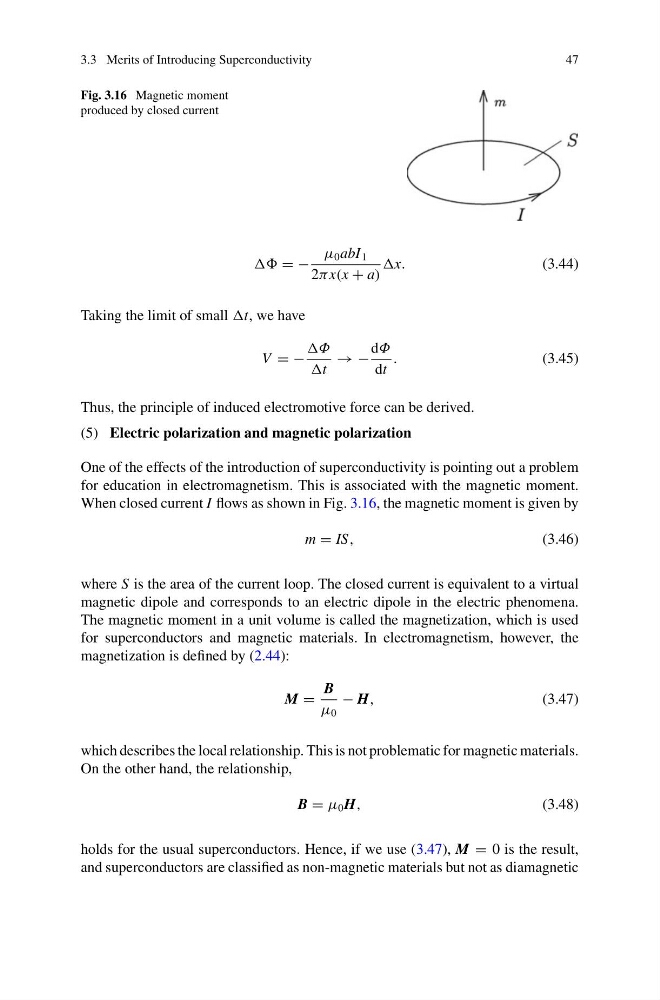
Fig. 3.16 Magnetic moment
produced by closed current
= −
μ 0 abI 1
2π x(x + a)
x.
(3.44)
Taking the limit of small t, we have
V = −
Φ
t
→ −
dΦ
dt
.
(3.45)
Thus, the principle of induced electromotive force can be derived.
(5) Electric polarization and magnetic polarization
One of the effects of the introduction of superconductivity is pointing out a problem
for education in electromagnetism. This is associated with the magnetic moment.
When closed current I flows as shown in Fig. 3.16, the magnetic moment is given by
m = IS,
(3.46)
where S is the area of the current loop. The closed current is equivalent to a virtual
magnetic dipole and corresponds to an electric dipole in the electric phenomena.
The magnetic moment in a unit volume is called the magnetization, which is used
for superconductors and magnetic materials. In electromagnetism, however, the
magnetization is defined by (2.44):
M =
B
μ 0
− H,
(3.47)
which describes the local relationship. This is not problematic for magnetic materials.
On the other hand, the relationship,
B = μ 0 H,
(3.48)
holds for the usual superconductors. Hence, if we use (3.47), M = 0 is the result,
and superconductors are classified as non-magnetic materials but not as diamagnetic
47
Fig. 3.16 Magnetic moment
produced by closed current
= −
μ 0 abI 1
2π x(x + a)
x.
(3.44)
Taking the limit of small t, we have
V = −
Φ
t
→ −
dΦ
dt
.
(3.45)
Thus, the principle of induced electromotive force can be derived.
(5) Electric polarization and magnetic polarization
One of the effects of the introduction of superconductivity is pointing out a problem
for education in electromagnetism. This is associated with the magnetic moment.
When closed current I flows as shown in Fig. 3.16, the magnetic moment is given by
m = IS,
(3.46)
where S is the area of the current loop. The closed current is equivalent to a virtual
magnetic dipole and corresponds to an electric dipole in the electric phenomena.
The magnetic moment in a unit volume is called the magnetization, which is used
for superconductors and magnetic materials. In electromagnetism, however, the
magnetization is defined by (2.44):
M =
B
μ 0
− H,
(3.47)
which describes the local relationship. This is not problematic for magnetic materials.
On the other hand, the relationship,
B = μ 0 H,
(3.48)
holds for the usual superconductors. Hence, if we use (3.47), M = 0 is the result,
and superconductors are classified as non-magnetic materials but not as diamagnetic