

46
3 Effects of the Introduction of Superconductivity into Electromagnetism
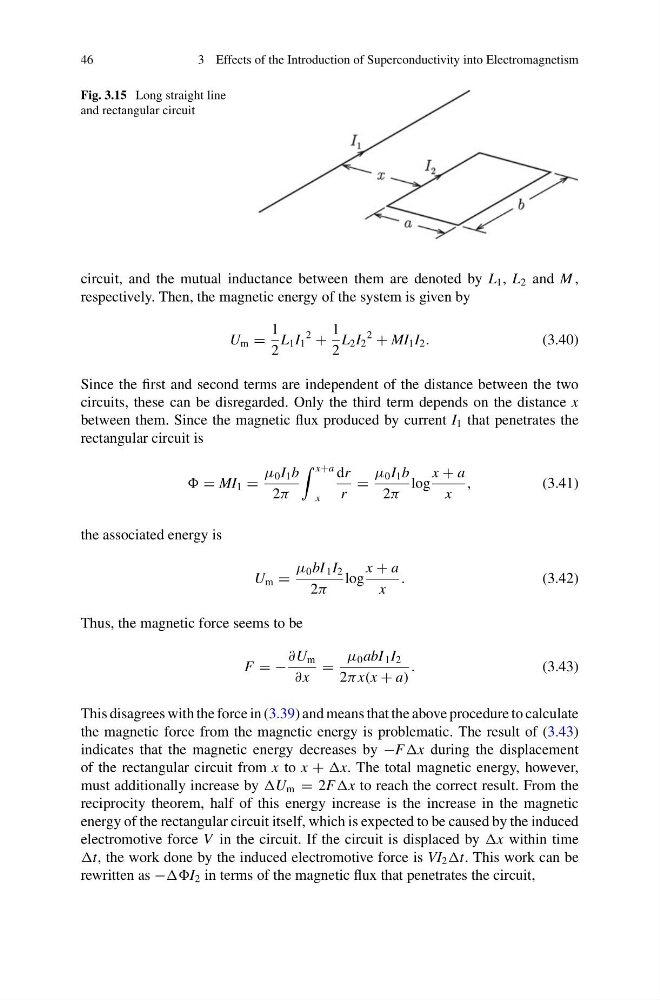
Fig. 3.15 Long straight line
and rectangular circuit
circuit, and the mutual inductance between them are denoted by L 1 , L 2 and M ,
respectively. Then, the magnetic energy of the system is given by
U m =
1
2
L 1 I 1
2
+
1
2
L 2 I 2
2
+ MI 1 I 2 .
(3.40)
Since the first and second terms are independent of the distance between the two
circuits, these can be disregarded. Only the third term depends on the distance x
between them. Since the magnetic flux produced by current I 1 that penetrates the
rectangular circuit is
= MI 1 =
μ 0 I 1 b
2π
x+a
x
dr
r
=
μ 0 I 1 b
2π
log
x + a
x
,
(3.41)
the associated energy is
U m =
μ 0 bI 1 I 2
2π
log
x + a
x
.
(3.42)
Thus, the magnetic force seems to be
F = −
∂U m
∂x
=
μ 0 abI 1 I 2
2π x(x + a)
.
(3.43)
This disagrees with the force in (3.39) and means that the above procedure to calculate
the magnetic force from the magnetic energy is problematic. The result of (3.43)
indicates that the magnetic energy decreases by −Fx during the displacement
of the rectangular circuit from x to x + x. The total magnetic energy, however,
must additionally increase by U m = 2Fx to reach the correct result. From the
reciprocity theorem, half of this energy increase is the increase in the magnetic
energy of the rectangular circuit itself, which is expected to be caused by the induced
electromotive force V in the circuit. If the circuit is displaced by x within time
t, the work done by the induced electromotive force is VI 2 t. This work can be
rewritten as −I 2 in terms of the magnetic flux that penetrates the circuit,
3 Effects of the Introduction of Superconductivity into Electromagnetism
Fig. 3.15 Long straight line
and rectangular circuit
circuit, and the mutual inductance between them are denoted by L 1 , L 2 and M ,
respectively. Then, the magnetic energy of the system is given by
U m =
1
2
L 1 I 1
2
+
1
2
L 2 I 2
2
+ MI 1 I 2 .
(3.40)
Since the first and second terms are independent of the distance between the two
circuits, these can be disregarded. Only the third term depends on the distance x
between them. Since the magnetic flux produced by current I 1 that penetrates the
rectangular circuit is
= MI 1 =
μ 0 I 1 b
2π
x+a
x
dr
r
=
μ 0 I 1 b
2π
log
x + a
x
,
(3.41)
the associated energy is
U m =
μ 0 bI 1 I 2
2π
log
x + a
x
.
(3.42)
Thus, the magnetic force seems to be
F = −
∂U m
∂x
=
μ 0 abI 1 I 2
2π x(x + a)
.
(3.43)
This disagrees with the force in (3.39) and means that the above procedure to calculate
the magnetic force from the magnetic energy is problematic. The result of (3.43)
indicates that the magnetic energy decreases by −Fx during the displacement
of the rectangular circuit from x to x + x. The total magnetic energy, however,
must additionally increase by U m = 2Fx to reach the correct result. From the
reciprocity theorem, half of this energy increase is the increase in the magnetic
energy of the rectangular circuit itself, which is expected to be caused by the induced
electromotive force V in the circuit. If the circuit is displaced by x within time
t, the work done by the induced electromotive force is VI 2 t. This work can be
rewritten as −I 2 in terms of the magnetic flux that penetrates the circuit,