

38
3 Effects of the Introduction of Superconductivity into Electromagnetism
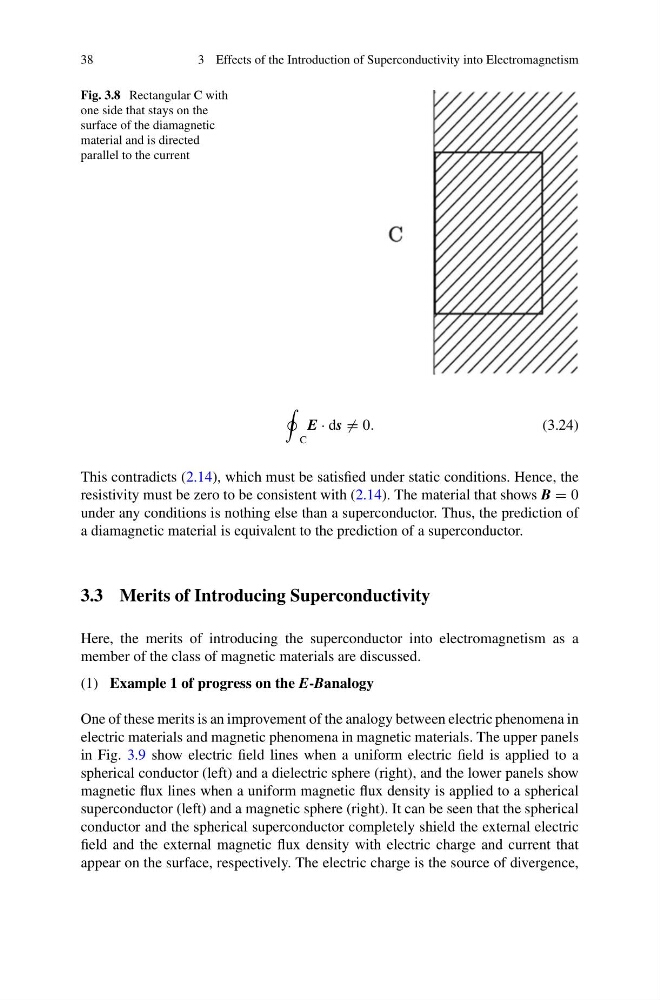
Fig. 3.8 Rectangular C with
one side that stays on the
surface of the diamagnetic
material and is directed
parallel to the current
C
E · ds = 0.
(3.24)
This contradicts (2.14), which must be satisfied under static conditions. Hence, the
resistivity must be zero to be consistent with (2.14). The material that shows B = 0
under any conditions is nothing else than a superconductor. Thus, the prediction of
a diamagnetic material is equivalent to the prediction of a superconductor.
3.3 Merits of Introducing Superconductivity
Here, the merits of introducing the superconductor into electromagnetism as a
member of the class of magnetic materials are discussed.
(1) Example 1 of progress on the E-Banalogy
One of these merits is an improvement of the analogy between electric phenomena in
electric materials and magnetic phenomena in magnetic materials. The upper panels
in Fig. 3.9 show electric field lines when a uniform electric field is applied to a
spherical conductor (left) and a dielectric sphere (right), and the lower panels show
magnetic flux lines when a uniform magnetic flux density is applied to a spherical
superconductor (left) and a magnetic sphere (right). It can be seen that the spherical
conductor and the spherical superconductor completely shield the external electric
field and the external magnetic flux density with electric charge and current that
appear on the surface, respectively. The electric charge is the source of divergence,
3 Effects of the Introduction of Superconductivity into Electromagnetism
Fig. 3.8 Rectangular C with
one side that stays on the
surface of the diamagnetic
material and is directed
parallel to the current
C
E · ds = 0.
(3.24)
This contradicts (2.14), which must be satisfied under static conditions. Hence, the
resistivity must be zero to be consistent with (2.14). The material that shows B = 0
under any conditions is nothing else than a superconductor. Thus, the prediction of
a diamagnetic material is equivalent to the prediction of a superconductor.
3.3 Merits of Introducing Superconductivity
Here, the merits of introducing the superconductor into electromagnetism as a
member of the class of magnetic materials are discussed.
(1) Example 1 of progress on the E-Banalogy
One of these merits is an improvement of the analogy between electric phenomena in
electric materials and magnetic phenomena in magnetic materials. The upper panels
in Fig. 3.9 show electric field lines when a uniform electric field is applied to a
spherical conductor (left) and a dielectric sphere (right), and the lower panels show
magnetic flux lines when a uniform magnetic flux density is applied to a spherical
superconductor (left) and a magnetic sphere (right). It can be seen that the spherical
conductor and the spherical superconductor completely shield the external electric
field and the external magnetic flux density with electric charge and current that
appear on the surface, respectively. The electric charge is the source of divergence,