

16
2 Basic Electromagnetism
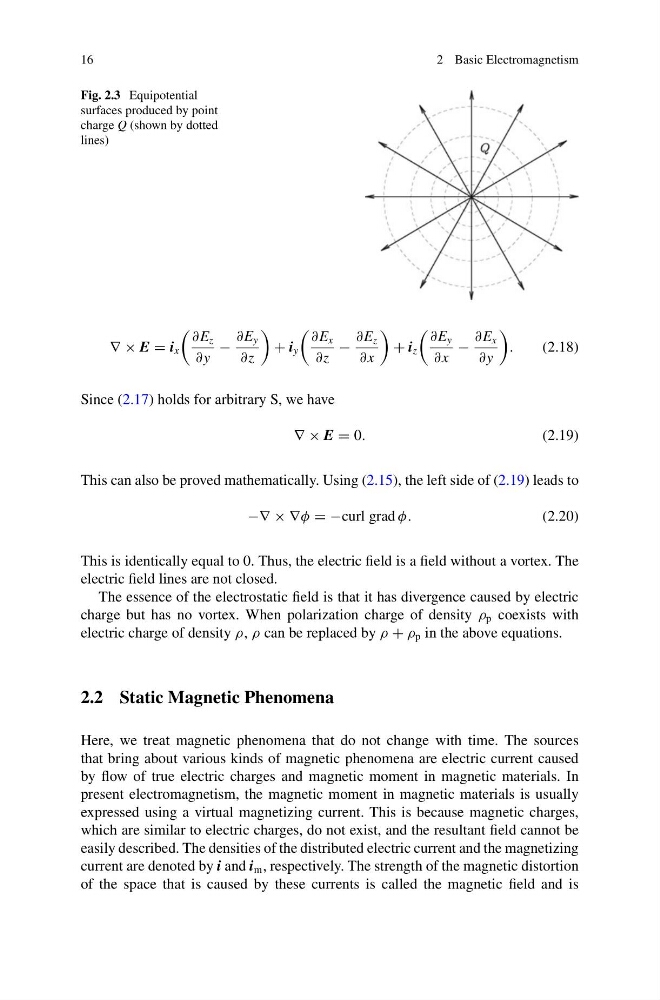
Fig. 2.3 Equipotential
surfaces produced by point
charge Q (shown by dotted
lines)
∇ × E = i x
∂E z
∂y
−
∂E y
∂z
+ i y
∂E x
∂z
−
∂E z
∂x
+ i z
∂E y
∂x
−
∂E x
∂y
.
(2.18)
Since (2.17) holds for arbitrary S, we have
∇ × E = 0.
(2.19)
This can also be proved mathematically. Using (2.15), the left side of (2.19) leads to
−∇ × ∇φ = −curl grad φ.
(2.20)
This is identically equal to 0. Thus, the electric field is a field without a vortex. The
electric field lines are not closed.
The essence of the electrostatic field is that it has divergence caused by electric
charge but has no vortex. When polarization charge of density ρ p coexists with
electric charge of density ρ, ρ can be replaced by ρ + ρ p in the above equations.
2.2 Static Magnetic Phenomena
Here, we treat magnetic phenomena that do not change with time. The sources
that bring about various kinds of magnetic phenomena are electric current caused
by flow of true electric charges and magnetic moment in magnetic materials. In
present electromagnetism, the magnetic moment in magnetic materials is usually
expressed using a virtual magnetizing current. This is because magnetic charges,
which are similar to electric charges, do not exist, and the resultant field cannot be
easily described. The densities of the distributed electric current and the magnetizing
current are denoted by i and i m , respectively. The strength of the magnetic distortion
of the space that is caused by these currents is called the magnetic field and is
2 Basic Electromagnetism
Fig. 2.3 Equipotential
surfaces produced by point
charge Q (shown by dotted
lines)
∇ × E = i x
∂E z
∂y
−
∂E y
∂z
+ i y
∂E x
∂z
−
∂E z
∂x
+ i z
∂E y
∂x
−
∂E x
∂y
.
(2.18)
Since (2.17) holds for arbitrary S, we have
∇ × E = 0.
(2.19)
This can also be proved mathematically. Using (2.15), the left side of (2.19) leads to
−∇ × ∇φ = −curl grad φ.
(2.20)
This is identically equal to 0. Thus, the electric field is a field without a vortex. The
electric field lines are not closed.
The essence of the electrostatic field is that it has divergence caused by electric
charge but has no vortex. When polarization charge of density ρ p coexists with
electric charge of density ρ, ρ can be replaced by ρ + ρ p in the above equations.
2.2 Static Magnetic Phenomena
Here, we treat magnetic phenomena that do not change with time. The sources
that bring about various kinds of magnetic phenomena are electric current caused
by flow of true electric charges and magnetic moment in magnetic materials. In
present electromagnetism, the magnetic moment in magnetic materials is usually
expressed using a virtual magnetizing current. This is because magnetic charges,
which are similar to electric charges, do not exist, and the resultant field cannot be
easily described. The densities of the distributed electric current and the magnetizing
current are denoted by i and i m , respectively. The strength of the magnetic distortion
of the space that is caused by these currents is called the magnetic field and is