

7.2 Superconductor Technology in the Future
161
(2) Applications for environment
One superconductor technology that contributes to environmental issues is highgradient magnetic separation (HGMS). Much higher magnetic field can be produced
by magnetized high-temperature superconducting bulks than permanent magnets in
the Nd system. The combination of this strong magnetic field with a filter made of
a magnetic material with high permeability makes it possible to separate magnetic
particles from other materials by attracting them strongly at places where the strength
of the magnetic field varies greatly in space. In many cases the magnetic seeding
process is employed to attach magnetic nanoparticles to the substance to be removed.
Then, the substance is removed using HGMS. Examples are found in the purification of water used for paper manufacturing, removal of harmful chemicals that cause
environmental pollution from liquids, improvement of the water quality of lakes or
ponds in which large amounts of blue-green algae grow, etc. It is also expected to be
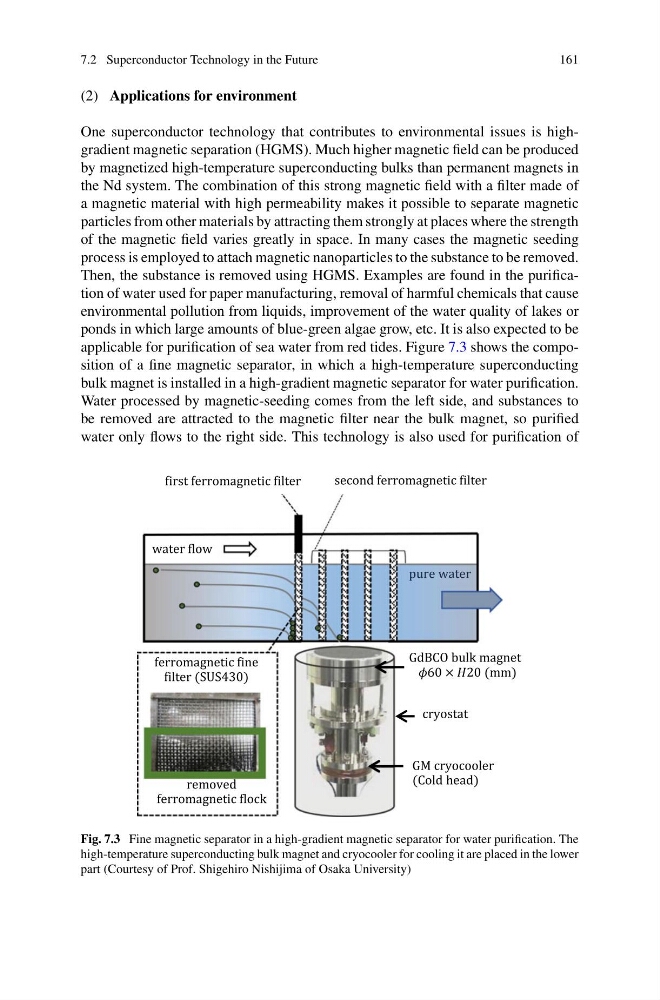
applicable for purification of sea water from red tides. Figure 7.3 shows the composition of a fine magnetic separator, in which a high-temperature superconducting
bulk magnet is installed in a high-gradient magnetic separator for water purification.
Water processed by magnetic-seeding comes from the left side, and substances to
be removed are attracted to the magnetic filter near the bulk magnet, so purified
water only flows to the right side. This technology is also used for purification of
Fig. 7.3 Fine magnetic separator in a high-gradient magnetic separator for water purification. The
high-temperature superconducting bulk magnet and cryocooler for cooling it are placed in the lower
part (Courtesy of Prof. Shigehiro Nishijima of Osaka University)
161
(2) Applications for environment
One superconductor technology that contributes to environmental issues is highgradient magnetic separation (HGMS). Much higher magnetic field can be produced
by magnetized high-temperature superconducting bulks than permanent magnets in
the Nd system. The combination of this strong magnetic field with a filter made of
a magnetic material with high permeability makes it possible to separate magnetic
particles from other materials by attracting them strongly at places where the strength
of the magnetic field varies greatly in space. In many cases the magnetic seeding
process is employed to attach magnetic nanoparticles to the substance to be removed.
Then, the substance is removed using HGMS. Examples are found in the purification of water used for paper manufacturing, removal of harmful chemicals that cause
environmental pollution from liquids, improvement of the water quality of lakes or
ponds in which large amounts of blue-green algae grow, etc. It is also expected to be
applicable for purification of sea water from red tides. Figure 7.3 shows the composition of a fine magnetic separator, in which a high-temperature superconducting
bulk magnet is installed in a high-gradient magnetic separator for water purification.
Water processed by magnetic-seeding comes from the left side, and substances to
be removed are attracted to the magnetic filter near the bulk magnet, so purified
water only flows to the right side. This technology is also used for purification of
Fig. 7.3 Fine magnetic separator in a high-gradient magnetic separator for water purification. The
high-temperature superconducting bulk magnet and cryocooler for cooling it are placed in the lower
part (Courtesy of Prof. Shigehiro Nishijima of Osaka University)