

160
7 Concluding Remarks
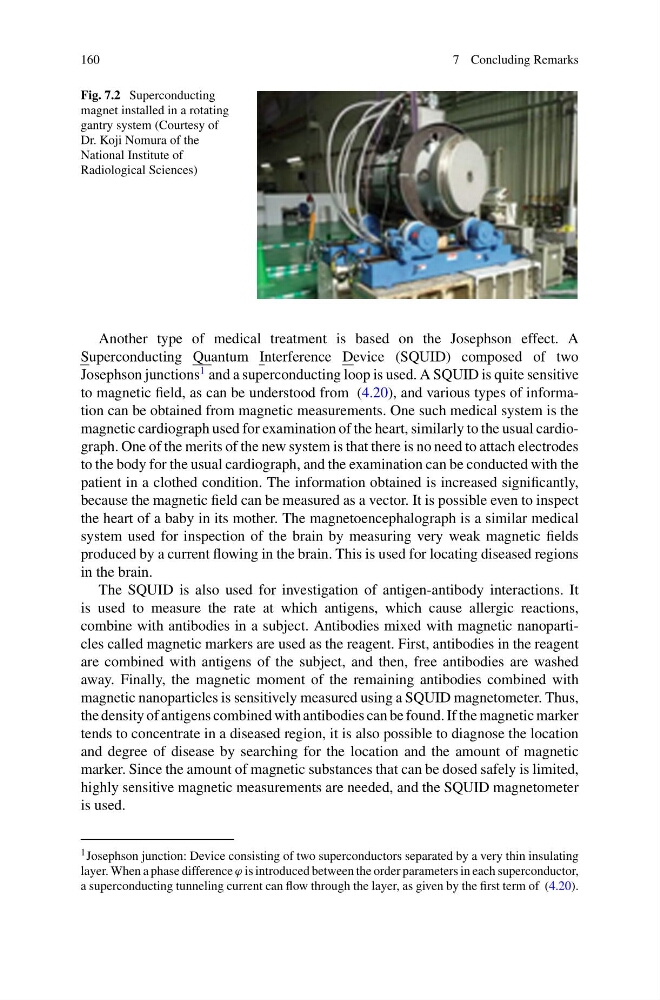
Fig. 7.2 Superconducting
magnet installed in a rotating
gantry system (Courtesy of
Dr. Koji Nomura of the
National Institute of
Radiological Sciences)
Another type of medical treatment is based on the Josephson effect. A
Superconducting Quantum Interference Device (SQUID) composed of two
Josephson junctions
1 and a superconducting loop is used. A SQUID is quite sensitive
to magnetic field, as can be understood from (4.20), and various types of information can be obtained from magnetic measurements. One such medical system is the
magnetic cardiograph used for examination of the heart, similarly to the usual cardiograph. One of the merits of the new system is that there is no need to attach electrodes
to the body for the usual cardiograph, and the examination can be conducted with the
patient in a clothed condition. The information obtained is increased significantly,
because the magnetic field can be measured as a vector. It is possible even to inspect
the heart of a baby in its mother. The magnetoencephalograph is a similar medical
system used for inspection of the brain by measuring very weak magnetic fields
produced by a current flowing in the brain. This is used for locating diseased regions
in the brain.
The SQUID is also used for investigation of antigen-antibody interactions. It
is used to measure the rate at which antigens, which cause allergic reactions,
combine with antibodies in a subject. Antibodies mixed with magnetic nanoparticles called magnetic markers are used as the reagent. First, antibodies in the reagent
are combined with antigens of the subject, and then, free antibodies are washed
away. Finally, the magnetic moment of the remaining antibodies combined with
magnetic nanoparticles is sensitively measured using a SQUID magnetometer. Thus,
the density of antigens combined with antibodies can be found. If the magnetic marker
tends to concentrate in a diseased region, it is also possible to diagnose the location
and degree of disease by searching for the location and the amount of magnetic
marker. Since the amount of magnetic substances that can be dosed safely is limited,
highly sensitive magnetic measurements are needed, and the SQUID magnetometer
is used.
1 Josephson junction: Device consisting of two superconductors separated by a very thin insulating
layer. When a phase difference ϕ is introduced between the order parameters in each superconductor,
a superconducting tunneling current can flow through the layer, as given by the first term of (4.20).
7 Concluding Remarks
Fig. 7.2 Superconducting
magnet installed in a rotating
gantry system (Courtesy of
Dr. Koji Nomura of the
National Institute of
Radiological Sciences)
Another type of medical treatment is based on the Josephson effect. A
Superconducting Quantum Interference Device (SQUID) composed of two
Josephson junctions
1 and a superconducting loop is used. A SQUID is quite sensitive
to magnetic field, as can be understood from (4.20), and various types of information can be obtained from magnetic measurements. One such medical system is the
magnetic cardiograph used for examination of the heart, similarly to the usual cardiograph. One of the merits of the new system is that there is no need to attach electrodes
to the body for the usual cardiograph, and the examination can be conducted with the
patient in a clothed condition. The information obtained is increased significantly,
because the magnetic field can be measured as a vector. It is possible even to inspect
the heart of a baby in its mother. The magnetoencephalograph is a similar medical
system used for inspection of the brain by measuring very weak magnetic fields
produced by a current flowing in the brain. This is used for locating diseased regions
in the brain.
The SQUID is also used for investigation of antigen-antibody interactions. It
is used to measure the rate at which antigens, which cause allergic reactions,
combine with antibodies in a subject. Antibodies mixed with magnetic nanoparticles called magnetic markers are used as the reagent. First, antibodies in the reagent
are combined with antigens of the subject, and then, free antibodies are washed
away. Finally, the magnetic moment of the remaining antibodies combined with
magnetic nanoparticles is sensitively measured using a SQUID magnetometer. Thus,
the density of antigens combined with antibodies can be found. If the magnetic marker
tends to concentrate in a diseased region, it is also possible to diagnose the location
and degree of disease by searching for the location and the amount of magnetic
marker. Since the amount of magnetic substances that can be dosed safely is limited,
highly sensitive magnetic measurements are needed, and the SQUID magnetometer
is used.
1 Josephson junction: Device consisting of two superconductors separated by a very thin insulating
layer. When a phase difference ϕ is introduced between the order parameters in each superconductor,
a superconducting tunneling current can flow through the layer, as given by the first term of (4.20).