

6.7 New Electromagnetism
151
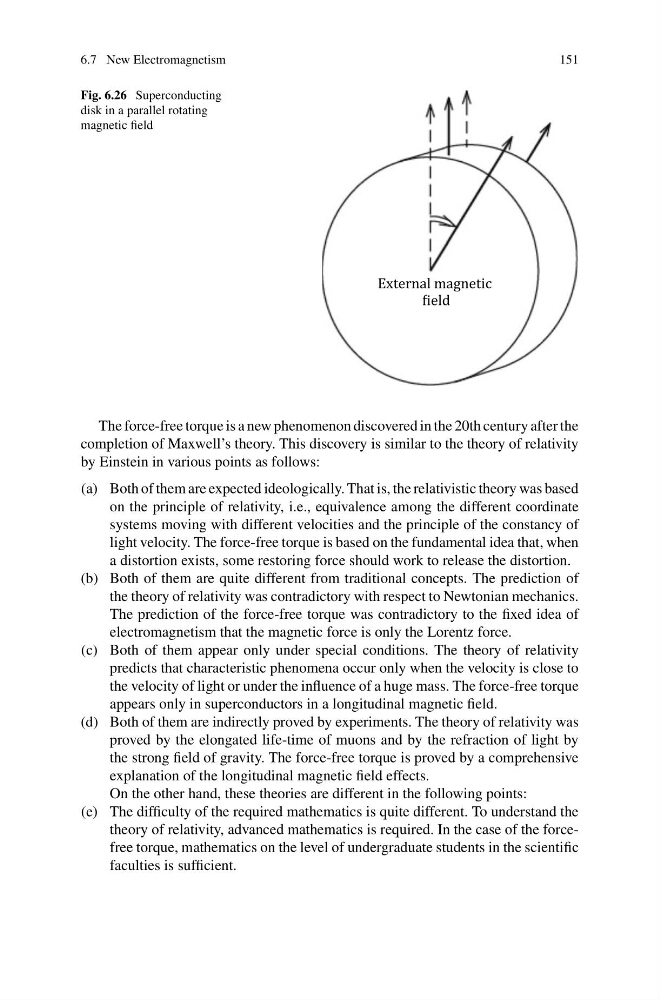
Fig. 6.26 Superconducting
disk in a parallel rotating
magnetic field
The force-free torque is a new phenomenon discovered in the 20th century after the
completion of Maxwell’s theory. This discovery is similar to the theory of relativity
by Einstein in various points as follows:
(a) Both of them are expected ideologically. That is, the relativistic theory was based
on the principle of relativity, i.e., equivalence among the different coordinate
systems moving with different velocities and the principle of the constancy of
light velocity. The force-free torque is based on the fundamental idea that, when
a distortion exists, some restoring force should work to release the distortion.
(b) Both of them are quite different from traditional concepts. The prediction of
the theory of relativity was contradictory with respect to Newtonian mechanics.
The prediction of the force-free torque was contradictory to the fixed idea of
electromagnetism that the magnetic force is only the Lorentz force.
(c) Both of them appear only under special conditions. The theory of relativity
predicts that characteristic phenomena occur only when the velocity is close to
the velocity of light or under the influence of a huge mass. The force-free torque
appears only in superconductors in a longitudinal magnetic field.
(d) Both of them are indirectly proved by experiments. The theory of relativity was
proved by the elongated life-time of muons and by the refraction of light by
the strong field of gravity. The force-free torque is proved by a comprehensive
explanation of the longitudinal magnetic field effects.
On the other hand, these theories are different in the following points:
(e) The difficulty of the required mathematics is quite different. To understand the
theory of relativity, advanced mathematics is required. In the case of the forcefree torque, mathematics on the level of undergraduate students in the scientific
faculties is sufficient.
151
Fig. 6.26 Superconducting
disk in a parallel rotating
magnetic field
The force-free torque is a new phenomenon discovered in the 20th century after the
completion of Maxwell’s theory. This discovery is similar to the theory of relativity
by Einstein in various points as follows:
(a) Both of them are expected ideologically. That is, the relativistic theory was based
on the principle of relativity, i.e., equivalence among the different coordinate
systems moving with different velocities and the principle of the constancy of
light velocity. The force-free torque is based on the fundamental idea that, when
a distortion exists, some restoring force should work to release the distortion.
(b) Both of them are quite different from traditional concepts. The prediction of
the theory of relativity was contradictory with respect to Newtonian mechanics.
The prediction of the force-free torque was contradictory to the fixed idea of
electromagnetism that the magnetic force is only the Lorentz force.
(c) Both of them appear only under special conditions. The theory of relativity
predicts that characteristic phenomena occur only when the velocity is close to
the velocity of light or under the influence of a huge mass. The force-free torque
appears only in superconductors in a longitudinal magnetic field.
(d) Both of them are indirectly proved by experiments. The theory of relativity was
proved by the elongated life-time of muons and by the refraction of light by
the strong field of gravity. The force-free torque is proved by a comprehensive
explanation of the longitudinal magnetic field effects.
On the other hand, these theories are different in the following points:
(e) The difficulty of the required mathematics is quite different. To understand the
theory of relativity, advanced mathematics is required. In the case of the forcefree torque, mathematics on the level of undergraduate students in the scientific
faculties is sufficient.