

150
6 Longitudinal Magnetic Field Effect
Force-free torque
The Lorentz force
(The Biot-Savart Law)
Maxwell’s theory
The Coulomb
force
Faraday’s law
Displacement
current
Ohm’s law
Critical state
theory (extended
model)
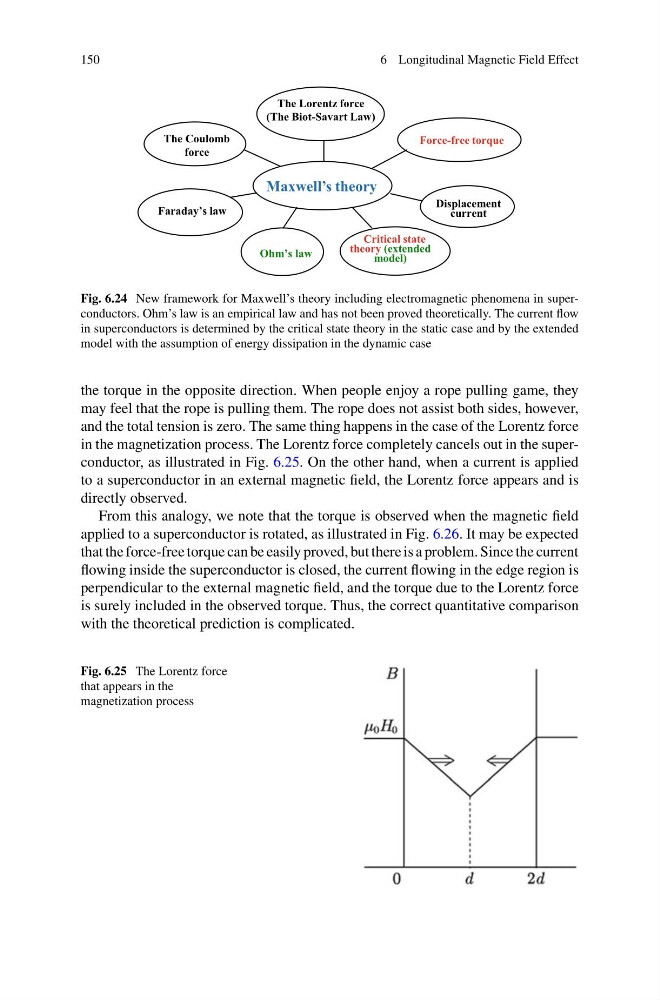
Fig. 6.24 New framework for Maxwell’s theory including electromagnetic phenomena in superconductors. Ohm’s law is an empirical law and has not been proved theoretically. The current flow
in superconductors is determined by the critical state theory in the static case and by the extended
model with the assumption of energy dissipation in the dynamic case
the torque in the opposite direction. When people enjoy a rope pulling game, they
may feel that the rope is pulling them. The rope does not assist both sides, however,
and the total tension is zero. The same thing happens in the case of the Lorentz force
in the magnetization process. The Lorentz force completely cancels out in the superconductor, as illustrated in Fig. 6.25. On the other hand, when a current is applied
to a superconductor in an external magnetic field, the Lorentz force appears and is
directly observed.
From this analogy, we note that the torque is observed when the magnetic field
applied to a superconductor is rotated, as illustrated in Fig. 6.26. It may be expected
that the force-free torque can be easily proved, but there is a problem. Since the current
flowing inside the superconductor is closed, the current flowing in the edge region is
perpendicular to the external magnetic field, and the torque due to the Lorentz force
is surely included in the observed torque. Thus, the correct quantitative comparison
with the theoretical prediction is complicated.
Fig. 6.25 The Lorentz force
that appears in the
magnetization process
6 Longitudinal Magnetic Field Effect
Force-free torque
The Lorentz force
(The Biot-Savart Law)
Maxwell’s theory
The Coulomb
force
Faraday’s law
Displacement
current
Ohm’s law
Critical state
theory (extended
model)
Fig. 6.24 New framework for Maxwell’s theory including electromagnetic phenomena in superconductors. Ohm’s law is an empirical law and has not been proved theoretically. The current flow
in superconductors is determined by the critical state theory in the static case and by the extended
model with the assumption of energy dissipation in the dynamic case
the torque in the opposite direction. When people enjoy a rope pulling game, they
may feel that the rope is pulling them. The rope does not assist both sides, however,
and the total tension is zero. The same thing happens in the case of the Lorentz force
in the magnetization process. The Lorentz force completely cancels out in the superconductor, as illustrated in Fig. 6.25. On the other hand, when a current is applied
to a superconductor in an external magnetic field, the Lorentz force appears and is
directly observed.
From this analogy, we note that the torque is observed when the magnetic field
applied to a superconductor is rotated, as illustrated in Fig. 6.26. It may be expected
that the force-free torque can be easily proved, but there is a problem. Since the current
flowing inside the superconductor is closed, the current flowing in the edge region is
perpendicular to the external magnetic field, and the torque due to the Lorentz force
is surely included in the observed torque. Thus, the correct quantitative comparison
with the theoretical prediction is complicated.
Fig. 6.25 The Lorentz force
that appears in the
magnetization process