

6.6 Comparison with Electromagnetic Phenomena in the Transverse Magnetic Field
147
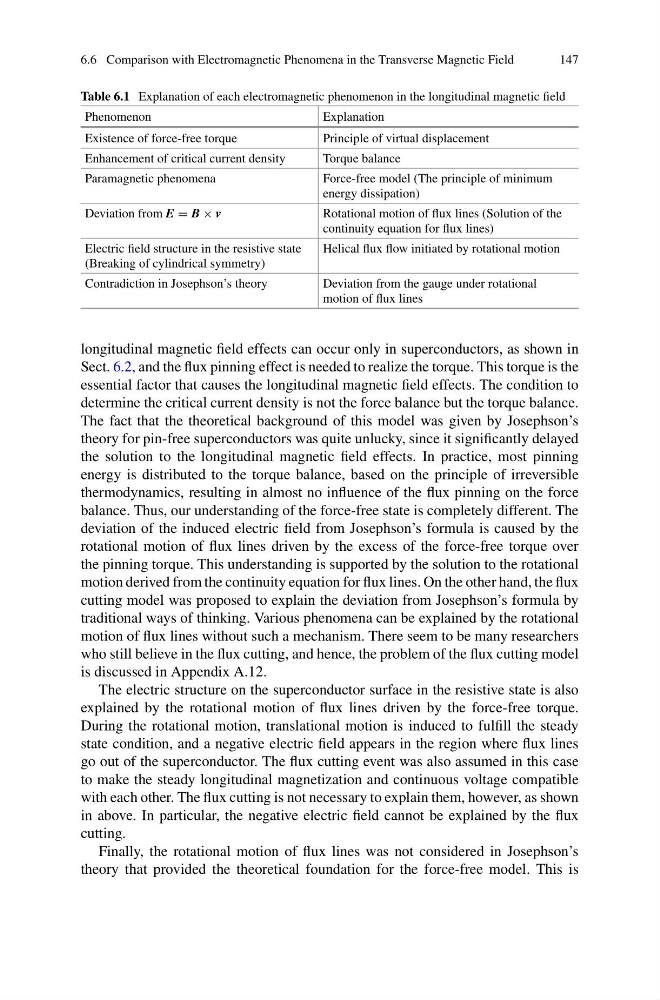
Table 6.1 Explanation of each electromagnetic phenomenon in the longitudinal magnetic field
Phenomenon
Explanation
Existence of force-free torque
Principle of virtual displacement
Enhancement of critical current density
Torque balance
Paramagnetic phenomena
Force-free model (The principle of minimum
energy dissipation)
Deviation from E = B × v
Rotational motion of flux lines (Solution of the
continuity equation for flux lines)
Electric field structure in the resistive state
(Breaking of cylindrical symmetry)
Helical flux flow initiated by rotational motion
Contradiction in Josephson’s theory
Deviation from the gauge under rotational
motion of flux lines
longitudinal magnetic field effects can occur only in superconductors, as shown in
Sect. 6.2, and the flux pinning effect is needed to realize the torque. This torque is the
essential factor that causes the longitudinal magnetic field effects. The condition to
determine the critical current density is not the force balance but the torque balance.
The fact that the theoretical background of this model was given by Josephson’s
theory for pin-free superconductors was quite unlucky, since it significantly delayed
the solution to the longitudinal magnetic field effects. In practice, most pinning
energy is distributed to the torque balance, based on the principle of irreversible
thermodynamics, resulting in almost no influence of the flux pinning on the force
balance. Thus, our understanding of the force-free state is completely different. The
deviation of the induced electric field from Josephson’s formula is caused by the
rotational motion of flux lines driven by the excess of the force-free torque over
the pinning torque. This understanding is supported by the solution to the rotational
motion derived from the continuity equation for flux lines. On the other hand, the flux
cutting model was proposed to explain the deviation from Josephson’s formula by
traditional ways of thinking. Various phenomena can be explained by the rotational
motion of flux lines without such a mechanism. There seem to be many researchers
who still believe in the flux cutting, and hence, the problem of the flux cutting model
is discussed in Appendix A.12.
The electric structure on the superconductor surface in the resistive state is also
explained by the rotational motion of flux lines driven by the force-free torque.
During the rotational motion, translational motion is induced to fulfill the steady
state condition, and a negative electric field appears in the region where flux lines
go out of the superconductor. The flux cutting event was also assumed in this case
to make the steady longitudinal magnetization and continuous voltage compatible
with each other. The flux cutting is not necessary to explain them, however, as shown
in above. In particular, the negative electric field cannot be explained by the flux
cutting.
Finally, the rotational motion of flux lines was not considered in Josephson’s
theory that provided the theoretical foundation for the force-free model. This is
147
Table 6.1 Explanation of each electromagnetic phenomenon in the longitudinal magnetic field
Phenomenon
Explanation
Existence of force-free torque
Principle of virtual displacement
Enhancement of critical current density
Torque balance
Paramagnetic phenomena
Force-free model (The principle of minimum
energy dissipation)
Deviation from E = B × v
Rotational motion of flux lines (Solution of the
continuity equation for flux lines)
Electric field structure in the resistive state
(Breaking of cylindrical symmetry)
Helical flux flow initiated by rotational motion
Contradiction in Josephson’s theory
Deviation from the gauge under rotational
motion of flux lines
longitudinal magnetic field effects can occur only in superconductors, as shown in
Sect. 6.2, and the flux pinning effect is needed to realize the torque. This torque is the
essential factor that causes the longitudinal magnetic field effects. The condition to
determine the critical current density is not the force balance but the torque balance.
The fact that the theoretical background of this model was given by Josephson’s
theory for pin-free superconductors was quite unlucky, since it significantly delayed
the solution to the longitudinal magnetic field effects. In practice, most pinning
energy is distributed to the torque balance, based on the principle of irreversible
thermodynamics, resulting in almost no influence of the flux pinning on the force
balance. Thus, our understanding of the force-free state is completely different. The
deviation of the induced electric field from Josephson’s formula is caused by the
rotational motion of flux lines driven by the excess of the force-free torque over
the pinning torque. This understanding is supported by the solution to the rotational
motion derived from the continuity equation for flux lines. On the other hand, the flux
cutting model was proposed to explain the deviation from Josephson’s formula by
traditional ways of thinking. Various phenomena can be explained by the rotational
motion of flux lines without such a mechanism. There seem to be many researchers
who still believe in the flux cutting, and hence, the problem of the flux cutting model
is discussed in Appendix A.12.
The electric structure on the superconductor surface in the resistive state is also
explained by the rotational motion of flux lines driven by the force-free torque.
During the rotational motion, translational motion is induced to fulfill the steady
state condition, and a negative electric field appears in the region where flux lines
go out of the superconductor. The flux cutting event was also assumed in this case
to make the steady longitudinal magnetization and continuous voltage compatible
with each other. The flux cutting is not necessary to explain them, however, as shown
in above. In particular, the negative electric field cannot be explained by the flux
cutting.
Finally, the rotational motion of flux lines was not considered in Josephson’s
theory that provided the theoretical foundation for the force-free model. This is