

6.4 Electromagnetic Phenomena Caused by Rotation of Flux Lines
133
6.4 Electromagnetic Phenomena Caused by Rotation
of Flux Lines
The flux pinning interactions determine the critical current density, as discussed
above. This is supported by the experimental result that observed electromagnetic
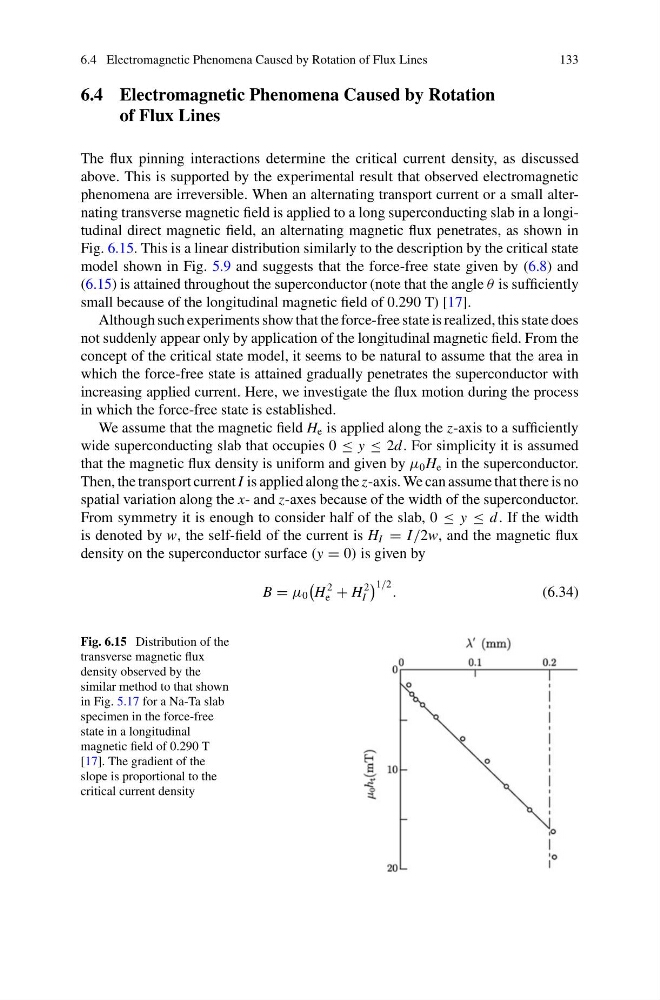
phenomena are irreversible. When an alternating transport current or a small alternating transverse magnetic field is applied to a long superconducting slab in a longitudinal direct magnetic field, an alternating magnetic flux penetrates, as shown in
Fig. 6.15. This is a linear distribution similarly to the description by the critical state
model shown in Fig. 5.9 and suggests that the force-free state given by (6.8) and
(6.15) is attained throughout the superconductor (note that the angle θ is sufficiently
small because of the longitudinal magnetic field of 0.290 T) [17].
Although such experiments show that the force-free state is realized, this state does
not suddenly appear only by application of the longitudinal magnetic field. From the
concept of the critical state model, it seems to be natural to assume that the area in
which the force-free state is attained gradually penetrates the superconductor with
increasing applied current. Here, we investigate the flux motion during the process
in which the force-free state is established.
We assume that the magnetic field H e is applied along the z-axis to a sufficiently
wide superconducting slab that occupies 0 ≤ y ≤ 2d . For simplicity it is assumed
that the magnetic flux density is uniform and given by μ 0 H e in the superconductor.
Then, the transport current I is applied along the z-axis. We can assume that there is no
spatial variation along the x- and z-axes because of the width of the superconductor.
From symmetry it is enough to consider half of the slab, 0 ≤ y ≤ d . If the width
is denoted by w, the self-field of the current is H I = I /2w, and the magnetic flux
density on the superconductor surface (y = 0) is given by
B = μ 0
H
2
e + H
2
I
1/2 .
(6.34)
Fig. 6.15 Distribution of the
transverse magnetic flux
density observed by the
similar method to that shown
in Fig. 5.17 for a Na-Ta slab
specimen in the force-free
state in a longitudinal
magnetic field of 0.290 T
[17]. The gradient of the
slope is proportional to the
critical current density
133
6.4 Electromagnetic Phenomena Caused by Rotation
of Flux Lines
The flux pinning interactions determine the critical current density, as discussed
above. This is supported by the experimental result that observed electromagnetic
phenomena are irreversible. When an alternating transport current or a small alternating transverse magnetic field is applied to a long superconducting slab in a longitudinal direct magnetic field, an alternating magnetic flux penetrates, as shown in
Fig. 6.15. This is a linear distribution similarly to the description by the critical state
model shown in Fig. 5.9 and suggests that the force-free state given by (6.8) and
(6.15) is attained throughout the superconductor (note that the angle θ is sufficiently
small because of the longitudinal magnetic field of 0.290 T) [17].
Although such experiments show that the force-free state is realized, this state does
not suddenly appear only by application of the longitudinal magnetic field. From the
concept of the critical state model, it seems to be natural to assume that the area in
which the force-free state is attained gradually penetrates the superconductor with
increasing applied current. Here, we investigate the flux motion during the process
in which the force-free state is established.
We assume that the magnetic field H e is applied along the z-axis to a sufficiently
wide superconducting slab that occupies 0 ≤ y ≤ 2d . For simplicity it is assumed
that the magnetic flux density is uniform and given by μ 0 H e in the superconductor.
Then, the transport current I is applied along the z-axis. We can assume that there is no
spatial variation along the x- and z-axes because of the width of the superconductor.
From symmetry it is enough to consider half of the slab, 0 ≤ y ≤ d . If the width
is denoted by w, the self-field of the current is H I = I /2w, and the magnetic flux
density on the superconductor surface (y = 0) is given by
B = μ 0
H
2
e + H
2
I
1/2 .
(6.34)
Fig. 6.15 Distribution of the
transverse magnetic flux
density observed by the
similar method to that shown
in Fig. 5.17 for a Na-Ta slab
specimen in the force-free
state in a longitudinal
magnetic field of 0.290 T
[17]. The gradient of the
slope is proportional to the
critical current density