

132
6 Longitudinal Magnetic Field Effect
Note the fact that the magnetic torque appears in spite of the lack of any magnetic
force, i.e., the Lorentz force. Such a situation cannot be found in dynamics, in which
the torque is a moment of a force. Namely, no torque exists, if there is no force. The
force-free torque density is independent of the size of the superconductor, whereas the
mechanical torque density becomes large as the distorted body becomes large. This
is because the relative displacement becomes large between two points in adjacent
planes as the distance from the rotation center becomes large. This is essentially
different from the correspondence between the electromagnetic phenomena in the
transverse magnetic field and mechanical phenomena in dynamics. This will be
discussed in more detail in Sect. 6.6.
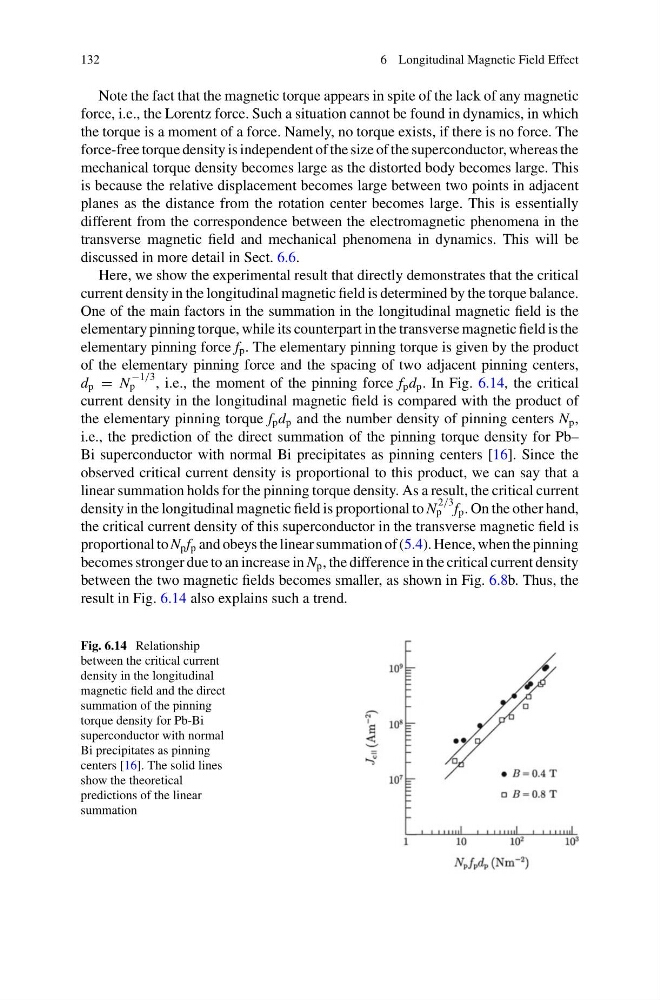
Here, we show the experimental result that directly demonstrates that the critical
current density in the longitudinal magnetic field is determined by the torque balance.
One of the main factors in the summation in the longitudinal magnetic field is the
elementary pinning torque, while its counterpart in the transverse magnetic field is the
elementary pinning force f p . The elementary pinning torque is given by the product
of the elementary pinning force and the spacing of two adjacent pinning centers,
d p = N
−1/3
p
, i.e., the moment of the pinning force f p d p . In Fig. 6.14, the critical
current density in the longitudinal magnetic field is compared with the product of
the elementary pinning torque f p d p and the number density of pinning centers N p ,
i.e., the prediction of the direct summation of the pinning torque density for Pb–
Bi superconductor with normal Bi precipitates as pinning centers [16]. Since the
observed critical current density is proportional to this product, we can say that a
linear summation holds for the pinning torque density. As a result, the critical current
density in the longitudinal magnetic field is proportional to N
2/3
p f p . On the other hand,
the critical current density of this superconductor in the transverse magnetic field is
proportional to N p f p and obeys the linear summation of (5.4). Hence, when the pinning
becomes stronger due to an increase in N p , the difference in the critical current density
between the two magnetic fields becomes smaller, as shown in Fig. 6.8b. Thus, the
result in Fig. 6.14 also explains such a trend.
Fig. 6.14 Relationship
between the critical current
density in the longitudinal
magnetic field and the direct
summation of the pinning
torque density for Pb-Bi
superconductor with normal
Bi precipitates as pinning
centers [16]. The solid lines
show the theoretical
predictions of the linear
summation
6 Longitudinal Magnetic Field Effect
Note the fact that the magnetic torque appears in spite of the lack of any magnetic
force, i.e., the Lorentz force. Such a situation cannot be found in dynamics, in which
the torque is a moment of a force. Namely, no torque exists, if there is no force. The
force-free torque density is independent of the size of the superconductor, whereas the
mechanical torque density becomes large as the distorted body becomes large. This
is because the relative displacement becomes large between two points in adjacent
planes as the distance from the rotation center becomes large. This is essentially
different from the correspondence between the electromagnetic phenomena in the
transverse magnetic field and mechanical phenomena in dynamics. This will be
discussed in more detail in Sect. 6.6.
Here, we show the experimental result that directly demonstrates that the critical
current density in the longitudinal magnetic field is determined by the torque balance.
One of the main factors in the summation in the longitudinal magnetic field is the
elementary pinning torque, while its counterpart in the transverse magnetic field is the
elementary pinning force f p . The elementary pinning torque is given by the product
of the elementary pinning force and the spacing of two adjacent pinning centers,
d p = N
−1/3
p
, i.e., the moment of the pinning force f p d p . In Fig. 6.14, the critical
current density in the longitudinal magnetic field is compared with the product of
the elementary pinning torque f p d p and the number density of pinning centers N p ,
i.e., the prediction of the direct summation of the pinning torque density for Pb–
Bi superconductor with normal Bi precipitates as pinning centers [16]. Since the
observed critical current density is proportional to this product, we can say that a
linear summation holds for the pinning torque density. As a result, the critical current
density in the longitudinal magnetic field is proportional to N
2/3
p f p . On the other hand,
the critical current density of this superconductor in the transverse magnetic field is
proportional to N p f p and obeys the linear summation of (5.4). Hence, when the pinning
becomes stronger due to an increase in N p , the difference in the critical current density
between the two magnetic fields becomes smaller, as shown in Fig. 6.8b. Thus, the
result in Fig. 6.14 also explains such a trend.
Fig. 6.14 Relationship
between the critical current
density in the longitudinal
magnetic field and the direct
summation of the pinning
torque density for Pb-Bi
superconductor with normal
Bi precipitates as pinning
centers [16]. The solid lines
show the theoretical
predictions of the linear
summation