

6.1 Experimental Results
119
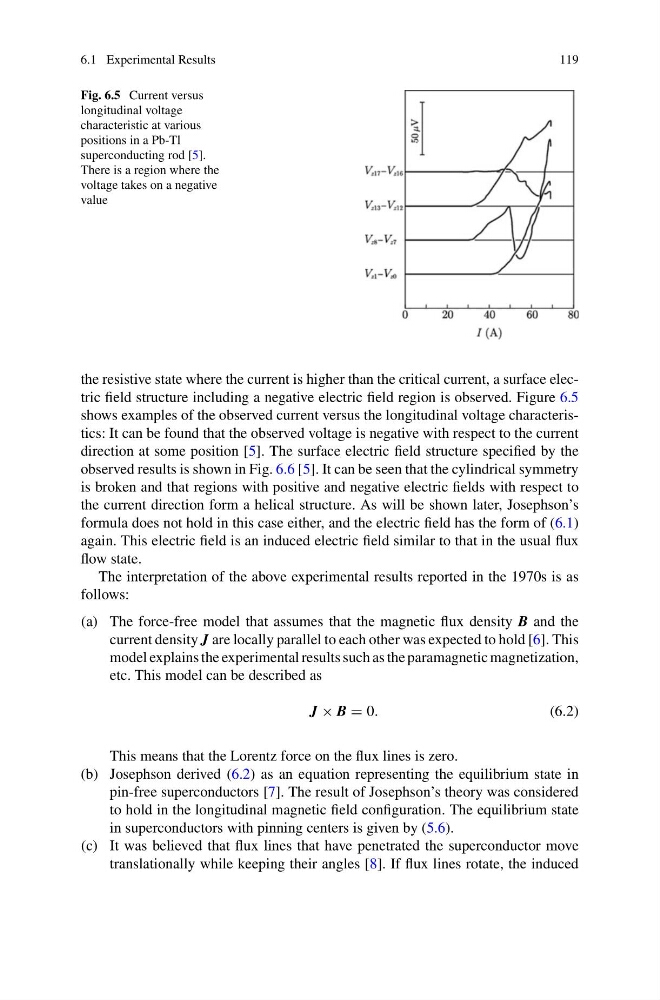
Fig. 6.5 Current versus
longitudinal voltage
characteristic at various
positions in a Pb-Tl
superconducting rod [5].
There is a region where the
voltage takes on a negative
value
the resistive state where the current is higher than the critical current, a surface electric field structure including a negative electric field region is observed. Figure 6.5
shows examples of the observed current versus the longitudinal voltage characteristics: It can be found that the observed voltage is negative with respect to the current
direction at some position [5]. The surface electric field structure specified by the
observed results is shown in Fig. 6.6 [5]. It can be seen that the cylindrical symmetry
is broken and that regions with positive and negative electric fields with respect to
the current direction form a helical structure. As will be shown later, Josephson’s
formula does not hold in this case either, and the electric field has the form of (6.1)
again. This electric field is an induced electric field similar to that in the usual flux
flow state.
The interpretation of the above experimental results reported in the 1970s is as
follows:
(a) The force-free model that assumes that the magnetic flux density B and the
current density J are locally parallel to each other was expected to hold [6]. This
model explains the experimental results such as the paramagnetic magnetization,
etc. This model can be described as
J × B = 0.
(6.2)
This means that the Lorentz force on the flux lines is zero.
(b) Josephson derived (6.2) as an equation representing the equilibrium state in
pin-free superconductors [7]. The result of Josephson’s theory was considered
to hold in the longitudinal magnetic field configuration. The equilibrium state
in superconductors with pinning centers is given by (5.6).
(c) It was believed that flux lines that have penetrated the superconductor move
translationally while keeping their angles [8]. If flux lines rotate, the induced
119
Fig. 6.5 Current versus
longitudinal voltage
characteristic at various
positions in a Pb-Tl
superconducting rod [5].
There is a region where the
voltage takes on a negative
value
the resistive state where the current is higher than the critical current, a surface electric field structure including a negative electric field region is observed. Figure 6.5
shows examples of the observed current versus the longitudinal voltage characteristics: It can be found that the observed voltage is negative with respect to the current
direction at some position [5]. The surface electric field structure specified by the
observed results is shown in Fig. 6.6 [5]. It can be seen that the cylindrical symmetry
is broken and that regions with positive and negative electric fields with respect to
the current direction form a helical structure. As will be shown later, Josephson’s
formula does not hold in this case either, and the electric field has the form of (6.1)
again. This electric field is an induced electric field similar to that in the usual flux
flow state.
The interpretation of the above experimental results reported in the 1970s is as
follows:
(a) The force-free model that assumes that the magnetic flux density B and the
current density J are locally parallel to each other was expected to hold [6]. This
model explains the experimental results such as the paramagnetic magnetization,
etc. This model can be described as
J × B = 0.
(6.2)
This means that the Lorentz force on the flux lines is zero.
(b) Josephson derived (6.2) as an equation representing the equilibrium state in
pin-free superconductors [7]. The result of Josephson’s theory was considered
to hold in the longitudinal magnetic field configuration. The equilibrium state
in superconductors with pinning centers is given by (5.6).
(c) It was believed that flux lines that have penetrated the superconductor move
translationally while keeping their angles [8]. If flux lines rotate, the induced