

6.1 Experimental Results
117
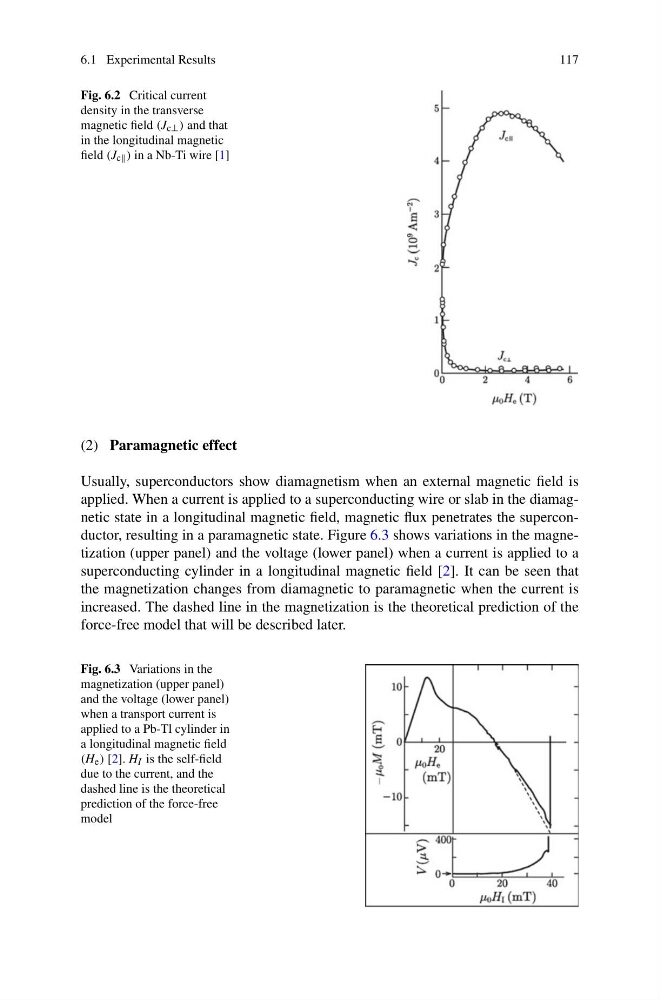
Fig. 6.2 Critical current
density in the transverse
magnetic field (J c⊥ ) and that
in the longitudinal magnetic
field (J c ) in a Nb-Ti wire [1]
(2) Paramagnetic effect
Usually, superconductors show diamagnetism when an external magnetic field is
applied. When a current is applied to a superconducting wire or slab in the diamagnetic state in a longitudinal magnetic field, magnetic flux penetrates the superconductor, resulting in a paramagnetic state. Figure 6.3 shows variations in the magnetization (upper panel) and the voltage (lower panel) when a current is applied to a
superconducting cylinder in a longitudinal magnetic field [2]. It can be seen that
the magnetization changes from diamagnetic to paramagnetic when the current is
increased. The dashed line in the magnetization is the theoretical prediction of the
force-free model that will be described later.
Fig. 6.3 Variations in the
magnetization (upper panel)
and the voltage (lower panel)
when a transport current is
applied to a Pb-Tl cylinder in
a longitudinal magnetic field
(H e ) [2]. H I is the self-field
due to the current, and the
dashed line is the theoretical
prediction of the force-free
model
117
Fig. 6.2 Critical current
density in the transverse
magnetic field (J c⊥ ) and that
in the longitudinal magnetic
field (J c ) in a Nb-Ti wire [1]
(2) Paramagnetic effect
Usually, superconductors show diamagnetism when an external magnetic field is
applied. When a current is applied to a superconducting wire or slab in the diamagnetic state in a longitudinal magnetic field, magnetic flux penetrates the superconductor, resulting in a paramagnetic state. Figure 6.3 shows variations in the magnetization (upper panel) and the voltage (lower panel) when a current is applied to a
superconducting cylinder in a longitudinal magnetic field [2]. It can be seen that
the magnetization changes from diamagnetic to paramagnetic when the current is
increased. The dashed line in the magnetization is the theoretical prediction of the
force-free model that will be described later.
Fig. 6.3 Variations in the
magnetization (upper panel)
and the voltage (lower panel)
when a transport current is
applied to a Pb-Tl cylinder in
a longitudinal magnetic field
(H e ) [2]. H I is the self-field
due to the current, and the
dashed line is the theoretical
prediction of the force-free
model