

116
6 Longitudinal Magnetic Field Effect
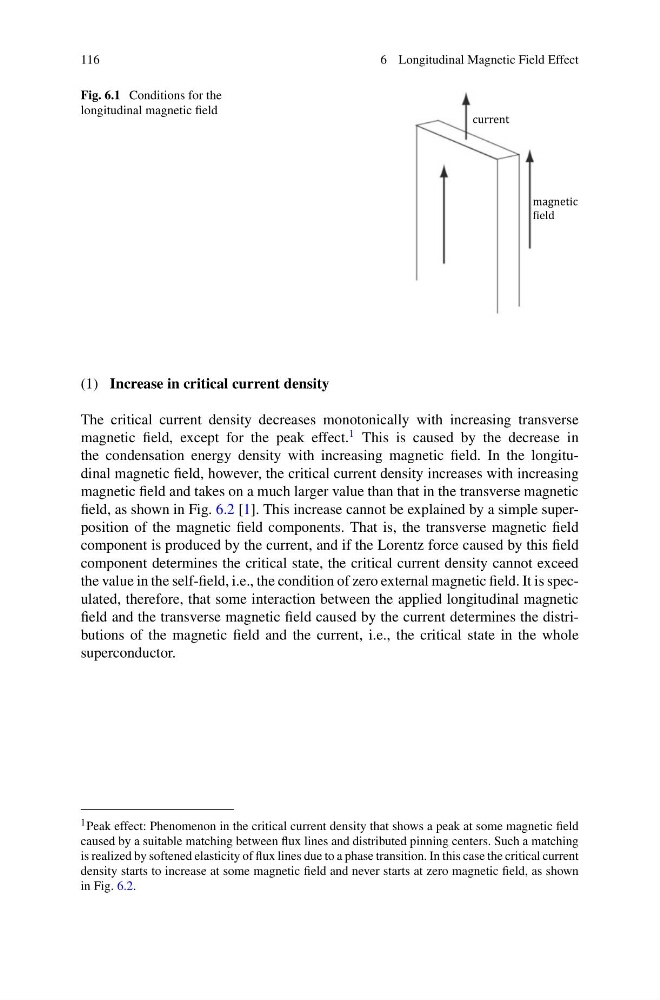
Fig. 6.1 Conditions for the
longitudinal magnetic field
(1) Increase in critical current density
The critical current density decreases monotonically with increasing transverse
magnetic field, except for the peak effect.
1 This is caused by the decrease in
the condensation energy density with increasing magnetic field. In the longitudinal magnetic field, however, the critical current density increases with increasing
magnetic field and takes on a much larger value than that in the transverse magnetic
field, as shown in Fig. 6.2 [1]. This increase cannot be explained by a simple superposition of the magnetic field components. That is, the transverse magnetic field
component is produced by the current, and if the Lorentz force caused by this field
component determines the critical state, the critical current density cannot exceed
the value in the self-field, i.e., the condition of zero external magnetic field. It is speculated, therefore, that some interaction between the applied longitudinal magnetic
field and the transverse magnetic field caused by the current determines the distributions of the magnetic field and the current, i.e., the critical state in the whole
superconductor.
1 Peak effect: Phenomenon in the critical current density that shows a peak at some magnetic field
caused by a suitable matching between flux lines and distributed pinning centers. Such a matching
is realized by softened elasticity of flux lines due to a phase transition. In this case the critical current
density starts to increase at some magnetic field and never starts at zero magnetic field, as shown
in Fig. 6.2.
6 Longitudinal Magnetic Field Effect
Fig. 6.1 Conditions for the
longitudinal magnetic field
(1) Increase in critical current density
The critical current density decreases monotonically with increasing transverse
magnetic field, except for the peak effect.
1 This is caused by the decrease in
the condensation energy density with increasing magnetic field. In the longitudinal magnetic field, however, the critical current density increases with increasing
magnetic field and takes on a much larger value than that in the transverse magnetic
field, as shown in Fig. 6.2 [1]. This increase cannot be explained by a simple superposition of the magnetic field components. That is, the transverse magnetic field
component is produced by the current, and if the Lorentz force caused by this field
component determines the critical state, the critical current density cannot exceed
the value in the self-field, i.e., the condition of zero external magnetic field. It is speculated, therefore, that some interaction between the applied longitudinal magnetic
field and the transverse magnetic field caused by the current determines the distributions of the magnetic field and the current, i.e., the critical state in the whole
superconductor.
1 Peak effect: Phenomenon in the critical current density that shows a peak at some magnetic field
caused by a suitable matching between flux lines and distributed pinning centers. Such a matching
is realized by softened elasticity of flux lines due to a phase transition. In this case the critical current
density starts to increase at some magnetic field and never starts at zero magnetic field, as shown
in Fig. 6.2.