

112
5 Flux Pinning Phenomena
however, since this process essentially contains the problem of the breaking of time
reversal symmetry.
Coffee break (5)
Principle of minimum energy dissipation
It is assumed in the critical state model that the flux pinning interaction minimizes the
change in the magnetic flux distribution caused by a change in the external magnetic
field, etc. Here, we discuss the relationship between this assumption and the principle
of minimum energy dissipation in irreversible thermodynamics. Assume that the
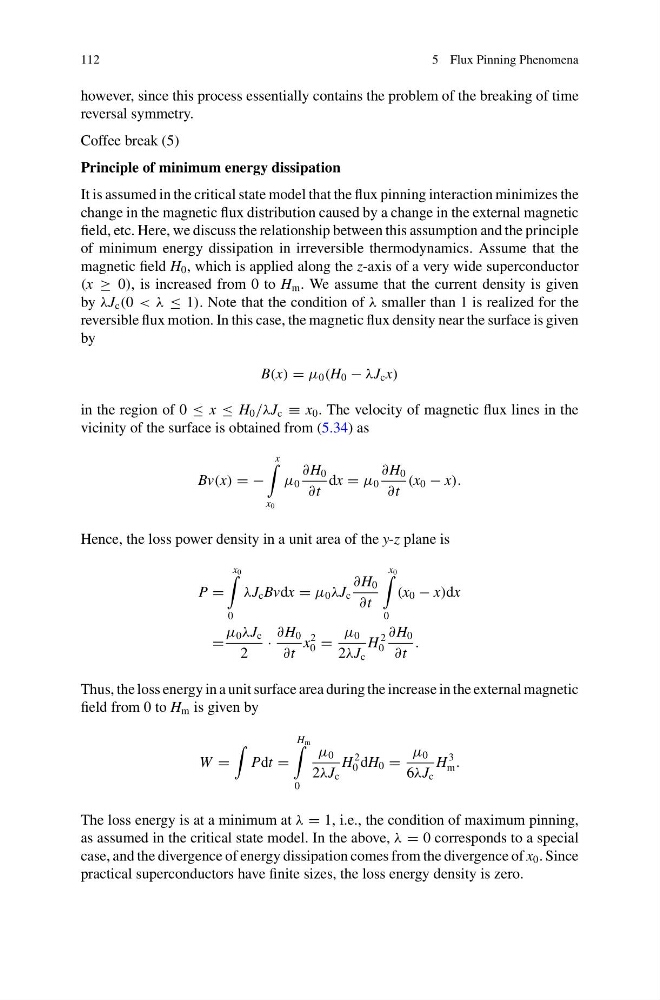
magnetic field H 0 , which is applied along the z-axis of a very wide superconductor
(x ≥ 0), is increased from 0 to H m . We assume that the current density is given
by λJ c (0 < λ ≤ 1). Note that the condition of λ smaller than 1 is realized for the
reversible flux motion. In this case, the magnetic flux density near the surface is given
by
B(x) = μ 0 (H 0 − λJ c x)
in the region of 0 ≤ x ≤ H 0 /λJ c ≡ x 0 . The velocity of magnetic flux lines in the
vicinity of the surface is obtained from (5.34) as
Bv(x) = −
x
x 0
μ 0
∂H 0
∂t
dx = μ 0
∂H 0
∂t
(x 0 − x).
Hence, the loss power density in a unit area of the y-z plane is
P =
x 0
0
λJ c Bvdx = μ 0 λJ c
∂H 0
∂t
x 0
0
(x 0 − x)dx
=
μ 0 λJ c
2
·
∂H 0
∂t
x
2
0 =
μ 0
2λJ c
H
2
0
∂H 0
∂t
.
Thus, the loss energy in a unit surface area during the increase in the external magnetic
field from 0 to H m is given by
W =
Pdt =
H m
0
μ 0
2λJ c
H
2
0 dH 0 =
μ 0
6λJ c
H
3
m .
The loss energy is at a minimum at λ = 1, i.e., the condition of maximum pinning,
as assumed in the critical state model. In the above, λ = 0 corresponds to a special
case, and the divergence of energy dissipation comes from the divergence of x 0 . Since
practical superconductors have finite sizes, the loss energy density is zero.
5 Flux Pinning Phenomena
however, since this process essentially contains the problem of the breaking of time
reversal symmetry.
Coffee break (5)
Principle of minimum energy dissipation
It is assumed in the critical state model that the flux pinning interaction minimizes the
change in the magnetic flux distribution caused by a change in the external magnetic
field, etc. Here, we discuss the relationship between this assumption and the principle
of minimum energy dissipation in irreversible thermodynamics. Assume that the
magnetic field H 0 , which is applied along the z-axis of a very wide superconductor
(x ≥ 0), is increased from 0 to H m . We assume that the current density is given
by λJ c (0 < λ ≤ 1). Note that the condition of λ smaller than 1 is realized for the
reversible flux motion. In this case, the magnetic flux density near the surface is given
by
B(x) = μ 0 (H 0 − λJ c x)
in the region of 0 ≤ x ≤ H 0 /λJ c ≡ x 0 . The velocity of magnetic flux lines in the
vicinity of the surface is obtained from (5.34) as
Bv(x) = −
x
x 0
μ 0
∂H 0
∂t
dx = μ 0
∂H 0
∂t
(x 0 − x).
Hence, the loss power density in a unit area of the y-z plane is
P =
x 0
0
λJ c Bvdx = μ 0 λJ c
∂H 0
∂t
x 0
0
(x 0 − x)dx
=
μ 0 λJ c
2
·
∂H 0
∂t
x
2
0 =
μ 0
2λJ c
H
2
0
∂H 0
∂t
.
Thus, the loss energy in a unit surface area during the increase in the external magnetic
field from 0 to H m is given by
W =
Pdt =
H m
0
μ 0
2λJ c
H
2
0 dH 0 =
μ 0
6λJ c
H
3
m .
The loss energy is at a minimum at λ = 1, i.e., the condition of maximum pinning,
as assumed in the critical state model. In the above, λ = 0 corresponds to a special
case, and the divergence of energy dissipation comes from the divergence of x 0 . Since
practical superconductors have finite sizes, the loss energy density is zero.