

5.7 Critical State Theory
111
in the equation of motion before and after the instability. When flux lines move even
slightly along the positive direction from the position at x = −(3a f /4) in Fig. 5.25,
these flux lines move discontinuously to x = x 0 in the pinning potential. After that,
even if the flux lines move in the opposite direction, they must go back continuously
until they reach x = −a f /4. That is, the situation is different from that before the
instability. It is also shown that the first law of thermodynamics is not satisfied, if
there is no energy dissipation. For the two kinds of irreversibility, refer to Appendix
A.9.
Here, we consider the irreversibility in superconductors microscopically. The
derivation of irreversibility is difficult, for example, for the motion of molecules,
because of the time reversal symmetry of the equation of motion. On the other
hand, the mechanism of the irreversibility is different in superconductors. Whereas
molecules move freely in various directions, atoms, including those in defects that
can pin flux lines, which are responsible for energy dissipation, are restrained and
thermally vibrating around their equilibrium positions in a solid superconductor.
When a current is applied to the superconductor in a magnetic field, the Lorentz force
acts on it. It is assumed that the superconductor is fixed, so as not to move under the
Lorentz force. Each atom around the defects is slightly displaced by the flux pinning
interaction. In fact, distortion can be observed in superconductors, when the Lorentz
force is present. In the condition where voltage appears, the Lorentz force causes
motion of the flux lines. When flux lines are depinned, the atoms around defects that
have pinned flux lines become free and start to oscillate. That is, the atoms acquire
energy through interaction with flux lines from the source that supplies the current. As
discussed in the summation theory, pinning centers are distributed randomly without
any correlation with non-distorted lattice points (() with long-range order. Each flux
line is depinned when it reaches = δ(x = −3a f /4) and the corresponding time t 0
is also random among the depinned flux lines for the above reason. If we denote the
amplitude and angular frequency of oscillation of each atom by A and ω, respectively,
the moment of each atom of weight m is represented as Amωcos[ω(t − t 0 )]. Hence,
if n is the number of atoms that oscillate around one pinning center, the moment that
the superconductor of unit volume acquires during one cycle is given by
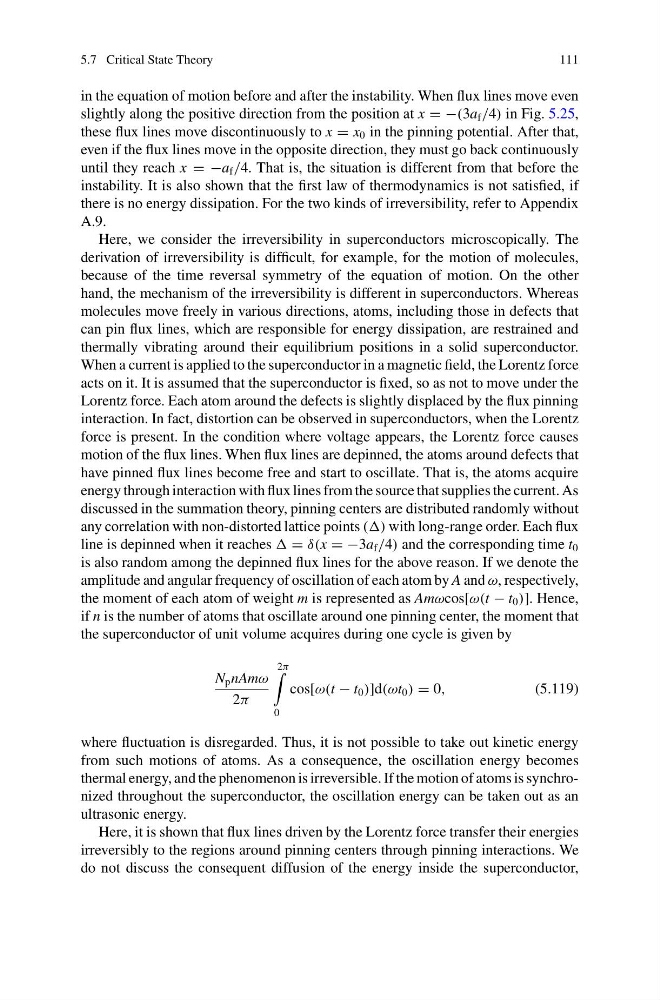
N p nAmω
2π
2π
0
cos[ω(t − t 0 )]d(ωt 0 ) = 0,
(5.119)
where fluctuation is disregarded. Thus, it is not possible to take out kinetic energy
from such motions of atoms. As a consequence, the oscillation energy becomes
thermal energy, and the phenomenon is irreversible. If the motion of atoms is synchronized throughout the superconductor, the oscillation energy can be taken out as an
ultrasonic energy.
Here, it is shown that flux lines driven by the Lorentz force transfer their energies
irreversibly to the regions around pinning centers through pinning interactions. We
do not discuss the consequent diffusion of the energy inside the superconductor,
111
in the equation of motion before and after the instability. When flux lines move even
slightly along the positive direction from the position at x = −(3a f /4) in Fig. 5.25,
these flux lines move discontinuously to x = x 0 in the pinning potential. After that,
even if the flux lines move in the opposite direction, they must go back continuously
until they reach x = −a f /4. That is, the situation is different from that before the
instability. It is also shown that the first law of thermodynamics is not satisfied, if
there is no energy dissipation. For the two kinds of irreversibility, refer to Appendix
A.9.
Here, we consider the irreversibility in superconductors microscopically. The
derivation of irreversibility is difficult, for example, for the motion of molecules,
because of the time reversal symmetry of the equation of motion. On the other
hand, the mechanism of the irreversibility is different in superconductors. Whereas
molecules move freely in various directions, atoms, including those in defects that
can pin flux lines, which are responsible for energy dissipation, are restrained and
thermally vibrating around their equilibrium positions in a solid superconductor.
When a current is applied to the superconductor in a magnetic field, the Lorentz force
acts on it. It is assumed that the superconductor is fixed, so as not to move under the
Lorentz force. Each atom around the defects is slightly displaced by the flux pinning
interaction. In fact, distortion can be observed in superconductors, when the Lorentz
force is present. In the condition where voltage appears, the Lorentz force causes
motion of the flux lines. When flux lines are depinned, the atoms around defects that
have pinned flux lines become free and start to oscillate. That is, the atoms acquire
energy through interaction with flux lines from the source that supplies the current. As
discussed in the summation theory, pinning centers are distributed randomly without
any correlation with non-distorted lattice points (() with long-range order. Each flux
line is depinned when it reaches = δ(x = −3a f /4) and the corresponding time t 0
is also random among the depinned flux lines for the above reason. If we denote the
amplitude and angular frequency of oscillation of each atom by A and ω, respectively,
the moment of each atom of weight m is represented as Amωcos[ω(t − t 0 )]. Hence,
if n is the number of atoms that oscillate around one pinning center, the moment that
the superconductor of unit volume acquires during one cycle is given by
N p nAmω
2π
2π
0
cos[ω(t − t 0 )]d(ωt 0 ) = 0,
(5.119)
where fluctuation is disregarded. Thus, it is not possible to take out kinetic energy
from such motions of atoms. As a consequence, the oscillation energy becomes
thermal energy, and the phenomenon is irreversible. If the motion of atoms is synchronized throughout the superconductor, the oscillation energy can be taken out as an
ultrasonic energy.
Here, it is shown that flux lines driven by the Lorentz force transfer their energies
irreversibly to the regions around pinning centers through pinning interactions. We
do not discuss the consequent diffusion of the energy inside the superconductor,