

90
S. B. Christensen et al.
12.1 Targeting of Chemotherapeutics
Classical prodrugs are made by masking functional groups in the drug, like carboxylic
acids or alcohols, to obtain a more efficient form of drug delivery [162]. In the
case of thapsigargin, however, advanced use of prodrugs was attempted by targeting
the toxin against the tumors [163]. Targeting toxins can involve antibody-directed
enzyme prodrug therapy (ADEPT) [164], gene-directed enzyme prodrug therapy
(GDEPT), antibody-drug conjugated therapy (ADC), or taking advantage of enzymes
with unique substrate specificity overexpressed in the tumors [163]. The prodrug
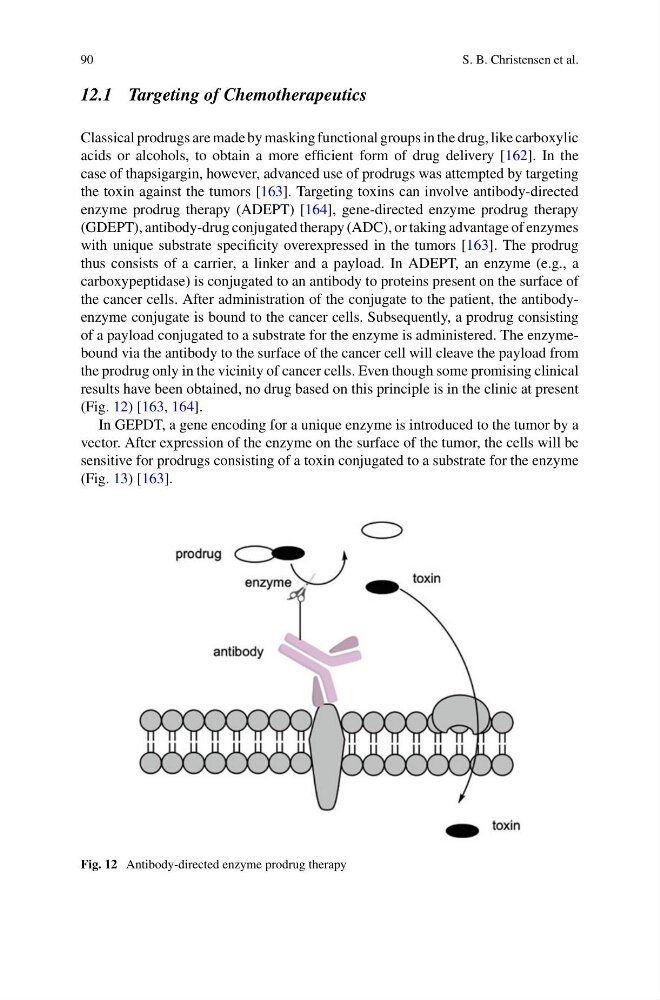
thus consists of a carrier, a linker and a payload. In ADEPT, an enzyme (e.g., a
carboxypeptidase) is conjugated to an antibody to proteins present on the surface of
the cancer cells. After administration of the conjugate to the patient, the antibodyenzyme conjugate is bound to the cancer cells. Subsequently, a prodrug consisting
of a payload conjugated to a substrate for the enzyme is administered. The enzymebound via the antibody to the surface of the cancer cell will cleave the payload from
the prodrug only in the vicinity of cancer cells. Even though some promising clinical
results have been obtained, no drug based on this principle is in the clinic at present
(Fig. 12) [163, 164].
In GEPDT, a gene encoding for a unique enzyme is introduced to the tumor by a
vector. After expression of the enzyme on the surface of the tumor, the cells will be
sensitive for prodrugs consisting of a toxin conjugated to a substrate for the enzyme
(Fig. 13) [163].
Fig. 12 Antibody-directed enzyme prodrug therapy
S. B. Christensen et al.
12.1 Targeting of Chemotherapeutics
Classical prodrugs are made by masking functional groups in the drug, like carboxylic
acids or alcohols, to obtain a more efficient form of drug delivery [162]. In the
case of thapsigargin, however, advanced use of prodrugs was attempted by targeting
the toxin against the tumors [163]. Targeting toxins can involve antibody-directed
enzyme prodrug therapy (ADEPT) [164], gene-directed enzyme prodrug therapy
(GDEPT), antibody-drug conjugated therapy (ADC), or taking advantage of enzymes
with unique substrate specificity overexpressed in the tumors [163]. The prodrug
thus consists of a carrier, a linker and a payload. In ADEPT, an enzyme (e.g., a
carboxypeptidase) is conjugated to an antibody to proteins present on the surface of
the cancer cells. After administration of the conjugate to the patient, the antibodyenzyme conjugate is bound to the cancer cells. Subsequently, a prodrug consisting
of a payload conjugated to a substrate for the enzyme is administered. The enzymebound via the antibody to the surface of the cancer cell will cleave the payload from
the prodrug only in the vicinity of cancer cells. Even though some promising clinical
results have been obtained, no drug based on this principle is in the clinic at present
(Fig. 12) [163, 164].
In GEPDT, a gene encoding for a unique enzyme is introduced to the tumor by a
vector. After expression of the enzyme on the surface of the tumor, the cells will be
sensitive for prodrugs consisting of a toxin conjugated to a substrate for the enzyme
(Fig. 13) [163].
Fig. 12 Antibody-directed enzyme prodrug therapy