

88
S. B. Christensen et al.
O
flexible alkyl group b
O
O
O
small alkyl group c
small alkyl group a
lipophilic group
OR
OR
O
O
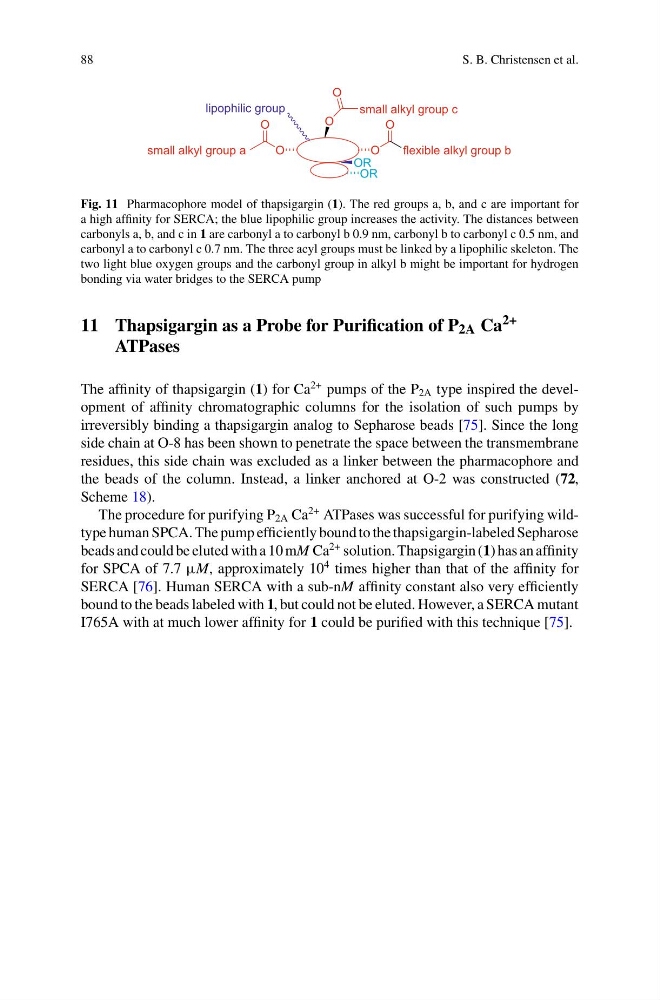
Fig. 11 Pharmacophore model of thapsigargin (1). The red groups a, b, and c are important for
a high affinity for SERCA; the blue lipophilic group increases the activity. The distances between
carbonyls a, b, and c in 1 are carbonyl a to carbonyl b 0.9 nm, carbonyl b to carbonyl c 0.5 nm, and
carbonyl a to carbonyl c 0.7 nm. The three acyl groups must be linked by a lipophilic skeleton. The
two light blue oxygen groups and the carbonyl group in alkyl b might be important for hydrogen
bonding via water bridges to the SERCA pump
11 Thapsigargin as a Probe for Purification of P 2A Ca 2+
ATPases
The affinity of thapsigargin (1) for Ca
2+ pumps of the P 2A type inspired the development of affinity chromatographic columns for the isolation of such pumps by
irreversibly binding a thapsigargin analog to Sepharose beads [75]. Since the long
side chain at O-8 has been shown to penetrate the space between the transmembrane
residues, this side chain was excluded as a linker between the pharmacophore and
the beads of the column. Instead, a linker anchored at O-2 was constructed (72,
Scheme 18).
The procedure for purifying P 2A Ca
2+ ATPases was successful for purifying wildtype human SPCA. The pump efficiently bound to the thapsigargin-labeled Sepharose
beads and could be eluted with a 10 mM Ca
2+ solution. Thapsigargin (1) has an affinity
for SPCA of 7.7 μM, approximately 10
4 times higher than that of the affinity for
SERCA [76]. Human SERCA with a sub-nM affinity constant also very efficiently
bound to the beads labeled with 1, but could not be eluted. However, a SERCA mutant
I765A with at much lower affinity for 1 could be purified with this technique [75].
S. B. Christensen et al.
O
flexible alkyl group b
O
O
O
small alkyl group c
small alkyl group a
lipophilic group
OR
OR
O
O
Fig. 11 Pharmacophore model of thapsigargin (1). The red groups a, b, and c are important for
a high affinity for SERCA; the blue lipophilic group increases the activity. The distances between
carbonyls a, b, and c in 1 are carbonyl a to carbonyl b 0.9 nm, carbonyl b to carbonyl c 0.5 nm, and
carbonyl a to carbonyl c 0.7 nm. The three acyl groups must be linked by a lipophilic skeleton. The
two light blue oxygen groups and the carbonyl group in alkyl b might be important for hydrogen
bonding via water bridges to the SERCA pump
11 Thapsigargin as a Probe for Purification of P 2A Ca 2+
ATPases
The affinity of thapsigargin (1) for Ca
2+ pumps of the P 2A type inspired the development of affinity chromatographic columns for the isolation of such pumps by
irreversibly binding a thapsigargin analog to Sepharose beads [75]. Since the long
side chain at O-8 has been shown to penetrate the space between the transmembrane
residues, this side chain was excluded as a linker between the pharmacophore and
the beads of the column. Instead, a linker anchored at O-2 was constructed (72,
Scheme 18).
The procedure for purifying P 2A Ca
2+ ATPases was successful for purifying wildtype human SPCA. The pump efficiently bound to the thapsigargin-labeled Sepharose
beads and could be eluted with a 10 mM Ca
2+ solution. Thapsigargin (1) has an affinity
for SPCA of 7.7 μM, approximately 10
4 times higher than that of the affinity for
SERCA [76]. Human SERCA with a sub-nM affinity constant also very efficiently
bound to the beads labeled with 1, but could not be eluted. However, a SERCA mutant
I765A with at much lower affinity for 1 could be purified with this technique [75].