

From Plant to Patient: Thapsigargin, a Tool for Understanding …
61
1 Introduction: Silphium and Thapsia garganica
Silphium (Latin) or σ´ ιλϕιoν (silphion, Greek) was a resin exported from the ancient
Greek settlement Cyrene located on the northern coast of Libya [1, 2]. The product
was sold for its weight in silver, with one source even referring to its weight in gold,
making Cyrene a prosperous society from about 600 BC to about 100 BC. Several
coins depict the plant from which silphium was prepared. These pictures clearly
reveal that the parent plant must have belonged to the Apiaceae family. Overharvesting of the population extinguished the plant and in the third century AD the
export ceased [1, 2]. Several theories on the identity of the producing plant have
been presented, and, in particular, species belonging to the genus Ferula have gained
acceptance in this regard. The ruins of Cyrene were visited by the Swedish botanist
Söderling-Brydolf in the 1960’s and a large population of Thapsia garganica L.
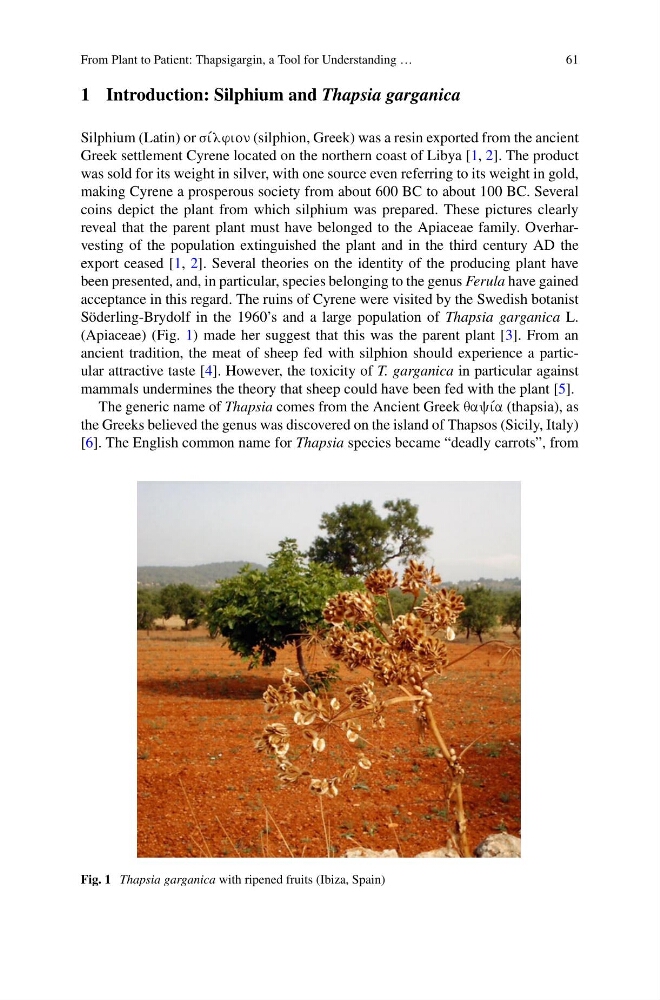
(Apiaceae) (Fig. 1) made her suggest that this was the parent plant [3]. From an
ancient tradition, the meat of sheep fed with silphion should experience a particular attractive taste [4]. However, the toxicity of T. garganica in particular against
mammals undermines the theory that sheep could have been fed with the plant [5].
The generic name of Thapsia comes from the Ancient Greek θαψ´ ια (thapsia), as
the Greeks believed the genus was discovered on the island of Thapsos (Sicily, Italy)
[6]. The English common name for Thapsia species became “deadly carrots”, from
Fig. 1 Thapsia garganica with ripened fruits (Ibiza, Spain)
61
1 Introduction: Silphium and Thapsia garganica
Silphium (Latin) or σ´ ιλϕιoν (silphion, Greek) was a resin exported from the ancient
Greek settlement Cyrene located on the northern coast of Libya [1, 2]. The product
was sold for its weight in silver, with one source even referring to its weight in gold,
making Cyrene a prosperous society from about 600 BC to about 100 BC. Several
coins depict the plant from which silphium was prepared. These pictures clearly
reveal that the parent plant must have belonged to the Apiaceae family. Overharvesting of the population extinguished the plant and in the third century AD the
export ceased [1, 2]. Several theories on the identity of the producing plant have
been presented, and, in particular, species belonging to the genus Ferula have gained
acceptance in this regard. The ruins of Cyrene were visited by the Swedish botanist
Söderling-Brydolf in the 1960’s and a large population of Thapsia garganica L.
(Apiaceae) (Fig. 1) made her suggest that this was the parent plant [3]. From an
ancient tradition, the meat of sheep fed with silphion should experience a particular attractive taste [4]. However, the toxicity of T. garganica in particular against
mammals undermines the theory that sheep could have been fed with the plant [5].
The generic name of Thapsia comes from the Ancient Greek θαψ´ ια (thapsia), as
the Greeks believed the genus was discovered on the island of Thapsos (Sicily, Italy)
[6]. The English common name for Thapsia species became “deadly carrots”, from
Fig. 1 Thapsia garganica with ripened fruits (Ibiza, Spain)