

The Role of Total Synthesis in Structure …
41
3.4 Pheromones from Madagascan Mantellid Frogs
Although frogs primarily communicate through acoustic signals, non-volatile (e.g.
water-soluble proteins) and more recently volatile pheromones have been shown
to play an important role for distinguishing conspecies from closely related species.
Over the past few years macrolactones have been identified as a particularly important
group of semiochemicals in frogs. They are derived biosynthetically from fatty acids
that are oxidized at the ω-terminus. Cyclization increases the lipophilicity and hence
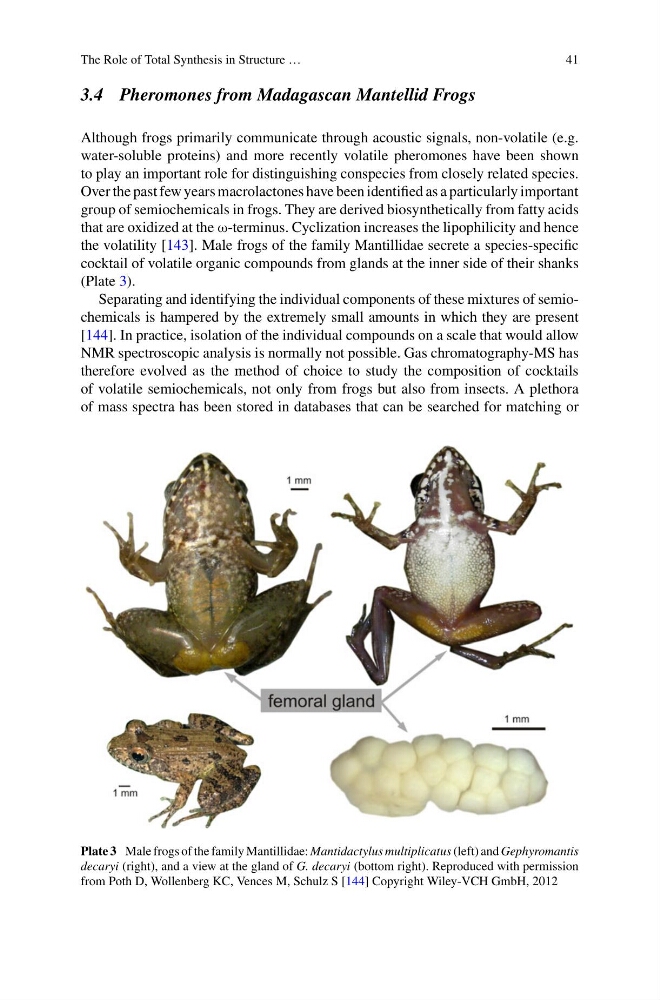
the volatility [143]. Male frogs of the family Mantillidae secrete a species-specific
cocktail of volatile organic compounds from glands at the inner side of their shanks
(Plate 3).
Separating and identifying the individual components of these mixtures of semiochemicals is hampered by the extremely small amounts in which they are present
[144]. In practice, isolation of the individual compounds on a scale that would allow
NMR spectroscopic analysis is normally not possible. Gas chromatography-MS has
therefore evolved as the method of choice to study the composition of cocktails
of volatile semiochemicals, not only from frogs but also from insects. A plethora
of mass spectra has been stored in databases that can be searched for matching or
Plate 3 Male frogs of the family Mantillidae: Mantidactylus multiplicatus (left) and Gephyromantis
decaryi (right), and a view at the gland of G. decaryi (bottom right). Reproduced with permission
from Poth D, Wollenberg KC, Vences M, Schulz S [144] Copyright Wiley-VCH GmbH, 2012
41
3.4 Pheromones from Madagascan Mantellid Frogs
Although frogs primarily communicate through acoustic signals, non-volatile (e.g.
water-soluble proteins) and more recently volatile pheromones have been shown
to play an important role for distinguishing conspecies from closely related species.
Over the past few years macrolactones have been identified as a particularly important
group of semiochemicals in frogs. They are derived biosynthetically from fatty acids
that are oxidized at the ω-terminus. Cyclization increases the lipophilicity and hence
the volatility [143]. Male frogs of the family Mantillidae secrete a species-specific
cocktail of volatile organic compounds from glands at the inner side of their shanks
(Plate 3).
Separating and identifying the individual components of these mixtures of semiochemicals is hampered by the extremely small amounts in which they are present
[144]. In practice, isolation of the individual compounds on a scale that would allow
NMR spectroscopic analysis is normally not possible. Gas chromatography-MS has
therefore evolved as the method of choice to study the composition of cocktails
of volatile semiochemicals, not only from frogs but also from insects. A plethora
of mass spectra has been stored in databases that can be searched for matching or
Plate 3 Male frogs of the family Mantillidae: Mantidactylus multiplicatus (left) and Gephyromantis
decaryi (right), and a view at the gland of G. decaryi (bottom right). Reproduced with permission
from Poth D, Wollenberg KC, Vences M, Schulz S [144] Copyright Wiley-VCH GmbH, 2012