

The Role of Total Synthesis in Structure …
31
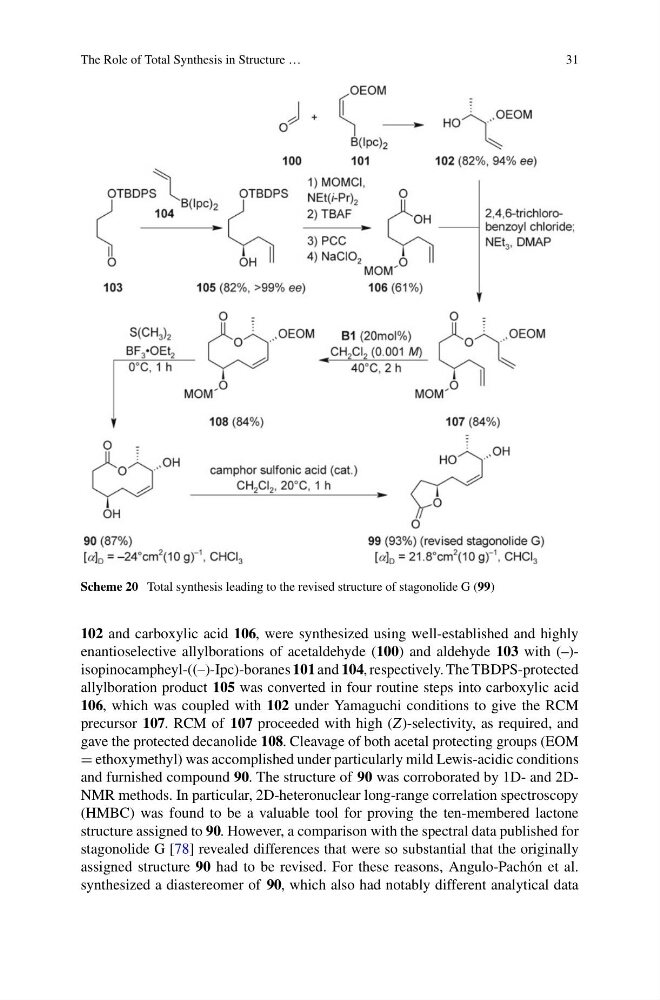
Scheme 20 Total synthesis leading to the revised structure of stagonolide G (99)
102 and carboxylic acid 106, were synthesized using well-established and highly
enantioselective allylborations of acetaldehyde (100) and aldehyde 103 with (–)isopinocampheyl-((–)-Ipc)-boranes 101 and 104, respectively. The TBDPS-protected
allylboration product 105 was converted in four routine steps into carboxylic acid
106, which was coupled with 102 under Yamaguchi conditions to give the RCM
precursor 107. RCM of 107 proceeded with high (Z)-selectivity, as required, and
gave the protected decanolide 108. Cleavage of both acetal protecting groups (EOM
= ethoxymethyl) was accomplished under particularly mild Lewis-acidic conditions
and furnished compound 90. The structure of 90 was corroborated by 1D- and 2DNMR methods. In particular, 2D-heteronuclear long-range correlation spectroscopy
(HMBC) was found to be a valuable tool for proving the ten-membered lactone
structure assigned to 90. However, a comparison with the spectral data published for
stagonolide G [78] revealed differences that were so substantial that the originally
assigned structure 90 had to be revised. For these reasons, Angulo-Pachón et al.
synthesized a diastereomer of 90, which also had notably different analytical data
31
Scheme 20 Total synthesis leading to the revised structure of stagonolide G (99)
102 and carboxylic acid 106, were synthesized using well-established and highly
enantioselective allylborations of acetaldehyde (100) and aldehyde 103 with (–)isopinocampheyl-((–)-Ipc)-boranes 101 and 104, respectively. The TBDPS-protected
allylboration product 105 was converted in four routine steps into carboxylic acid
106, which was coupled with 102 under Yamaguchi conditions to give the RCM
precursor 107. RCM of 107 proceeded with high (Z)-selectivity, as required, and
gave the protected decanolide 108. Cleavage of both acetal protecting groups (EOM
= ethoxymethyl) was accomplished under particularly mild Lewis-acidic conditions
and furnished compound 90. The structure of 90 was corroborated by 1D- and 2DNMR methods. In particular, 2D-heteronuclear long-range correlation spectroscopy
(HMBC) was found to be a valuable tool for proving the ten-membered lactone
structure assigned to 90. However, a comparison with the spectral data published for
stagonolide G [78] revealed differences that were so substantial that the originally
assigned structure 90 had to be revised. For these reasons, Angulo-Pachón et al.
synthesized a diastereomer of 90, which also had notably different analytical data