

14
B. Schmidt
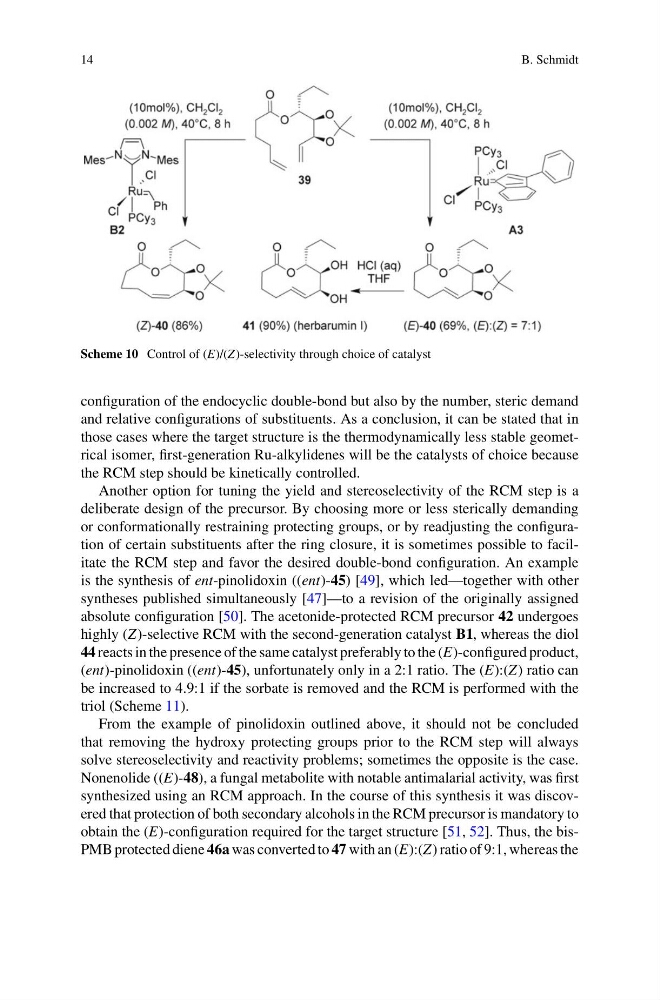
Scheme 10 Control of (E)/(Z)-selectivity through choice of catalyst
configuration of the endocyclic double-bond but also by the number, steric demand
and relative configurations of substituents. As a conclusion, it can be stated that in
those cases where the target structure is the thermodynamically less stable geometrical isomer, first-generation Ru-alkylidenes will be the catalysts of choice because
the RCM step should be kinetically controlled.
Another option for tuning the yield and stereoselectivity of the RCM step is a
deliberate design of the precursor. By choosing more or less sterically demanding
or conformationally restraining protecting groups, or by readjusting the configuration of certain substituents after the ring closure, it is sometimes possible to facilitate the RCM step and favor the desired double-bond configuration. An example
is the synthesis of ent-pinolidoxin ((ent)-45) [49], which led—together with other
syntheses published simultaneously [47]—to a revision of the originally assigned
absolute configuration [50]. The acetonide-protected RCM precursor 42 undergoes
highly (Z)-selective RCM with the second-generation catalyst B1, whereas the diol
44 reacts in the presence of the same catalyst preferably to the (E)-configured product,
(ent)-pinolidoxin ((ent)-45), unfortunately only in a 2:1 ratio. The (E):(Z) ratio can
be increased to 4.9:1 if the sorbate is removed and the RCM is performed with the
triol (Scheme 11).
From the example of pinolidoxin outlined above, it should not be concluded
that removing the hydroxy protecting groups prior to the RCM step will always
solve stereoselectivity and reactivity problems; sometimes the opposite is the case.
Nonenolide ((E)-48), a fungal metabolite with notable antimalarial activity, was first
synthesized using an RCM approach. In the course of this synthesis it was discovered that protection of both secondary alcohols in the RCM precursor is mandatory to
obtain the (E)-configuration required for the target structure [51, 52]. Thus, the bisPMB protected diene 46a was converted to 47 with an (E):(Z) ratio of 9:1, whereas the
B. Schmidt
Scheme 10 Control of (E)/(Z)-selectivity through choice of catalyst
configuration of the endocyclic double-bond but also by the number, steric demand
and relative configurations of substituents. As a conclusion, it can be stated that in
those cases where the target structure is the thermodynamically less stable geometrical isomer, first-generation Ru-alkylidenes will be the catalysts of choice because
the RCM step should be kinetically controlled.
Another option for tuning the yield and stereoselectivity of the RCM step is a
deliberate design of the precursor. By choosing more or less sterically demanding
or conformationally restraining protecting groups, or by readjusting the configuration of certain substituents after the ring closure, it is sometimes possible to facilitate the RCM step and favor the desired double-bond configuration. An example
is the synthesis of ent-pinolidoxin ((ent)-45) [49], which led—together with other
syntheses published simultaneously [47]—to a revision of the originally assigned
absolute configuration [50]. The acetonide-protected RCM precursor 42 undergoes
highly (Z)-selective RCM with the second-generation catalyst B1, whereas the diol
44 reacts in the presence of the same catalyst preferably to the (E)-configured product,
(ent)-pinolidoxin ((ent)-45), unfortunately only in a 2:1 ratio. The (E):(Z) ratio can
be increased to 4.9:1 if the sorbate is removed and the RCM is performed with the
triol (Scheme 11).
From the example of pinolidoxin outlined above, it should not be concluded
that removing the hydroxy protecting groups prior to the RCM step will always
solve stereoselectivity and reactivity problems; sometimes the opposite is the case.
Nonenolide ((E)-48), a fungal metabolite with notable antimalarial activity, was first
synthesized using an RCM approach. In the course of this synthesis it was discovered that protection of both secondary alcohols in the RCM precursor is mandatory to
obtain the (E)-configuration required for the target structure [51, 52]. Thus, the bisPMB protected diene 46a was converted to 47 with an (E):(Z) ratio of 9:1, whereas the