

6
B. Schmidt
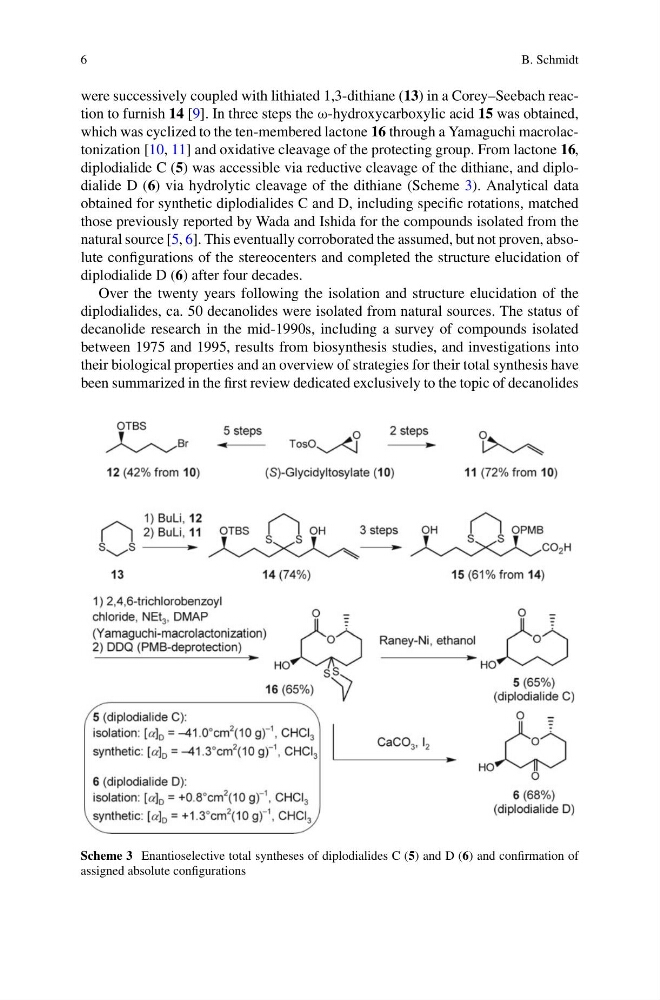
were successively coupled with lithiated 1,3-dithiane (13) in a Corey–Seebach reaction to furnish 14 [9]. In three steps the ω-hydroxycarboxylic acid 15 was obtained,
which was cyclized to the ten-membered lactone 16 through a Yamaguchi macrolactonization [10, 11] and oxidative cleavage of the protecting group. From lactone 16,
diplodialide C (5) was accessible via reductive cleavage of the dithiane, and diplodialide D (6) via hydrolytic cleavage of the dithiane (Scheme 3). Analytical data
obtained for synthetic diplodialides C and D, including specific rotations, matched
those previously reported by Wada and Ishida for the compounds isolated from the
natural source [5, 6]. This eventually corroborated the assumed, but not proven, absolute configurations of the stereocenters and completed the structure elucidation of
diplodialide D (6) after four decades.
Over the twenty years following the isolation and structure elucidation of the
diplodialides, ca. 50 decanolides were isolated from natural sources. The status of
decanolide research in the mid-1990s, including a survey of compounds isolated
between 1975 and 1995, results from biosynthesis studies, and investigations into
their biological properties and an overview of strategies for their total synthesis have
been summarized in the first review dedicated exclusively to the topic of decanolides
Scheme 3 Enantioselective total syntheses of diplodialides C (5) and D (6) and confirmation of
assigned absolute configurations
B. Schmidt
were successively coupled with lithiated 1,3-dithiane (13) in a Corey–Seebach reaction to furnish 14 [9]. In three steps the ω-hydroxycarboxylic acid 15 was obtained,
which was cyclized to the ten-membered lactone 16 through a Yamaguchi macrolactonization [10, 11] and oxidative cleavage of the protecting group. From lactone 16,
diplodialide C (5) was accessible via reductive cleavage of the dithiane, and diplodialide D (6) via hydrolytic cleavage of the dithiane (Scheme 3). Analytical data
obtained for synthetic diplodialides C and D, including specific rotations, matched
those previously reported by Wada and Ishida for the compounds isolated from the
natural source [5, 6]. This eventually corroborated the assumed, but not proven, absolute configurations of the stereocenters and completed the structure elucidation of
diplodialide D (6) after four decades.
Over the twenty years following the isolation and structure elucidation of the
diplodialides, ca. 50 decanolides were isolated from natural sources. The status of
decanolide research in the mid-1990s, including a survey of compounds isolated
between 1975 and 1995, results from biosynthesis studies, and investigations into
their biological properties and an overview of strategies for their total synthesis have
been summarized in the first review dedicated exclusively to the topic of decanolides
Scheme 3 Enantioselective total syntheses of diplodialides C (5) and D (6) and confirmation of
assigned absolute configurations