

The Role of Total Synthesis in Structure …
5
C-3 and C-9 still required synthetic degradation to known compounds and comparison with their published specific rotations, occasionally after derivatization [6]. By
oxidation of the secondary alcohol of diplodialide B (4) and hydrogenation of the
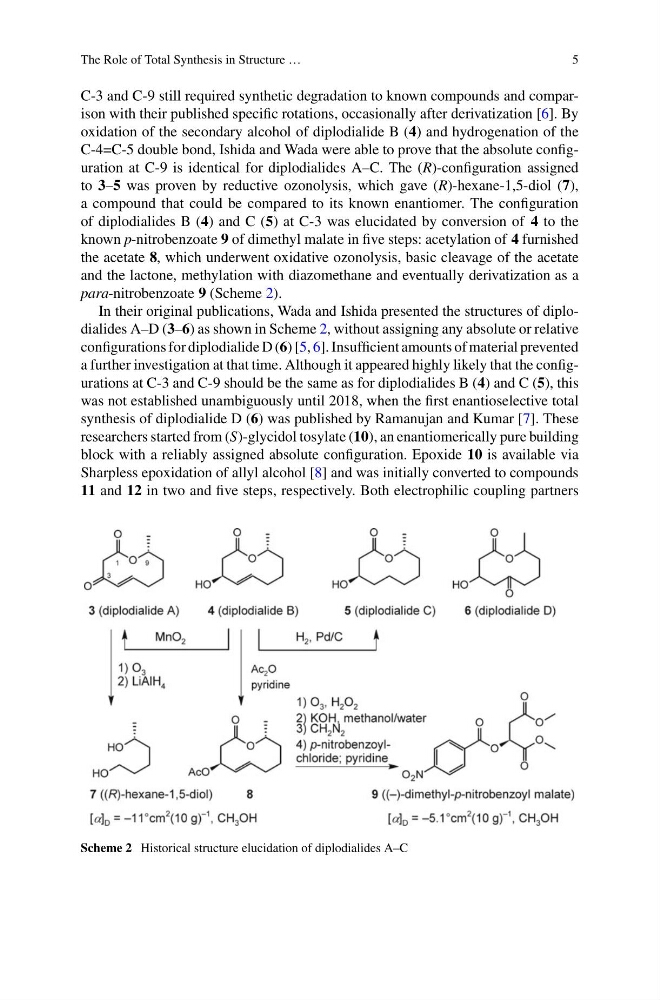
C-4=C-5 double bond, Ishida and Wada were able to prove that the absolute configuration at C-9 is identical for diplodialides A–C. The (R)-configuration assigned
to 3–5 was proven by reductive ozonolysis, which gave (R)-hexane-1,5-diol (7),
a compound that could be compared to its known enantiomer. The configuration
of diplodialides B (4) and C (5) at C-3 was elucidated by conversion of 4 to the
known p-nitrobenzoate 9 of dimethyl malate in five steps: acetylation of 4 furnished
the acetate 8, which underwent oxidative ozonolysis, basic cleavage of the acetate
and the lactone, methylation with diazomethane and eventually derivatization as a
para-nitrobenzoate 9 (Scheme 2).
In their original publications, Wada and Ishida presented the structures of diplodialides A–D (3–6) as shown in Scheme 2, without assigning any absolute or relative
configurations for diplodialide D (6) [5, 6]. Insufficient amounts of material prevented
a further investigation at that time. Although it appeared highly likely that the configurations at C-3 and C-9 should be the same as for diplodialides B (4) and C (5), this
was not established unambiguously until 2018, when the first enantioselective total
synthesis of diplodialide D (6) was published by Ramanujan and Kumar [7]. These
researchers started from (S)-glycidol tosylate (10), an enantiomerically pure building
block with a reliably assigned absolute configuration. Epoxide 10 is available via
Sharpless epoxidation of allyl alcohol [8] and was initially converted to compounds
11 and 12 in two and five steps, respectively. Both electrophilic coupling partners
Scheme 2 Historical structure elucidation of diplodialides A–C
5
C-3 and C-9 still required synthetic degradation to known compounds and comparison with their published specific rotations, occasionally after derivatization [6]. By
oxidation of the secondary alcohol of diplodialide B (4) and hydrogenation of the
C-4=C-5 double bond, Ishida and Wada were able to prove that the absolute configuration at C-9 is identical for diplodialides A–C. The (R)-configuration assigned
to 3–5 was proven by reductive ozonolysis, which gave (R)-hexane-1,5-diol (7),
a compound that could be compared to its known enantiomer. The configuration
of diplodialides B (4) and C (5) at C-3 was elucidated by conversion of 4 to the
known p-nitrobenzoate 9 of dimethyl malate in five steps: acetylation of 4 furnished
the acetate 8, which underwent oxidative ozonolysis, basic cleavage of the acetate
and the lactone, methylation with diazomethane and eventually derivatization as a
para-nitrobenzoate 9 (Scheme 2).
In their original publications, Wada and Ishida presented the structures of diplodialides A–D (3–6) as shown in Scheme 2, without assigning any absolute or relative
configurations for diplodialide D (6) [5, 6]. Insufficient amounts of material prevented
a further investigation at that time. Although it appeared highly likely that the configurations at C-3 and C-9 should be the same as for diplodialides B (4) and C (5), this
was not established unambiguously until 2018, when the first enantioselective total
synthesis of diplodialide D (6) was published by Ramanujan and Kumar [7]. These
researchers started from (S)-glycidol tosylate (10), an enantiomerically pure building
block with a reliably assigned absolute configuration. Epoxide 10 is available via
Sharpless epoxidation of allyl alcohol [8] and was initially converted to compounds
11 and 12 in two and five steps, respectively. Both electrophilic coupling partners
Scheme 2 Historical structure elucidation of diplodialides A–C