

74 4 Gas-Phase Synthesis of Nanoparticles
showing no lattice fringes at all. (Under the conditions of microwave plasma synthesis, alumina, similar to silica, is never crystallized.) From the nonspherical
shape of the zirconia particle one may guess that this particle is a result of the
coagulation of two particles.
Certainly, one could think of coating ceramic particles with metals, for example,
platinum. For application as catalysts, this would save expensive material. However,
it is impossible to realize this idea. Because of the relations of the surface energy,
this type of coating is impossible, the metal is deposited as clusters, a phenomenon
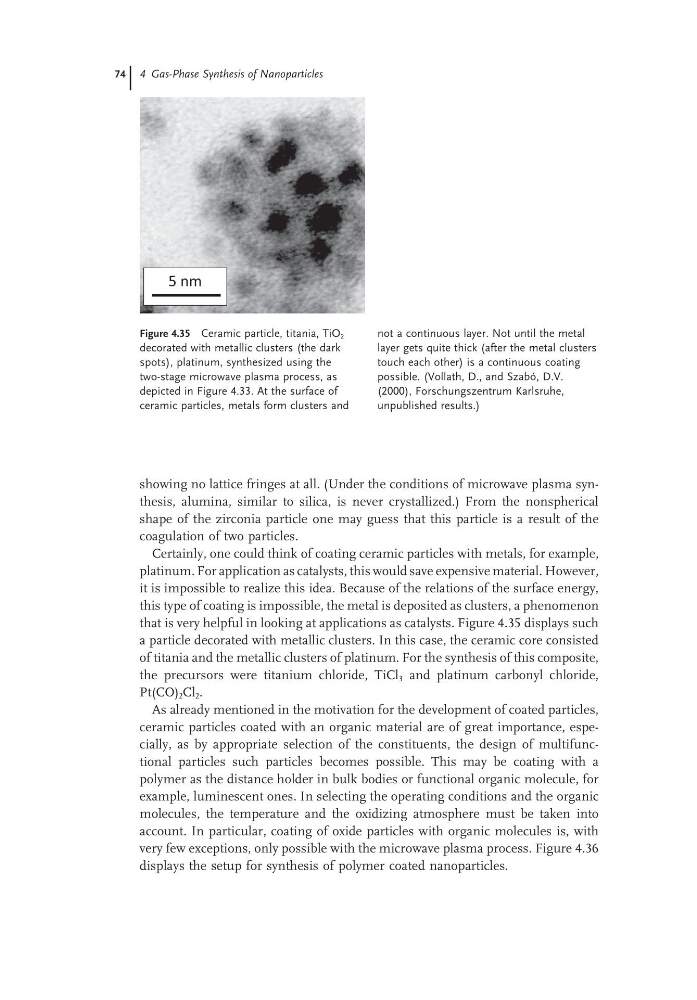
that is very helpful in looking at applications as catalysts. Figure 4.35 displays such
a particle decorated with metallic clusters. In this case, the ceramic core consisted
of titania and the metallic clusters of platinum. For the synthesis of this composite,
the precursors were titanium chloride, TiCl 3 and platinum carbonyl chloride,
Pt(CO) 2 Cl 2 .
As already mentioned in the motivation for the development of coated particles,
ceramic particles coated with an organic material are of great importance, especially, as by appropriate selection of the constituents, the design of multifunctional particles such particles becomes possible. This may be coating with a
polymer as the distance holder in bulk bodies or functional organic molecule, for
example, luminescent ones. In selecting the operating conditions and the organic
molecules, the temperature and the oxidizing atmosphere must be taken into
account. In particular, coating of oxide particles with organic molecules is, with
very few exceptions, only possible with the microwave plasma process. Figure 4.36
displays the setup for synthesis of polymer coated nanoparticles.
Figure 4.35 Ceramic particle, titania, TiO 2
decorated with metallic clusters (the dark
spots), platinum, synthesized using the
two-stage microwave plasma process, as
depicted in Figure 4.33. At the surface of
ceramic particles, metals form clusters and
not a continuous layer. Not until the metal
layer gets quite thick (after the metal clusters
touch each other) is a continuous coating
possible. (Vollath, D., and Szabó, D.V.
(2000), Forschungszentrum Karlsruhe,
unpublished results.)
5 nm
showing no lattice fringes at all. (Under the conditions of microwave plasma synthesis, alumina, similar to silica, is never crystallized.) From the nonspherical
shape of the zirconia particle one may guess that this particle is a result of the
coagulation of two particles.
Certainly, one could think of coating ceramic particles with metals, for example,
platinum. For application as catalysts, this would save expensive material. However,
it is impossible to realize this idea. Because of the relations of the surface energy,
this type of coating is impossible, the metal is deposited as clusters, a phenomenon
that is very helpful in looking at applications as catalysts. Figure 4.35 displays such
a particle decorated with metallic clusters. In this case, the ceramic core consisted
of titania and the metallic clusters of platinum. For the synthesis of this composite,
the precursors were titanium chloride, TiCl 3 and platinum carbonyl chloride,
Pt(CO) 2 Cl 2 .
As already mentioned in the motivation for the development of coated particles,
ceramic particles coated with an organic material are of great importance, especially, as by appropriate selection of the constituents, the design of multifunctional particles such particles becomes possible. This may be coating with a
polymer as the distance holder in bulk bodies or functional organic molecule, for
example, luminescent ones. In selecting the operating conditions and the organic
molecules, the temperature and the oxidizing atmosphere must be taken into
account. In particular, coating of oxide particles with organic molecules is, with
very few exceptions, only possible with the microwave plasma process. Figure 4.36
displays the setup for synthesis of polymer coated nanoparticles.
Figure 4.35 Ceramic particle, titania, TiO 2
decorated with metallic clusters (the dark
spots), platinum, synthesized using the
two-stage microwave plasma process, as
depicted in Figure 4.33. At the surface of
ceramic particles, metals form clusters and
not a continuous layer. Not until the metal
layer gets quite thick (after the metal clusters
touch each other) is a continuous coating
possible. (Vollath, D., and Szabó, D.V.
(2000), Forschungszentrum Karlsruhe,
unpublished results.)
5 nm