

3.2 Surface Energy 29
a nanoparticle. For the surface stress, a value of 1 N m ≙ 1 J m
−2 was selected. As
values for the surface energy and surface stress are poorly known for ceramic
materials, this value is often selected.
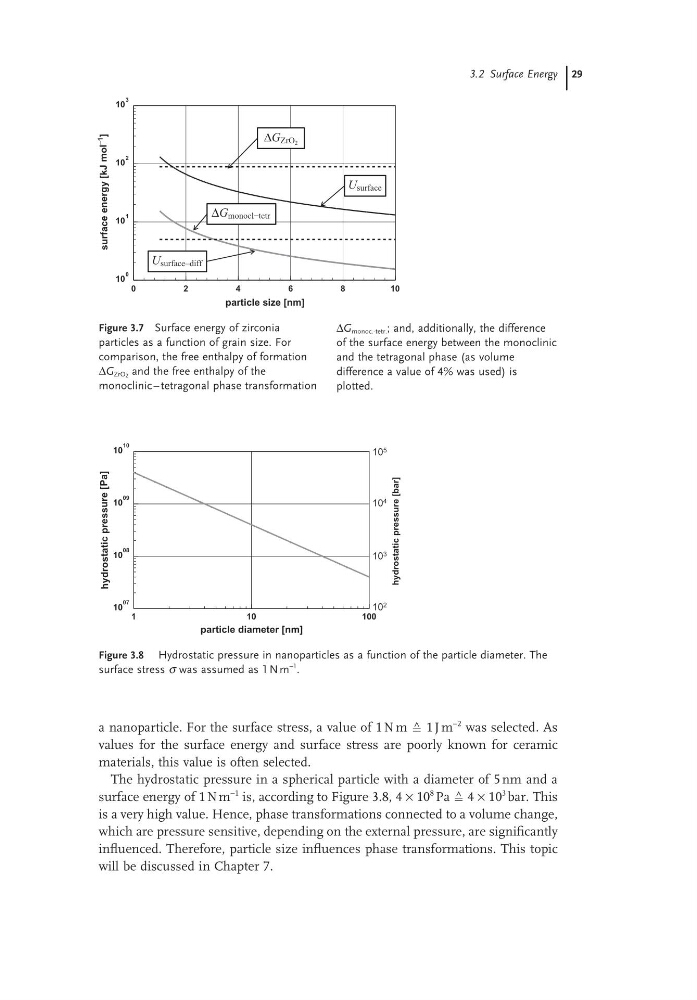
The hydrostatic pressure in a spherical particle with a diameter of 5 nm and a
surface energy of 1 N m
−1 is, according to Figure 3.8, 4 × 10
8 Pa ≙ 4 × 10
3 bar. This
is a very high value. Hence, phase transformations connected to a volume change,
which are pressure sensitive, depending on the external pressure, are significantly
influenced. Therefore, particle size influences phase transformations. This topic
will be discussed in Chapter 7.
Figure 3.7 Surface energy of zirconia
particles as a function of grain size. For
comparison, the free enthalpy of formation
∆G ZrO2 and the free enthalpy of the
monoclinic – tetragonal phase transformation
ΔG monoc.-tetr. ; and, additionally, the difference
of the surface energy between the monoclinic
and the tetragonal phase (as volume
difference a value of 4% was used) is
plotted.
0
2
4
6
8
10
particle size [nm]
10
0
10
1
10
2
10
3
surface
energy
[kJ
mol
–1
]
U surface
U surface–diff
∆G monocl−tetr
∆G ZrO 2
Figure 3.8 Hydrostatic pressure in nanoparticles as a function of the particle diameter. The
surface stress σ was assumed as 1 N m
−1 .
1
10
100
particle diameter [nm]
10
07
10
08
10
09
10
10
hydrostatic
pressure
[Pa]
10 5
10 4
10 3
10 2
hydrostatic pressure [bar]
a nanoparticle. For the surface stress, a value of 1 N m ≙ 1 J m
−2 was selected. As
values for the surface energy and surface stress are poorly known for ceramic
materials, this value is often selected.
The hydrostatic pressure in a spherical particle with a diameter of 5 nm and a
surface energy of 1 N m
−1 is, according to Figure 3.8, 4 × 10
8 Pa ≙ 4 × 10
3 bar. This
is a very high value. Hence, phase transformations connected to a volume change,
which are pressure sensitive, depending on the external pressure, are significantly
influenced. Therefore, particle size influences phase transformations. This topic
will be discussed in Chapter 7.
Figure 3.7 Surface energy of zirconia
particles as a function of grain size. For
comparison, the free enthalpy of formation
∆G ZrO2 and the free enthalpy of the
monoclinic – tetragonal phase transformation
ΔG monoc.-tetr. ; and, additionally, the difference
of the surface energy between the monoclinic
and the tetragonal phase (as volume
difference a value of 4% was used) is
plotted.
0
2
4
6
8
10
particle size [nm]
10
0
10
1
10
2
10
3
surface
energy
[kJ
mol
–1
]
U surface
U surface–diff
∆G monocl−tetr
∆G ZrO 2
Figure 3.8 Hydrostatic pressure in nanoparticles as a function of the particle diameter. The
surface stress σ was assumed as 1 N m
−1 .
1
10
100
particle diameter [nm]
10
07
10
08
10
09
10
10
hydrostatic
pressure
[Pa]
10 5
10 4
10 3
10 2
hydrostatic pressure [bar]