

20 2 Nanoparticles – Nanocomposites
can be produced in large quantities independently of the sensor material. The layer
with the sensing properties is producible either by sputtering or by wet chemical
methods.
The design depicted in Figures 2.13 and 2.14 is thus more progressed as it can
be miniaturized, a fact that allows the integration of many of these sensor elements
on a chip. This has two major advantages: (i) By averaging of many signals, the
noise can be reduced significantly; therefore, the measured signal is more reliable,
and (ii) the whole sensor chip can be coated with a diffusion layer, for example,
made of silica or alumina, of varying thickness and heated in a way that each
sensing element is at a different temperature. Depending on the molecular size
the time response of the different elements depends on the thickness of the
surface coating and the temperature of the individual element. After empirical
calibration, such a design is able to give, besides the oxygen potential (this is the
thermodynamic quantity, which is, in technical applications, mathematically converted to concentrations), information on the gas species, too.
References
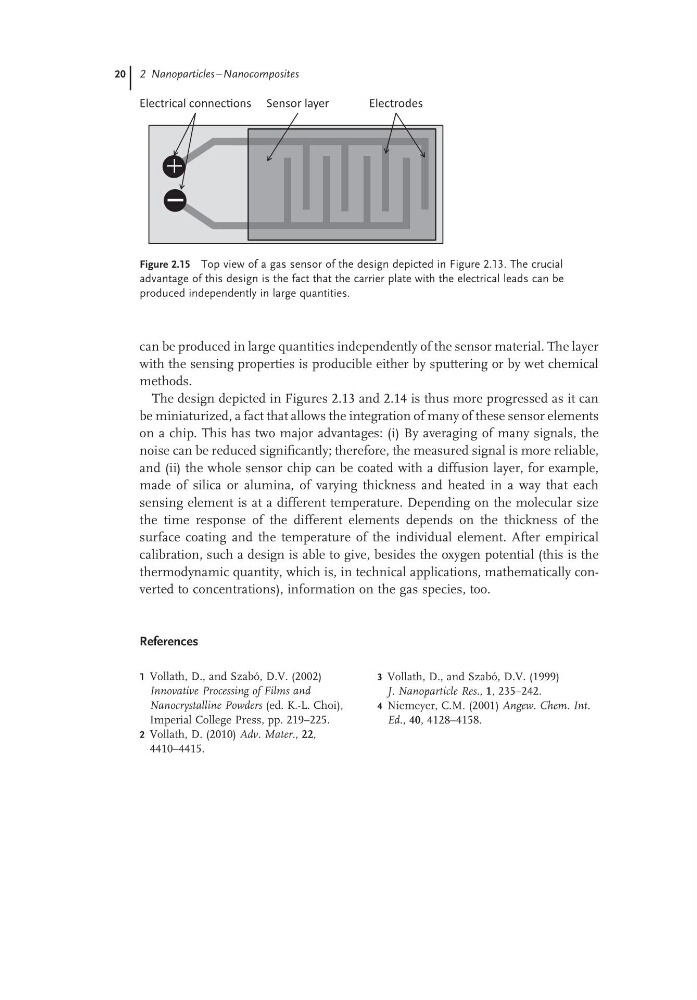
Figure 2.15 Top view of a gas sensor of the design depicted in Figure 2.13. The crucial
advantage of this design is the fact that the carrier plate with the electrical leads can be
produced independently in large quantities.
Electrodes
Sensor layer
Electrical connecƟons
1 Vollath, D., and Szabó, D.V. (2002)
Innovative Processing of Films and
Nanocrystalline Powders (ed. K.-L. Choi),
Imperial College Press, pp. 219–225.
2 Vollath, D. (2010) Adv. Mater., 22,
4410–4415.
3 Vollath, D., and Szabó, D.V. (1999)
J. Nanoparticle Res., 1, 235–242.
4 Niemeyer, C.M. (2001) Angew. Chem. Int.
Ed., 40, 4128–4158.
can be produced in large quantities independently of the sensor material. The layer
with the sensing properties is producible either by sputtering or by wet chemical
methods.
The design depicted in Figures 2.13 and 2.14 is thus more progressed as it can
be miniaturized, a fact that allows the integration of many of these sensor elements
on a chip. This has two major advantages: (i) By averaging of many signals, the
noise can be reduced significantly; therefore, the measured signal is more reliable,
and (ii) the whole sensor chip can be coated with a diffusion layer, for example,
made of silica or alumina, of varying thickness and heated in a way that each
sensing element is at a different temperature. Depending on the molecular size
the time response of the different elements depends on the thickness of the
surface coating and the temperature of the individual element. After empirical
calibration, such a design is able to give, besides the oxygen potential (this is the
thermodynamic quantity, which is, in technical applications, mathematically converted to concentrations), information on the gas species, too.
References
Figure 2.15 Top view of a gas sensor of the design depicted in Figure 2.13. The crucial
advantage of this design is the fact that the carrier plate with the electrical leads can be
produced independently in large quantities.
Electrodes
Sensor layer
Electrical connecƟons
1 Vollath, D., and Szabó, D.V. (2002)
Innovative Processing of Films and
Nanocrystalline Powders (ed. K.-L. Choi),
Imperial College Press, pp. 219–225.
2 Vollath, D. (2010) Adv. Mater., 22,
4410–4415.
3 Vollath, D., and Szabó, D.V. (1999)
J. Nanoparticle Res., 1, 235–242.
4 Niemeyer, C.M. (2001) Angew. Chem. Int.
Ed., 40, 4128–4158.