

12.3 Electron Microscopy 291
a design of Rose [6], who combined conventional electron lenses with multipole
elements. This design reduced the spherical aberration by a few orders of magnitude. Since these correctors are applied, the resolution power of electron microscopes is practically no longer limited. Nowadays, “sub-Ångström” resolution
electron microscopy (an Ångström is a non-SI length unit. 1 Å = 0.1 nm) is technically no longer a problem.
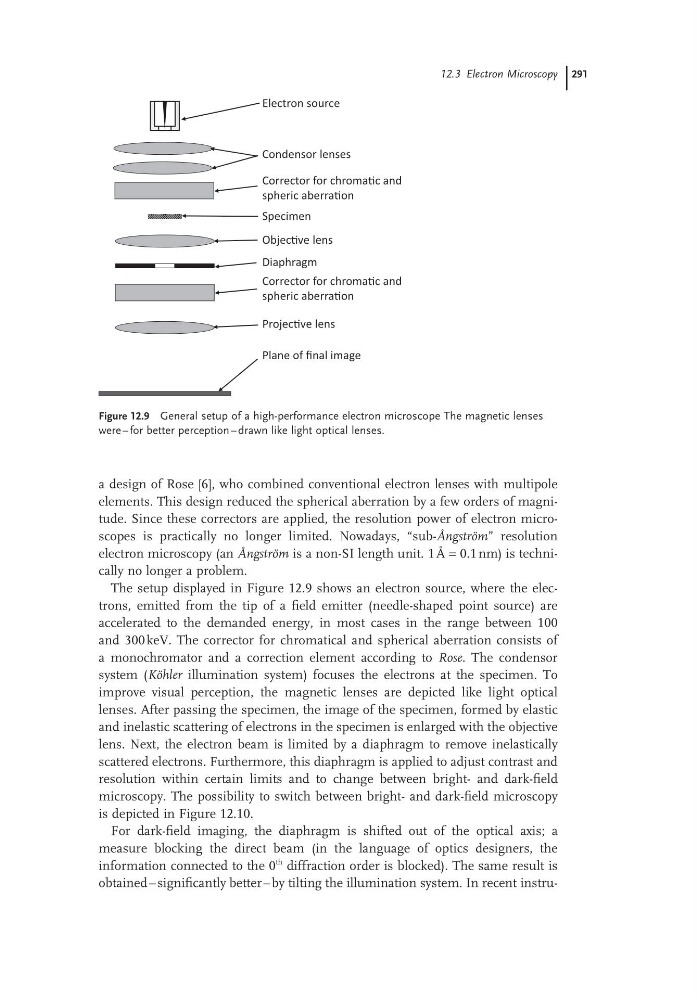
The setup displayed in Figure 12.9 shows an electron source, where the electrons, emitted from the tip of a field emitter (needle-shaped point source) are
accelerated to the demanded energy, in most cases in the range between 100
and 300 keV. The corrector for chromatical and spherical aberration consists of
a monochromator and a correction element according to Rose. The condensor
system (Köhler illumination system) focuses the electrons at the specimen. To
improve visual perception, the magnetic lenses are depicted like light optical
lenses. After passing the specimen, the image of the specimen, formed by elastic
and inelastic scattering of electrons in the specimen is enlarged with the objective
lens. Next, the electron beam is limited by a diaphragm to remove inelastically
scattered electrons. Furthermore, this diaphragm is applied to adjust contrast and
resolution within certain limits and to change between bright- and dark-field
microscopy. The possibility to switch between bright- and dark-field microscopy
is depicted in Figure 12.10.
For dark-field imaging, the diaphragm is shifted out of the optical axis; a
measure blocking the direct beam (in the language of optics designers, the
information connected to the 0
th diffraction order is blocked). The same result is
obtained – significantly better – by tilting the illumination system. In recent instruFigure 12.9 General setup of a high-performance electron microscope The magnetic lenses
were – for better perception – drawn like light optical lenses.
Electron source
Condensor lenses
Corrector for chromaƟc and
spheric aberraƟon
Specimen
ObjecƟve lens
Diaphragm
Corrector for chromaƟc and
spheric aberraƟon
ProjecƟve lens
Plane of final image
a design of Rose [6], who combined conventional electron lenses with multipole
elements. This design reduced the spherical aberration by a few orders of magnitude. Since these correctors are applied, the resolution power of electron microscopes is practically no longer limited. Nowadays, “sub-Ångström” resolution
electron microscopy (an Ångström is a non-SI length unit. 1 Å = 0.1 nm) is technically no longer a problem.
The setup displayed in Figure 12.9 shows an electron source, where the electrons, emitted from the tip of a field emitter (needle-shaped point source) are
accelerated to the demanded energy, in most cases in the range between 100
and 300 keV. The corrector for chromatical and spherical aberration consists of
a monochromator and a correction element according to Rose. The condensor
system (Köhler illumination system) focuses the electrons at the specimen. To
improve visual perception, the magnetic lenses are depicted like light optical
lenses. After passing the specimen, the image of the specimen, formed by elastic
and inelastic scattering of electrons in the specimen is enlarged with the objective
lens. Next, the electron beam is limited by a diaphragm to remove inelastically
scattered electrons. Furthermore, this diaphragm is applied to adjust contrast and
resolution within certain limits and to change between bright- and dark-field
microscopy. The possibility to switch between bright- and dark-field microscopy
is depicted in Figure 12.10.
For dark-field imaging, the diaphragm is shifted out of the optical axis; a
measure blocking the direct beam (in the language of optics designers, the
information connected to the 0
th diffraction order is blocked). The same result is
obtained – significantly better – by tilting the illumination system. In recent instruFigure 12.9 General setup of a high-performance electron microscope The magnetic lenses
were – for better perception – drawn like light optical lenses.
Electron source
Condensor lenses
Corrector for chromaƟc and
spheric aberraƟon
Specimen
ObjecƟve lens
Diaphragm
Corrector for chromaƟc and
spheric aberraƟon
ProjecƟve lens
Plane of final image