

288 12 Characterization of Nanomaterials
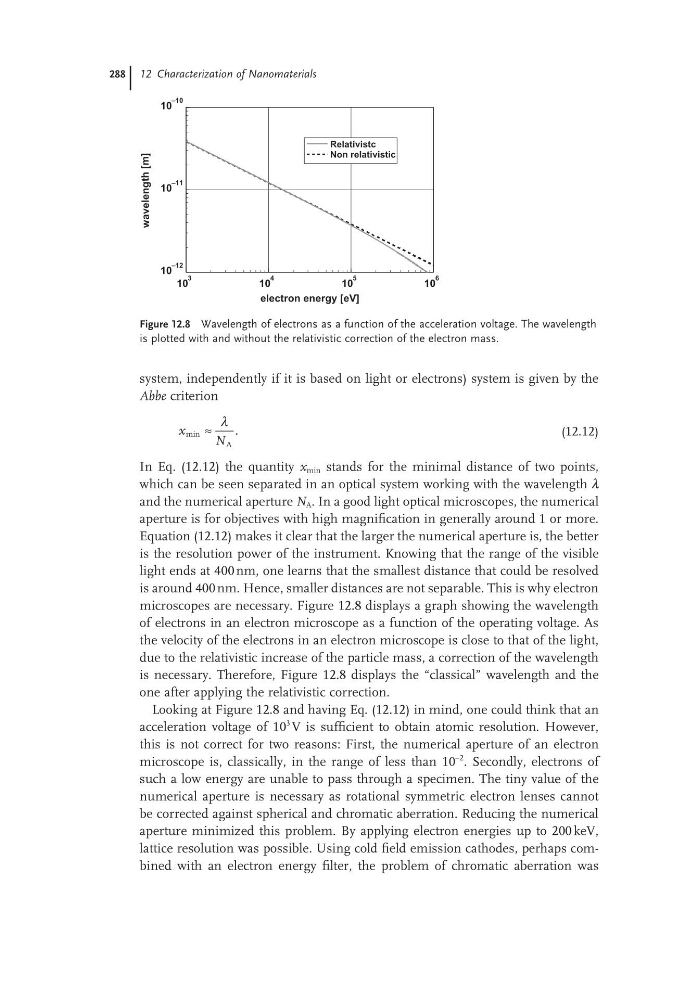
Figure 12.8 Wavelength of electrons as a function of the acceleration voltage. The wavelength
is plotted with and without the relativistic correction of the electron mass.
10
3
10
4
10
5
10
6
electron energy [eV]
10
–12
10
–11
10
–10
wavelength
[m]
Relativistc
Non relativistic
system, independently if it is based on light or electrons) system is given by the
Abbe criterion
x
N
min
.
≈
λ
A
(12.12)
In Eq. (12.12) the quantity x min stands for the minimal distance of two points,
which can be seen separated in an optical system working with the wavelength λ
and the numerical aperture N A . In a good light optical microscopes, the numerical
aperture is for objectives with high magnification in generally around 1 or more.
Equation (12.12) makes it clear that the larger the numerical aperture is, the better
is the resolution power of the instrument. Knowing that the range of the visible
light ends at 400 nm, one learns that the smallest distance that could be resolved
is around 400 nm. Hence, smaller distances are not separable. This is why electron
microscopes are necessary. Figure 12.8 displays a graph showing the wavelength
of electrons in an electron microscope as a function of the operating voltage. As
the velocity of the electrons in an electron microscope is close to that of the light,
due to the relativistic increase of the particle mass, a correction of the wavelength
is necessary. Therefore, Figure 12.8 displays the “classical” wavelength and the
one after applying the relativistic correction.
Looking at Figure 12.8 and having Eq. (12.12) in mind, one could think that an
acceleration voltage of 10
3 V is sufficient to obtain atomic resolution. However,
this is not correct for two reasons: First, the numerical aperture of an electron
microscope is, classically, in the range of less than 10
−2 . Secondly, electrons of
such a low energy are unable to pass through a specimen. The tiny value of the
numerical aperture is necessary as rotational symmetric electron lenses cannot
be corrected against spherical and chromatic aberration. Reducing the numerical
aperture minimized this problem. By applying electron energies up to 200 keV,
lattice resolution was possible. Using cold field emission cathodes, perhaps combined with an electron energy filter, the problem of chromatic aberration was
Figure 12.8 Wavelength of electrons as a function of the acceleration voltage. The wavelength
is plotted with and without the relativistic correction of the electron mass.
10
3
10
4
10
5
10
6
electron energy [eV]
10
–12
10
–11
10
–10
wavelength
[m]
Relativistc
Non relativistic
system, independently if it is based on light or electrons) system is given by the
Abbe criterion
x
N
min
.
≈
λ
A
(12.12)
In Eq. (12.12) the quantity x min stands for the minimal distance of two points,
which can be seen separated in an optical system working with the wavelength λ
and the numerical aperture N A . In a good light optical microscopes, the numerical
aperture is for objectives with high magnification in generally around 1 or more.
Equation (12.12) makes it clear that the larger the numerical aperture is, the better
is the resolution power of the instrument. Knowing that the range of the visible
light ends at 400 nm, one learns that the smallest distance that could be resolved
is around 400 nm. Hence, smaller distances are not separable. This is why electron
microscopes are necessary. Figure 12.8 displays a graph showing the wavelength
of electrons in an electron microscope as a function of the operating voltage. As
the velocity of the electrons in an electron microscope is close to that of the light,
due to the relativistic increase of the particle mass, a correction of the wavelength
is necessary. Therefore, Figure 12.8 displays the “classical” wavelength and the
one after applying the relativistic correction.
Looking at Figure 12.8 and having Eq. (12.12) in mind, one could think that an
acceleration voltage of 10
3 V is sufficient to obtain atomic resolution. However,
this is not correct for two reasons: First, the numerical aperture of an electron
microscope is, classically, in the range of less than 10
−2 . Secondly, electrons of
such a low energy are unable to pass through a specimen. The tiny value of the
numerical aperture is necessary as rotational symmetric electron lenses cannot
be corrected against spherical and chromatic aberration. Reducing the numerical
aperture minimized this problem. By applying electron energies up to 200 keV,
lattice resolution was possible. Using cold field emission cathodes, perhaps combined with an electron energy filter, the problem of chromatic aberration was