

266 11 Mechanical Properties
The properties of particle-filled polymers heavily depend on the production
process. In the simplest way, powder and polymer are kneaded together. This
process leads to the formation of clusters of particles that are, depending on the
kneading time, more or less well distributed. Further, more advanced processes
start with a suspension of the nanoparticulate powder in a liquid. This liquid is
either a solvent for the polymer or a liquid precursor compound, like a monomer.
The powders are brought into this liquid and equally distributed, perhaps by sonification. As last step, the liquid phase is either evaporated or polymerized. Processes starting with liquid suspensions lead to products of the highest quality.
Applying a constant amount of second phase leads, as was proven experimentally,
to an increase of strength if the particle size decreases. Also, clusters of small
particles seem to have advantages over larger particles. This relation is sketched
in Figure 11.21, which is an extension of a graph, drafted by Jordan et al. [16].
The ultimate strength of composites as depicted in Figures 11.21a–c may be
understood readily after applying Eq. (11.13). The failures introduced by stresses
into the specimen are larger in the case of larger particles (compare panels a and
b); therefore the strength is reduced. In the case of clusters of small particles,
generally, the crack goes through the cluster, hence, the crack is larger than in
case of singularized particles but smaller than in the case of a single particle having
the same size as the cluster. The considerations above assume perfect bonding
between the particle and the polymer. When this binding is insufficient, the filler
particles act as flaws and not as a strengthening element.
Most interesting are composites where the second phase consists of platelets.
This design is often found in nature, in materials of biological origin, where highstrength nanocomposites, consisting of a mineral phase bond together by proteins,
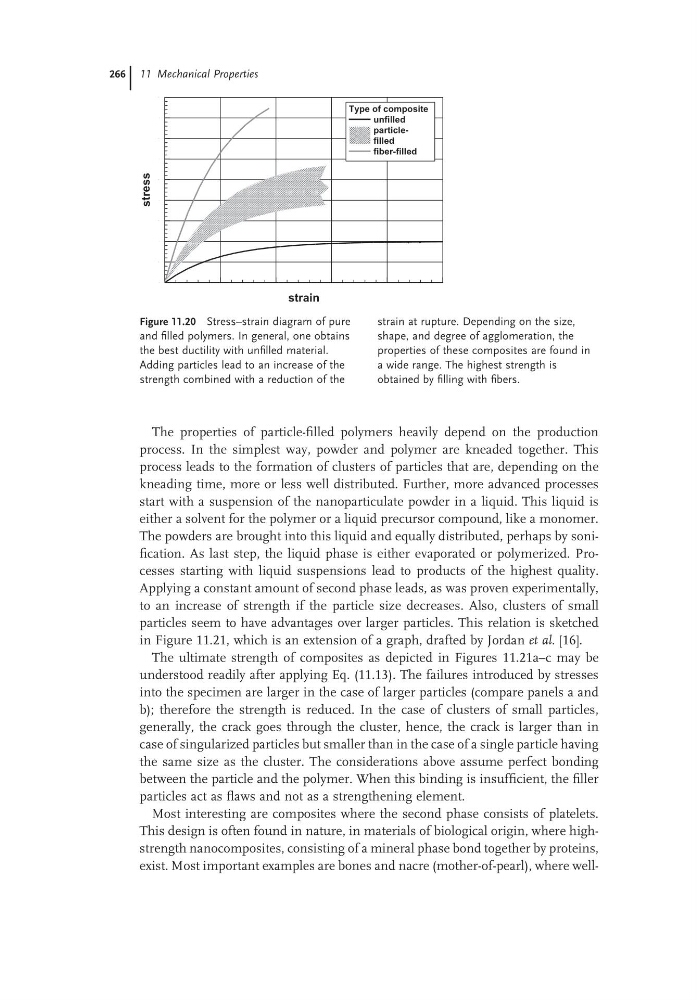
exist. Most important examples are bones and nacre (mother-of-pearl), where wellFigure 11.20 Stress–strain diagram of pure
and filled polymers. In general, one obtains
the best ductility with unfilled material.
Adding particles lead to an increase of the
strength combined with a reduction of the
strain at rupture. Depending on the size,
shape, and degree of agglomeration, the
properties of these composites are found in
a wide range. The highest strength is
obtained by filling with fibers.
0
1
2
3
4
5
strain
0
0.5
1
1.5
2
2.5
3
3.5
4
4.5
stress
Type of composite
unfilled
particlefilled
fiber-filled
The properties of particle-filled polymers heavily depend on the production
process. In the simplest way, powder and polymer are kneaded together. This
process leads to the formation of clusters of particles that are, depending on the
kneading time, more or less well distributed. Further, more advanced processes
start with a suspension of the nanoparticulate powder in a liquid. This liquid is
either a solvent for the polymer or a liquid precursor compound, like a monomer.
The powders are brought into this liquid and equally distributed, perhaps by sonification. As last step, the liquid phase is either evaporated or polymerized. Processes starting with liquid suspensions lead to products of the highest quality.
Applying a constant amount of second phase leads, as was proven experimentally,
to an increase of strength if the particle size decreases. Also, clusters of small
particles seem to have advantages over larger particles. This relation is sketched
in Figure 11.21, which is an extension of a graph, drafted by Jordan et al. [16].
The ultimate strength of composites as depicted in Figures 11.21a–c may be
understood readily after applying Eq. (11.13). The failures introduced by stresses
into the specimen are larger in the case of larger particles (compare panels a and
b); therefore the strength is reduced. In the case of clusters of small particles,
generally, the crack goes through the cluster, hence, the crack is larger than in
case of singularized particles but smaller than in the case of a single particle having
the same size as the cluster. The considerations above assume perfect bonding
between the particle and the polymer. When this binding is insufficient, the filler
particles act as flaws and not as a strengthening element.
Most interesting are composites where the second phase consists of platelets.
This design is often found in nature, in materials of biological origin, where highstrength nanocomposites, consisting of a mineral phase bond together by proteins,
exist. Most important examples are bones and nacre (mother-of-pearl), where wellFigure 11.20 Stress–strain diagram of pure
and filled polymers. In general, one obtains
the best ductility with unfilled material.
Adding particles lead to an increase of the
strength combined with a reduction of the
strain at rupture. Depending on the size,
shape, and degree of agglomeration, the
properties of these composites are found in
a wide range. The highest strength is
obtained by filling with fibers.
0
1
2
3
4
5
strain
0
0.5
1
1.5
2
2.5
3
3.5
4
4.5
stress
Type of composite
unfilled
particlefilled
fiber-filled