

11.4 Superplasticity 263
11.4
Superplasticity
Superplasticity is a very special property allowing large plastic deformation. Generally, plastic deformations of significantly more than 100%, may be up to 1000%,
are possible. In contrast to standard materials, which allow large plastic deformation, superplastic deformation has a unique feature: During plastic deformation,
conventional materials show, for example, in a tension test a local narrowing
before rupturing, superplastic materials becomes uniformly thinner. Superplasticity is restricted to very narrow ranges of small grain sizes and a quite narrow
temperature window. For conventional materials, the temperature range, where
superplasticity is found is around 0.5 T m (T m is the melting temperature in Kelvin).
Furthermore, superplasticity is restricted to a quite narrow range of deformation
rates. This phenomenon is observed in pure metals, alloys and ceramic materials,
certainly, as ceramic bodies cannot be produced without any flaws (e.g., pores) one
never reaches such huge strains as in metals. The deformation rate
ε of a superplastic specimen is described by:
ε
σ
∝
n
d
2
.
(11.12)
The stress exponent n in Eq. (11.12) is 1 for diffusion or grain-boundary processes
and 2 for dislocation processes.
Two typical examples of superplastic materials will be used for demonstration.
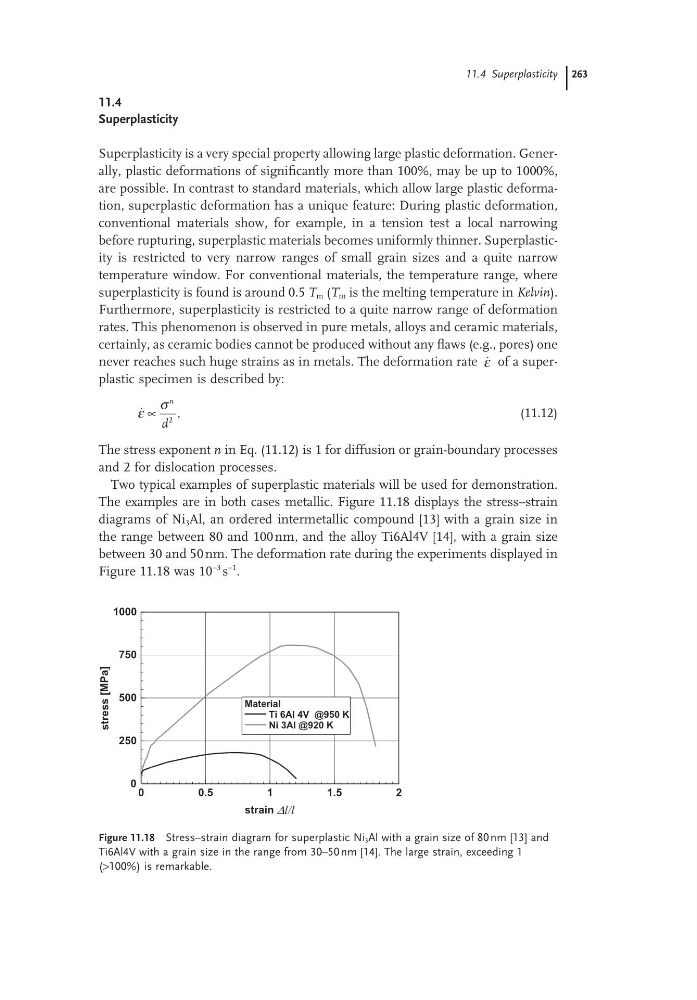
The examples are in both cases metallic. Figure 11.18 displays the stress–strain
diagrams of Ni 3 Al, an ordered intermetallic compound [13] with a grain size in
the range between 80 and 100 nm, and the alloy Ti6Al4V [14], with a grain size
between 30 and 50 nm. The deformation rate during the experiments displayed in
Figure 11.18 was 10
−3 s
−1 .
Figure 11.18 Stress–strain diagram for superplastic Ni 3 Al with a grain size of 80 nm [13] and
Ti6Al4V with a grain size in the range from 30–50 nm [14]. The large strain, exceeding 1
(>100%) is remarkable.
0
0.5
1
1.5
2
strain ∆l/l
0
250
500
750
1000
stress
[MPa]
Material
Ti 6Al 4V @950 K
Ni 3Al @920 K
11.4
Superplasticity
Superplasticity is a very special property allowing large plastic deformation. Generally, plastic deformations of significantly more than 100%, may be up to 1000%,
are possible. In contrast to standard materials, which allow large plastic deformation, superplastic deformation has a unique feature: During plastic deformation,
conventional materials show, for example, in a tension test a local narrowing
before rupturing, superplastic materials becomes uniformly thinner. Superplasticity is restricted to very narrow ranges of small grain sizes and a quite narrow
temperature window. For conventional materials, the temperature range, where
superplasticity is found is around 0.5 T m (T m is the melting temperature in Kelvin).
Furthermore, superplasticity is restricted to a quite narrow range of deformation
rates. This phenomenon is observed in pure metals, alloys and ceramic materials,
certainly, as ceramic bodies cannot be produced without any flaws (e.g., pores) one
never reaches such huge strains as in metals. The deformation rate
ε of a superplastic specimen is described by:
ε
σ
∝
n
d
2
.
(11.12)
The stress exponent n in Eq. (11.12) is 1 for diffusion or grain-boundary processes
and 2 for dislocation processes.
Two typical examples of superplastic materials will be used for demonstration.
The examples are in both cases metallic. Figure 11.18 displays the stress–strain
diagrams of Ni 3 Al, an ordered intermetallic compound [13] with a grain size in
the range between 80 and 100 nm, and the alloy Ti6Al4V [14], with a grain size
between 30 and 50 nm. The deformation rate during the experiments displayed in
Figure 11.18 was 10
−3 s
−1 .
Figure 11.18 Stress–strain diagram for superplastic Ni 3 Al with a grain size of 80 nm [13] and
Ti6Al4V with a grain size in the range from 30–50 nm [14]. The large strain, exceeding 1
(>100%) is remarkable.
0
0.5
1
1.5
2
strain ∆l/l
0
250
500
750
1000
stress
[MPa]
Material
Ti 6Al 4V @950 K
Ni 3Al @920 K